
A practical guide from Packaging in Time to help you choose better materials, structure, printing, and finishing for custom boxes.
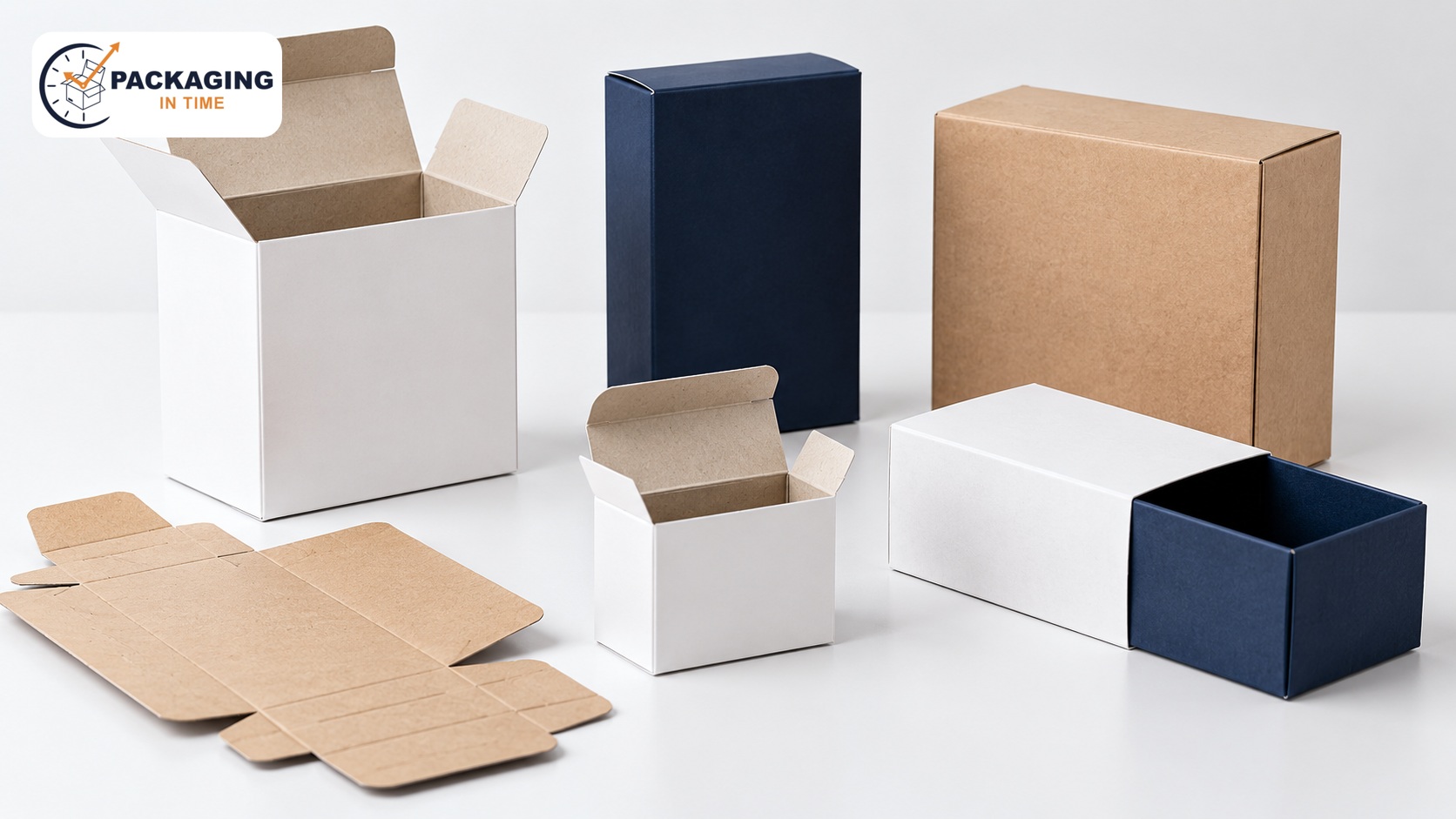
What are paperboard boxes
Paperboard boxes are carton structures made from paper-based board rather than corrugated shipping board or rigid set-up board. They are commonly converted into folding cartons, sleeves, tuck-end packs, window cartons and other retail packaging. Their primary role is normally product presentation, information and light product protection. The exact material, thickness, coating, print method and structure should be selected around the actual product, route and customer experience.
Choose the package layer first
A paperboard box is often the consumer-facing retail layer. It may sit around a bottle, jar, tube, food pouch, electronics accessory or product set. It is not automatically the outer parcel container. If the order travels through a delivery network, use a separate shipping component where the product and route require it. Clear layer definitions prevent a printed retail carton from being expected to provide transit protection it was not designed or tested to deliver.
Paperboard carton construction visual
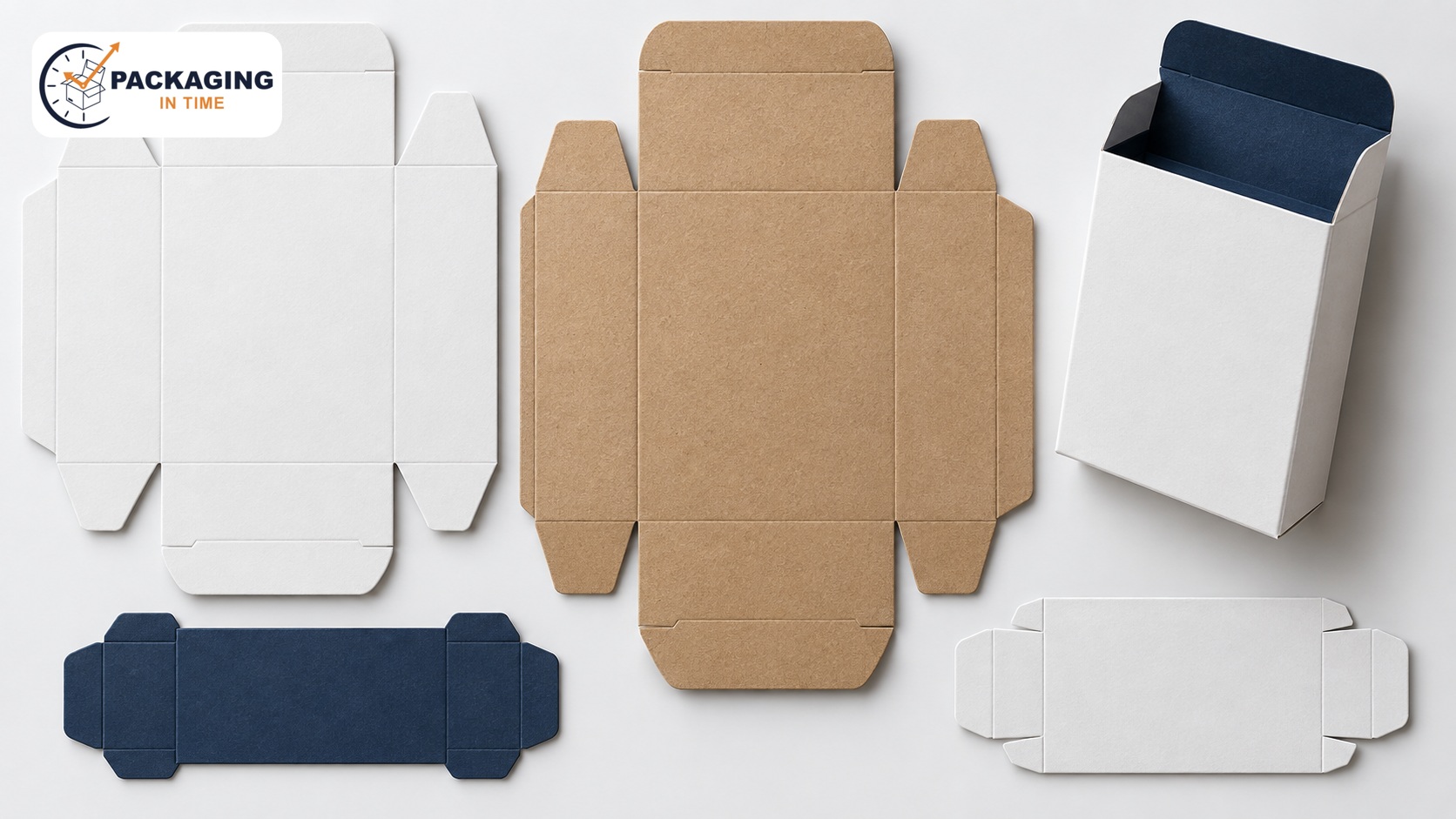
Paperboard carton construction: flat die-cut forms and an assembled retail carton.
Material and structure
Paperboard selection depends on product weight, carton size, panel span, desired appearance, print coverage, closure, finish and packing process. Folding cartons are generally supplied flat and erected for packing. A structural design must support the product without making loading difficult. Tuck tabs, lock bottoms, sleeves, windows and inserts should be tested with the finished item, including labels, caps, accessories and protective components.
Size and product fit
Start with the product dimensions in its finished state. Record length, width, depth, weight, sensitive surfaces and preferred orientation. Allow enough clearance to load and remove the product without crushing a label or stressing the carton. Too much empty space can let the item move; too little can make assembly slow and inconsistent. Use an approved dieline and a physical sample to check product fit after the selected board, print and finish are in place.
How paperboard cartons are converted
Paperboard cartons are cut, scored and folded around a structural dieline. The visible carton is the result of the board, cut profile, scores, glue area and closure design working together. Review those details against the assembled sample, not only a flat layout.
Printing and artwork
Paperboard gives brands a broad surface for product identity, variant cues, instructions and required labels. Keep important text, barcodes and logos inside approved safe areas and away from folds, glue areas and cuts. Bleed, trim, score lines and barcode quiet space should be confirmed from the printer’s dieline. A digital proof can check artwork representation; a physical sample is needed to assess fit, print position, finish and pack-out.
Finishes and windows
Matte, gloss, aqueous, soft-touch, foil, embossing and other effects should each solve a specific visual or handling need. They can change rub behavior, readability, cost, production steps and material-recovery considerations. A window adds product visibility but also adds a film and adhesive component. Do not make a broad recyclability claim from the paperboard surface alone; consider the complete construction and local recovery conditions.
Food cosmetics and regulated products
For food, identify the actual food-contact layer and intended use conditions. A paperboard outer carton around a sealed product is different from a component that directly contacts food. For cosmetics, electronics, pharmaceuticals and other regulated categories, separate what the packaging supplier controls from the brand’s responsibility for product classification, label content, claims and market-specific requirements. Do not use generic compliance claims for a finished box.
Quote inputs
A useful quote includes the product dimensions and weight, box style, internal size, board preference, print coverage, color system, finish, insert, quantity, destination, artwork status and needed date. State whether the carton will be delivered flat or assembled, who will pack it, and whether a physical sample is required. MOQ, price, lead time, tooling and freight depend on the final specification and should be confirmed with the supplier.
Paperboard boxes work best when product fit, structure, board, artwork, finish and route are considered together. Define the retail role first, select a structure around the real product and verify the finished configuration with a physical sample. This gives a brand a practical carton that presents the product clearly without confusing the retail layer with the outer shipping system.
Paperboard grades and surface choices
Paperboard is not one fixed material. A specification may need to distinguish a bright smooth printable face from a natural kraft appearance, a coated surface from an uncoated one, or a board chosen for a particular folding and carton-conversion requirement.
The suitable option depends on the product, artwork, finish, pack-out method and channel. A board that produces strong photographic reproduction may not be the same choice as one selected for a natural uncoated presentation. Request the material recommendation against the actual carton dimensions and performance requirement, rather than choosing from a generic description.
Carton styles and closures
Tuck-end cartons use folding flaps to close the top, bottom or both. Sleeves slide over an inner tray or product carton. Auto-lock and crash-lock bottoms can support packing convenience for selected products, while straight tuck configurations can be useful for lighter cartons.
Window cartons add a die-cut opening and normally a film and adhesive component. The best carton style is the one that supports loading, closure, shelf presentation and product removal. A familiar style name is not a substitute for checking the final product in the carton.
Retail display and shelf handling
A paperboard carton should be reviewed in the way it will be seen and handled. Check front-facing orientation, shelf depth, shelf lip, SKU identification, barcode position and how customers remove the product. Retail staff also need to recognize, replenish and scan the product.
A carton with a beautiful front panel but an obscured barcode or weak closure can create problems after it reaches the shelf. Confirm retailer requirements before the structural design and artwork are finalised.
Inserts dividers and product control
An insert is useful when it solves a specific product-control problem. It can center a product, separate two items, protect a sensitive surface or create a clear opening arrangement. It should be designed from the real product, including labels, caps and accessories.
Avoid adding an insert simply for decoration: unnecessary components can increase packing time and make the carton harder to recycle or explain to the customer. Test loading, removal and re-closing with the exact combination that will be sold.
Artwork approval and print controls
Packaging artwork should be controlled from the approved dieline. The final file needs identified trim, bleed, fold, glue and safe areas, along with a clear version owner and proof status. A design can look correct on a flat screen yet place important copy across a score or leave insufficient space for a barcode.
Review the assembled physical sample for readability, registration, scuffing and opening experience. Where product labels are regulated, the brand remains responsible for the required content and market-specific review.
Environmental claims
A paperboard carton can contain inks, coatings, adhesives, window films, foil, lamination and inserts. Those components influence how a pack should be described and how it may be recovered locally. Do not call every paperboard box recyclable, plastic-free or eco-friendly without checking the specific construction and the available local pathway.
Prefer precise, supported language about the verified material attribute and any relevant condition. Material reduction is useful only where it still supports product protection and practical packing.
From sample to production
A physical sample should answer defined questions: does the product fit, does the closure engage, does the insert hold the item, does the carton look right in its retail orientation, and can the intended team pack it consistently?
A digital proof primarily validates the artwork representation; it cannot fully confirm board feel, structure, finish or pack-out. Record the product version, dimensions, material, print, finish and sample decision. If one of these changes, review whether the approval still represents the finished carton.
Common paperboard-box mistakes
Common issues include measuring only a product’s widest point, selecting a carton that is too tight for labels and packing, treating a retail carton as a shipping box, and approving artwork before a final dieline is supplied.
Other problems arise when a window, coating or foil is treated as a purely visual decision without considering scuffing, material recovery and operational handling. A complete brief prevents many of these issues by connecting the product, structure, print, route and approval process.
Questions for a supplier
Ask what board and carton structure suit the actual product. Ask how the carton ships and assembles, whether a physical sample is available, what artwork information is needed, and which elements are included in the quote.
Confirm whether printing, finishing, inserts, packing, outer cases and delivery are included. Explain the retail channel and the product’s shipping arrangement. A supplier can recommend a practical packaging structure, but the brand must provide accurate product information and approve claims, label content and final artwork.
Frequently asked questions
Are paperboard boxes the same as corrugated shipping boxes? No. Paperboard cartons are commonly used as retail packaging, while corrugated structures are usually used for transit and shipping. Can paperboard boxes be printed? Yes, but print method, substrate, color and finish should be specified for the intended artwork and run.
Do paperboard boxes need inserts? Only where an insert improves fit, retention, separation or the customer opening experience. How should a carton be approved? Review the final dieline, artwork proof and physical product sample together before production.
Product weight and panel span
The board and structure must support the product across the carton base and side panels. A tall or heavy item can create stresses that a small lightweight carton does not. Confirm the packed weight, orientation and any load applied during handling so the carton recommendation is based on the physical product.
The board and structure must support the product across the carton base and side panels. A tall or heavy item can create stresses that a small lightweight carton does not. Confirm the packed weight, orientation and any load applied during handling so the carton recommendation is based on the physical product.
Moisture and handling conditions
Storage, transport and retail conditions can affect a paperboard carton. Refrigeration, high humidity, oily products or repeated handling may require a different material or protective approach. State the actual conditions rather than assuming that all paperboard behaves the same way.
Storage, transport and retail conditions can affect a paperboard carton. Refrigeration, high humidity, oily products or repeated handling may require a different material or protective approach. State the actual conditions rather than assuming that all paperboard behaves the same way.
Color and brand consistency
Color expectations depend on the artwork, print method, ink, board surface, proof and viewing conditions. A brand should provide approved color information and review a relevant proof or sample. Do not promise a universal color match before the final production conditions are known.
Color expectations depend on the artwork, print method, ink, board surface, proof and viewing conditions. A brand should provide approved color information and review a relevant proof or sample. Do not promise a universal color match before the final production conditions are known.
Barcode and variable data space
Reserve a flat, high-contrast space for a barcode or variable data where needed. Keep it clear of seams, folds, heavy decoration and locations likely to be scuffed. The final production configuration should be checked in the intended retail or warehouse scanning environment.
Reserve a flat, high-contrast space for a barcode or variable data where needed. Keep it clear of seams, folds, heavy decoration and locations likely to be scuffed. The final production configuration should be checked in the intended retail or warehouse scanning environment.
Pack out efficiency
A carton is not complete until it can be packed consistently. Check whether it arrives flat, how it is erected, where the product enters, whether an insert slows loading and how the closure is secured.
A simple pack-out test with the intended staff can prevent repeated variation. A carton is not complete until it can be packed consistently. Check whether it arrives flat, how it is erected, where the product enters, whether an insert slows loading and how the closure is secured. A simple pack-out test with the intended staff can prevent repeated variation.
Subscription and gift sets
A paperboard carton can organize a collection, include a sleeve or present several units as a set. Confirm how the customer sees and removes each item, and whether the set needs an outer shipping layer.
The presentation pack should not be assumed to be the delivery shipper. A paperboard carton can organize a collection, include a sleeve or present several units as a set. Confirm how the customer sees and removes each item, and whether the set needs an outer shipping layer. The presentation pack should not be assumed to be the delivery shipper.
Damage reduction
Damage control begins with product fit. A carton should not allow unnecessary movement or put pressure on fragile surfaces. When a product is shipped, assess the carton along with any retention and outer shipper. Change one relevant factor at a time when diagnosing a packing issue.
Damage control begins with product fit. A carton should not allow unnecessary movement or put pressure on fragile surfaces. When a product is shipped, assess the carton along with any retention and outer shipper. Change one relevant factor at a time when diagnosing a packing issue.
Sourcing and fibres
If a brand wants to discuss recycled content or responsible fibre sourcing, it should use supplier documentation and the applicable certification rules. A material claim must match the supplied board and the finished product claim.
Do not add a certification mark without the required approval. If a brand wants to discuss recycled content or responsible fibre sourcing, it should use supplier documentation and the applicable certification rules. A material claim must match the supplied board and the finished product claim. Do not add a certification mark without the required approval.
Proofing decisions
A digital proof and a physical sample answer different questions. Digital proofing checks the file and artwork representation. A physical sample assesses structure, fit, finish and packing. Keep the approval record clear about which item was reviewed and what decisions it supports.
A digital proof and a physical sample answer different questions. Digital proofing checks the file and artwork representation. A physical sample assesses structure, fit, finish and packing. Keep the approval record clear about which item was reviewed and what decisions it supports.
Carton lifecycle
A well-designed carton can support the product from packing through retail use. Consider how the customer opens it, whether it is retained as a gift box, and how components are separated after use. Keep environmental instructions specific to the construction and local recovery pathway.
A well-designed carton can support the product from packing through retail use. Consider how the customer opens it, whether it is retained as a gift box, and how components are separated after use. Keep environmental instructions specific to the construction and local recovery pathway.
Supplier communication
A supplier can recommend board, structure and manufacturing options only from a useful brief. Share the product, dimensions, weight, artwork, finish, quantity, destination and timing. State unknowns clearly so they can be resolved in sampling instead of being hidden in the quote.
A supplier can recommend board, structure and manufacturing options only from a useful brief. Share the product, dimensions, weight, artwork, finish, quantity, destination and timing. State unknowns clearly so they can be resolved in sampling instead of being hidden in the quote.
Final approval
Before production, confirm the product version, dieline, board, print file, finish, insert, barcode area, packing method and sign-off owner. This creates a reliable record for reorders and reduces the chance that a later product or artwork change is treated as insignificant.
Before production, confirm the product version, dieline, board, print file, finish, insert, barcode area, packing method and sign-off owner. This creates a reliable record for reorders and reduces the chance that a later product or artwork change is treated as insignificant.
Product weight and panel span in practice
The board and structure must support the product across the carton base and side panels. A tall or heavy item can create stresses that a small lightweight carton does not. Confirm the packed weight, orientation and any load applied during handling so the carton recommendation is based on the physical product.
Review this point with the actual finished product, approved artwork and intended packing sequence. A decision that looks suitable in a material swatch or digital layout still needs confirmation in the assembled carton. Record the selected option and the condition it is intended to address so a future reorder or product update can be assessed against the same requirement.
This keeps the carton specification practical, traceable and focused on product fit, retail presentation and the real route to customer.
Moisture and handling conditions in practice
Storage, transport and retail conditions can affect a paperboard carton. Refrigeration, high humidity, oily products or repeated handling may require a different material or protective approach. State the actual conditions rather than assuming that all paperboard behaves the same way.
Review this point with the actual finished product, approved artwork and intended packing sequence. A decision that looks suitable in a material swatch or digital layout still needs confirmation in the assembled carton. Record the selected option and the condition it is intended to address so a future reorder or product update can be assessed against the same requirement.
This keeps the carton specification practical, traceable and focused on product fit, retail presentation and the real route to customer.
Color and brand consistency in practice
Color expectations depend on the artwork, print method, ink, board surface, proof and viewing conditions. A brand should provide approved color information and review a relevant proof or sample. Do not promise a universal color match before the final production conditions are known.
Review this point with the actual finished product, approved artwork and intended packing sequence. A decision that looks suitable in a material swatch or digital layout still needs confirmation in the assembled carton. Record the selected option and the condition it is intended to address so a future reorder or product update can be assessed against the same requirement.
This keeps the carton specification practical, traceable and focused on product fit, retail presentation and the real route to customer.
Barcode and variable data space in practice
Reserve a flat, high-contrast space for a barcode or variable data where needed. Keep it clear of seams, folds, heavy decoration and locations likely to be scuffed. The final production configuration should be checked in the intended retail or warehouse scanning environment.
Review this point with the actual finished product, approved artwork and intended packing sequence. A decision that looks suitable in a material swatch or digital layout still needs confirmation in the assembled carton. Record the selected option and the condition it is intended to address so a future reorder or product update can be assessed against the same requirement.
This keeps the carton specification practical, traceable and focused on product fit, retail presentation and the real route to customer.
Pack out efficiency in practice
A carton is not complete until it can be packed consistently. Check whether it arrives flat, how it is erected, where the product enters, whether an insert slows loading and how the closure is secured.
A simple pack-out test with the intended staff can prevent repeated variation. Review this point with the actual finished product, approved artwork and intended packing sequence. A decision that looks suitable in a material swatch or digital layout still needs confirmation in the assembled carton.
Record the selected option and the condition it is intended to address so a future reorder or product update can be assessed against the same requirement. This keeps the carton specification practical, traceable and focused on product fit, retail presentation and the real route to customer.
Subscription and gift sets in practice
A paperboard carton can organize a collection, include a sleeve or present several units as a set. Confirm how the customer sees and removes each item, and whether the set needs an outer shipping layer.
The presentation pack should not be assumed to be the delivery shipper. Review this point with the actual finished product, approved artwork and intended packing sequence. A decision that looks suitable in a material swatch or digital layout still needs confirmation in the assembled carton.
Record the selected option and the condition it is intended to address so a future reorder or product update can be assessed against the same requirement. This keeps the carton specification practical, traceable and focused on product fit, retail presentation and the real route to customer.
Damage reduction in practice
Damage control begins with product fit. A carton should not allow unnecessary movement or put pressure on fragile surfaces. When a product is shipped, assess the carton along with any retention and outer shipper. Change one relevant factor at a time when diagnosing a packing issue.
Review this point with the actual finished product, approved artwork and intended packing sequence. A decision that looks suitable in a material swatch or digital layout still needs confirmation in the assembled carton. Record the selected option and the condition it is intended to address so a future reorder or product update can be assessed against the same requirement.
This keeps the carton specification practical, traceable and focused on product fit, retail presentation and the real route to customer.
Sourcing and fibres in practice
If a brand wants to discuss recycled content or responsible fibre sourcing, it should use supplier documentation and the applicable certification rules. A material claim must match the supplied board and the finished product claim.
Do not add a certification mark without the required approval. Review this point with the actual finished product, approved artwork and intended packing sequence. A decision that looks suitable in a material swatch or digital layout still needs confirmation in the assembled carton.
Record the selected option and the condition it is intended to address so a future reorder or product update can be assessed against the same requirement. This keeps the carton specification practical, traceable and focused on product fit, retail presentation and the real route to customer.
Proofing decisions in practice
A digital proof and a physical sample answer different questions. Digital proofing checks the file and artwork representation. A physical sample assesses structure, fit, finish and packing. Keep the approval record clear about which item was reviewed and what decisions it supports.
Review this point with the actual finished product, approved artwork and intended packing sequence. A decision that looks suitable in a material swatch or digital layout still needs confirmation in the assembled carton. Record the selected option and the condition it is intended to address so a future reorder or product update can be assessed against the same requirement.
This keeps the carton specification practical, traceable and focused on product fit, retail presentation and the real route to customer.
Carton lifecycle in practice
A well-designed carton can support the product from packing through retail use. Consider how the customer opens it, whether it is retained as a gift box, and how components are separated after use. Keep environmental instructions specific to the construction and local recovery pathway.
Review this point with the actual finished product, approved artwork and intended packing sequence. A decision that looks suitable in a material swatch or digital layout still needs confirmation in the assembled carton. Record the selected option and the condition it is intended to address so a future reorder or product update can be assessed against the same requirement.
This keeps the carton specification practical, traceable and focused on product fit, retail presentation and the real route to customer.
Supplier communication in practice
A supplier can recommend board, structure and manufacturing options only from a useful brief. Share the product, dimensions, weight, artwork, finish, quantity, destination and timing. State unknowns clearly so they can be resolved in sampling instead of being hidden in the quote.
Review this point with the actual finished product, approved artwork and intended packing sequence. A decision that looks suitable in a material swatch or digital layout still needs confirmation in the assembled carton. Record the selected option and the condition it is intended to address so a future reorder or product update can be assessed against the same requirement.
This keeps the carton specification practical, traceable and focused on product fit, retail presentation and the real route to customer.
Final approval in practice
Before production, confirm the product version, dieline, board, print file, finish, insert, barcode area, packing method and sign-off owner. This creates a reliable record for reorders and reduces the chance that a later product or artwork change is treated as insignificant.
Review this point with the actual finished product, approved artwork and intended packing sequence. A decision that looks suitable in a material swatch or digital layout still needs confirmation in the assembled carton. Record the selected option and the condition it is intended to address so a future reorder or product update can be assessed against the same requirement.
This keeps the carton specification practical, traceable and focused on product fit, retail presentation and the real route to customer.
For the broader retail-carton decision, review custom product boxes. When that paperboard carton requires a distinct outer delivery layer, use custom mailer boxes as the relevant e-commerce shipping guide.