
A practical guide from Packaging in Time to help you choose better materials, structure, printing, and finishing for custom boxes.
Why folding cartons remain a core retail packaging format
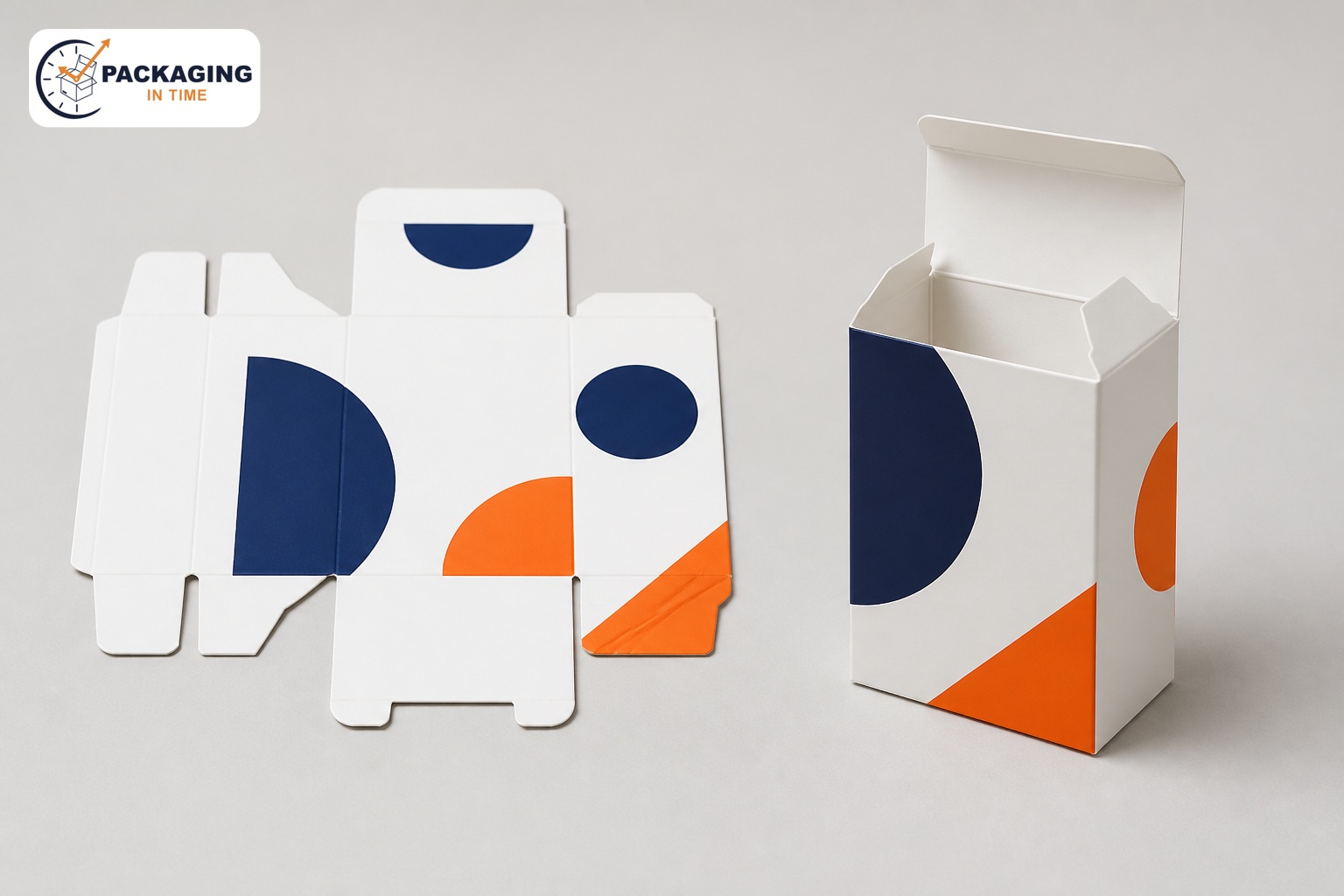
Custom folding cartons are paperboard boxes that are manufactured as flat blanks, printed and converted, then folded into shape during packing or fulfilment. They are common because they can carry brand artwork, contain a product or its primary container, and present a consistent footprint on a shelf without using the material volume of a set-up box.
A carton may hold a skincare bottle, tea pouch, soap bar, cosmetic compact, small electronics accessory, confectionery item or giftable product set. The structure is familiar to shoppers, but the specification behind it is not generic: the board, closure, dimensions, artwork, internal support and distribution route all need to match the actual product.
For a buyer, the useful question is not simply “What kind of box looks good?” It is “What package layer does this product need, and what must that layer do?” A folding carton can be a consumer-facing retail pack, a branded secondary carton around a primary container, a shelf-ready identity layer or part of a kit.
It may not be the parcel shipper. A light, attractive carton around a glass jar can still need an insert and a corrugated outer container before it is sent through an e-commerce network. Defining that boundary early prevents two recurring problems: overspecifying a carton for a job the shipper should perform, or expecting a retail carton to absorb distribution hazards it was never designed to handle.
What a folding carton is , and what it is not
A folding carton is generally made from paperboard that is cut, creased and glued into a flat blank. During packing, the blank is opened along its score lines and closed around the product. The crease pattern controls the panels, flaps, glue area and closure mechanism.
This is different from corrugated packaging, which uses linerboard and a fluted medium to create a thicker board structure, and different again from rigid set-up packaging, which uses a thicker board construction and is normally supplied already assembled. These are related packaging systems, but they should not be described as interchangeable materials or styles.
The distinction matters because it directs the right buyer decision. A folding carton is often selected for shelf presentation, printed storytelling and a compact retail format. Corrugated packaging is often selected when a product needs more support through storage or transit, although corrugated can also be used for retail displays and mailers.
A rigid box can create a more permanent, premium opening experience, but it normally uses more material and occupies more volume before filling. The most effective packaging system may combine them: a product sits in a printed folding carton, that carton is placed in a protective corrugated shipper, and an insert manages movement at the necessary layer.
The term “cardboard” is commonly used in conversation, but it is too broad for a final specification. It can refer to paperboard cartons, corrugated board or rigid board. A quote should state the intended structure and board type instead.
Likewise, a folding carton should not be called a shipping box simply because it encloses a product. A seller needs to define whether the carton travels only from factory to retail shelf, moves inside a master case, is handed to a customer in-store, or will face parcel drops, vibration and compression. The package layer and distribution route determine the appropriate protection strategy.
Folding cartons compared with corrugated mailers and rigid boxes
A concise comparison can prevent a lot of mistaken sourcing. Folding cartons are usually chosen for a printable, fold-flat retail pack. Corrugated mailers and shipping boxes use a fluted board system and are more often used as outer transit protection, though they can be printed and branded.
Rigid boxes use thicker board and are normally non-collapsible, which makes them appropriate where a premium reveal or a more substantial presentation is the priority. None of the three automatically solves every packaging need; each belongs to a particular part of the system.
Choose a folding carton when the product benefits from a compact branded enclosure, when shelf-facing information needs a defined panel layout, or when the product already has a primary container and needs an outer retail layer.
Typical examples include a carton around a bottle, tube or jar; a box around a wrapped bar; a printed carton around a pouch; or an outer pack for a small accessory. Choose corrugated when the main requirement is a stronger outer container for distribution, parcel handling or a larger product.
Choose a rigid format when the buyer values a set-up presentation, a layered opening sequence or a more permanent gift-pack feel and accepts the resulting construction and logistics implications.
It is also possible to use more than one. A beauty brand might use a folding carton for the shelf, a paperboard insert to keep the bottle stable, and a corrugated mailer for direct-to-consumer orders.
A retailer may receive cartons in a corrugated case, then display the individual cartons on shelf. In that situation, the carton needs to be evaluated for product fit, artwork readability and ordinary retail handling, while the outer case needs to be evaluated against the distribution environment.
Package testing, where used, should represent the actual product, orientation, packout and channel rather than a generic idea of “shipping safe.”
For a broader view of consumer-facing retail structures, see for a related retail-packaging comparison.
How carton structure changes the customer and packing experience
Carton structure is not decoration. It affects how a pack is filled, how it closes, where the glue areas sit, which panels carry artwork, how a shopper opens the box and how the package holds its shape.
A reliable selection starts with the product. Record the internal length, width and depth required by the product or primary container; the orientation in which it should sit; the product’s mass; any fragile features; and whether it needs an insert or divider. Then select a structure that can be packed efficiently and opened in the intended way.
Straight tuck end cartons place the top and bottom tuck closures in the same direction. They can give a clean visual alignment on the major panels and can work well for many retail products. Reverse tuck end cartons place the closures in opposite directions; they are also widely used and can suit automated or manual filling patterns depending on the actual specification.
Neither label is a performance guarantee. The relevant question is whether the flaps, friction, product orientation and retail handling work together in the proposed size and board.
Auto-bottom and crash-lock-bottom styles use a base that forms more quickly during packing. They may be considered when a product is heavier or when packing speed is an important factor, but the product weight, board and size still need review.
A simple tuck-bottom style can be appropriate for lighter products. Locking tabs, dust flaps, tear features, sleeves and internal partitions are additional structural decisions. They can change the way a carton is packed, opened, resealed and presented, so they should be documented in the dieline and sample approval rather than inferred from a name alone.
Sleeves are another folding-carton-related format. A sleeve wraps around an inner tray, product container or another box and can create a reveal without a fully enclosed six-panel carton. It may be used for premium food gifts, product bundles or branded overwrap.
The sleeve’s function is different from a conventional tuck-end carton: it may provide less full-panel containment and may rely on the inner component for product retention. A buyer should define which part of the system carries the product and which part carries the brand presentation.
Common folding carton styles and practical use cases
Tuck-end cartons are a common starting point for cosmetics, supplements, personal-care products, tea, small accessories and similar goods. They offer recognizable top and bottom closures, substantial printable panels and a flat-shipping format. Their strength is their adaptability, not that one exact carton pattern is right for every product.
A tall narrow bottle may need a different panel proportion and bottom treatment from a short, wide jar. A carton for a powder pouch may need a different opening sequence from a carton for an assembled electronic accessory.
Auto-bottom cartons can support a more rapid setup because the base comes together as the box is opened. They are often discussed for heavier or taller retail products, but “heavier” is relative to the structure, board, dimensions and internal support.
It is better to send the actual product weight and geometry for review than to select a base solely from a generic weight category. If the product is glass, has a narrow base, or shifts during handling, an insert or an outer shipping layer may still be needed even when the carton bottom is more substantial.
Five-panel wrap cartons and end-loading formats can be useful for bar-shaped, wrapped or horizontally loaded products. They allow the product to be placed along the carton’s long axis and can create a clean front panel.
Products such as soaps, confectionery, small devices and accessory kits may use formats in this family, but the final choice depends on the product’s dimensions, packout sequence and opening requirement. The panel arrangement should leave enough space for the front-facing brand message, mandatory or retailer-required information, barcode placement and any variable data.
Gable-style cartons incorporate a handle shape and are often used for gifts, bakery applications and portable product sets. They are still a different style from a standard tuck-end carton, even though both may use paperboard.
A handle adds a loading and carrying consideration; it should be assessed with the actual product weight, not just the visual concept. Windowed cartons add a die-cut aperture, sometimes with a transparent film. That can improve product visibility but removes board area and introduces film and adhesive choices. Each addition changes the structure and should be reviewed as part of the complete package.
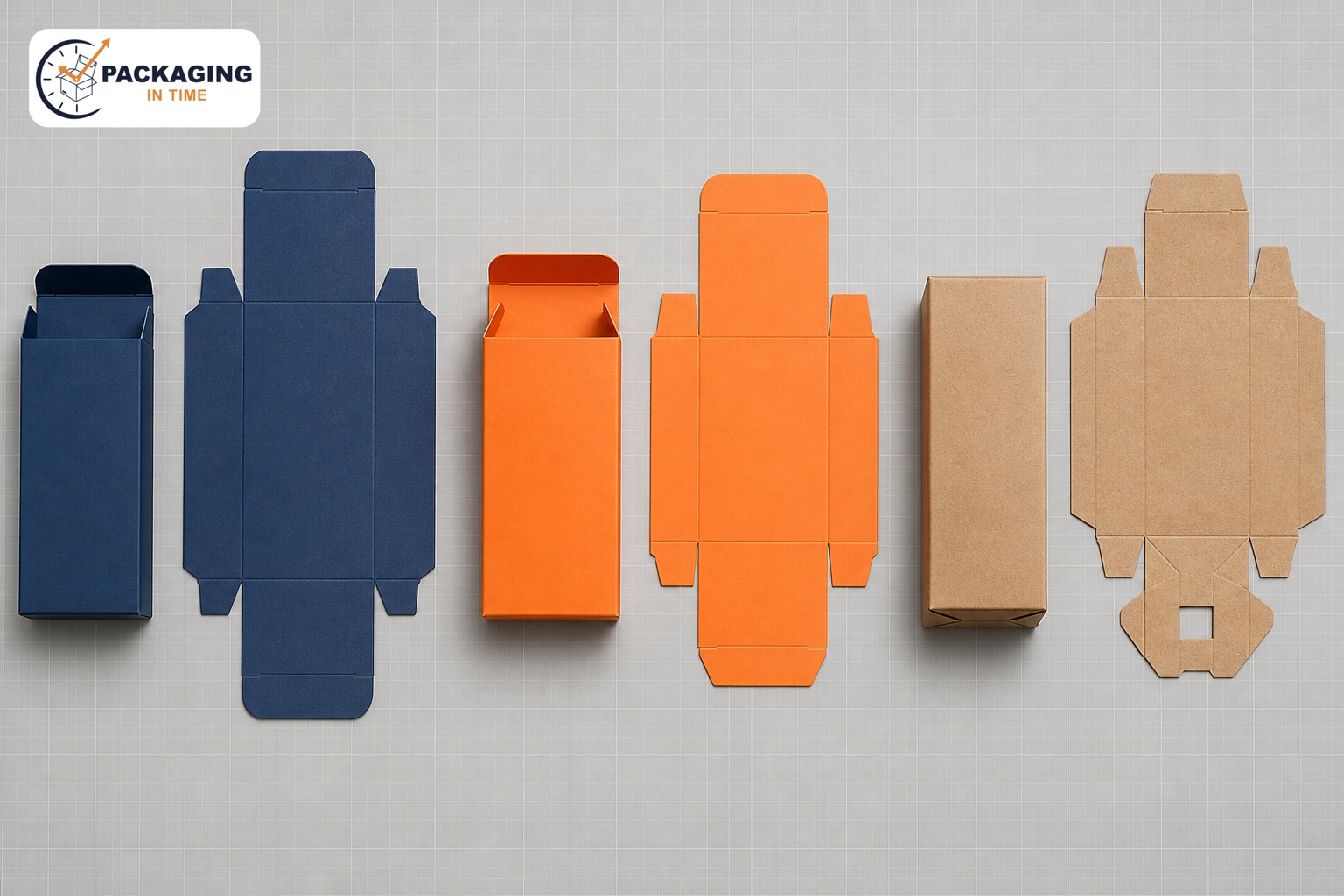
Folding-carton configurations: retail styles selected around product fit and closure needs.
Paperboard materials, caliper and surface selection
The board is the physical foundation of a folding carton. A paperboard specification affects stiffness, fold behavior, print appearance, edge quality and the way a package feels in hand. Buyers may consider bright white paperboard for high-color print and a polished retail look, uncoated or natural-looking board for a different tactile direction, or a material chosen for a particular brand and product requirement.
The correct selection is not only a visual decision. Carton size, product mass, panel proportions, closure design, print coverage and the distribution route all influence whether a proposed board is appropriate.
Caliper, often discussed as board thickness, is only one part of the decision. A thicker material may contribute to a more substantial feel, but it can also change folding behavior, scoring needs, the appearance of small folds and the fit of the carton around the product.
A large box with a heavy item may need a different structural approach from a small box with a light item. A highly decorated pack may need a surface that supports the intended print and finish.
Rather than requesting a thickness in isolation, define the product, internal dimensions, style, graphic coverage, finish and route to market so the board choice can be evaluated in context.
Coated and uncoated surfaces create different graphic and tactile effects. A coated surface can support crisp printed imagery and strong color reproduction, while an uncoated surface may contribute a more natural or textured feel. Neither description promises a particular result without the actual stock, ink system, artwork and proof.
The same artwork can behave differently across substrates, particularly when it contains large solid areas, fine type, gradients, metallic effects or a very dark background. A press proof and, where appropriate, a physical sample are the practical tools for confirming a desired appearance.
If a brand wants a fiber or recycled-content claim, the claim should be treated as a supply-chain and documentation question, not an assumption based on the appearance of the board. Likewise, an FSC claim or logo requires the relevant certification and trademark-use pathway.
A carton with film, foil, coatings, adhesive or an insert also has component-level recovery considerations. Material claims need to be specific, supported and appropriate to the markets where the product will be sold.
Sizing a folding carton around the real product
Carton dimensions should be described consistently as length, width and depth, with the document making clear whether the dimensions are internal carton dimensions, external dimensions or product dimensions. For most buying decisions, the starting point is the actual product footprint and height, plus the clearance required to load and remove the item without damaging the carton.
An overly tight carton can cause scuffing, difficult packing, bulging panels or torn edges. An oversized carton can allow product movement, make shelf presentation look weak and use more material than necessary.
Product orientation matters as much as nominal size. A tube can be packed upright or on its side; a bottle may need to remain upright; a product set may need a tray so the front-facing components remain visible.
Record the tallest, widest, heaviest and most fragile approved product variant, not only a placeholder. If labels, caps, pumps, lids, handles or protruding accessories change the usable footprint, include them in the measurement. This reduces the risk of approving a carton that fits one SKU but fails the actual assortment.
The dieline is where the dimensions become a production design. It typically needs cut lines, fold or score lines, trim, bleed, safe areas, glue zones and any specific areas for barcodes or variable data. Exact allowances are set by the selected manufacturer, material, structure and printing process.
A buyer should avoid copying generic dieline values from an unrelated box. The correct workflow is to supply approved dimensions and product details, receive a dieline for the intended structure, place artwork within the designated zones, and confirm the final proof and physical fit before volume production.
Printing, color control and artwork preparation
Folding cartons are a major brand surface. They can carry color, photography, ingredient or product information, instructions, marketing language, regulatory content, retailer data and a barcode. That makes artwork preparation as important as the structure.
A good brief identifies the main display panel, side panels, opening panel, bottom panel and any area that must remain clear for a barcode, lot code or retailer label. It also identifies which claims, product descriptors and mandatory statements are controlled by the brand or relevant responsible party rather than by the carton supplier.
CMYK process printing is commonly used for multicolor artwork. Spot colors are separately specified ink systems and may be considered when a project has a defined color requirement. Neither approach should be described as guaranteeing an exact match before the substrate, process, proof, lighting conditions and approval criteria are known.
If brand color is important, provide the relevant color reference and review the proof on the intended material. Artwork with large solid dark panels, fine reverse type, gradients, metallic effects or very small detail needs particular attention because those choices can expose normal process and substrate variation.
Digital, offset and flexographic printing are process families with different setup, run-length, substrate, color-control and finishing considerations. It is not useful to publish a universal break-even quantity; the appropriate process depends on the job. A buyer should instead share quantity, number of versions, artwork complexity, board, finish and delivery schedule. This produces a more meaningful recommendation than choosing a printing method by reputation alone.
Every artwork approval needs a controlled final file and a clear sign-off owner. A digital proof can confirm much of the artwork representation, but it does not replace a physical sample when the decision concerns structure, fit, fold behavior, finish or product packout.
A physical prototype can reveal whether an image crosses a fold poorly, whether a window sits in the right place, whether foil lands cleanly, or whether a product’s label faces the correct panel. The proof workflow should distinguish these roles rather than treating every approval as identical.
Coatings, finishes and tactile design controls
Finishes can help a folding carton communicate a premium, playful, clinical, natural or giftable direction, but every finish should be described as a production specification rather than a vague visual wish. Matte, gloss, aqueous, soft-touch, spot UV, foil, embossing and debossing each change the appearance or tactile experience in different ways.
The brief should state where the finish goes, how much coverage it has, which panel it affects, the required registration tolerance, and how the finished carton will be handled. That is more useful than simply requesting “luxury finishing.”
Foil, embossing and debossing can create contrast on a focal panel, but the artwork needs to accommodate the chosen board and the converting process. Very small details, tight registration, folds or heavy coverage can change the result.
Spot UV is often used for a gloss contrast against a matte background, but the visual effect depends on the underlying print, coating system and lighting. Soft-touch surfaces can create a distinct feel, but the actual product, channel and handling should be considered because frequent contact and dark coverage can make rub resistance and scuffing part of the approval discussion.
A coating is not a universal performance claim. It may affect appearance, rub resistance, print behavior and recovery considerations, but the desired functional result must be clear. If a buyer needs a carton to withstand a particular environment, friction level or product contact condition, that requirement needs a product-specific review and, where needed, documented validation.
It should not be converted into a generic “protective” or “food-safe” finish claim. The quality gate is the approved material-and-finish combination on a representative sample.
Inserts, dividers and product retention
A folding carton may hold a product directly, but many products benefit from an insert, divider or tray. The insert can keep a bottle centered, separate multiple components, support a fragile item, present a gift set in an orderly way or prevent the product from rotating behind a window.
Its design starts with the actual product geometry and expected hazards. A cosmetic jar, a glass bottle, a set of small components and a flexible pouch do not need the same retention method.
Paperboard inserts can align naturally with a retail-carton system and may be die-cut to create partitions, folded supports or cavities. Other materials may be considered for a specific function, but the performance and end-of-life discussion should be tied to the actual component, not to a generic label.
A cavity that looks tight in a digital render may be loose once the product label, cap, accessory or tolerance is considered. A physical sample should test the heaviest, tallest or most fragile approved variant, including the way it enters and exits the carton.
Internal support should not conceal a larger distribution problem. An insert can manage local movement inside the retail carton, but it does not automatically make the total pack suitable for parcel distribution. If the product is sold online, the retail carton, insert, cushioning, outer shipper and orientation should be considered together. Where a buyer needs an outer distribution layer, can be a relevant outer e-commerce option, depending on the product and channel.
Retail presentation, barcode space and product information
On shelf, a folding carton operates as a product-facing communication surface. The main display panel should help a shopper identify the product, while other panels carry the information required by the brand, retailer or applicable regulations.
This is one reason folding cartons are useful around small primary containers: the carton can provide more usable area than a bottle or jar label alone. However, more print area does not mean every panel should be filled. Good hierarchy leaves room for product identity, essential descriptors, instructions, barcode placement and any legally required information.
A barcode needs a flat, readable panel with adequate contrast and clearance from seams, folds, windows and highly reflective decoration. GS1 guidance makes clear that retail barcode implementation involves more than placing a code graphic on a pack: the data, print quality, scanning environment and retailer requirements can all matter.
The artwork workflow should therefore reserve the barcode area early and keep its placement under version control. Avoid moving it late in the design process to accommodate a decorative element.
For consumer commodities, label requirements can depend on the product category and market. Food, drugs, therapeutic devices and cosmetics can have separate regulatory pathways. The packaging supplier can assist with structure, print and artwork controls, but the brand or responsible party remains accountable for product classification, claims and required label content. The folding-carton brief should make that division clear. It protects both the project schedule and the quality of the final artwork approval.
Folding cartons by product category
Cosmetics and personal care products often use folding cartons as outer retail packaging around bottles, jars, tubes, pumps or compacts. The primary container and carton have different roles. The carton can add shelf presence, print area and a controlled unboxing step, while the primary container manages the product itself.
The brand should reserve adequate panels for the required cosmetic information and check that dark print, foil, embossing or soft-touch decoration does not compromise readability or barcode contrast. A fitted insert may be useful when the primary container is tall, heavy or visually sensitive.
Food and bakery applications require a more specific approach. The relevant question is not whether a generic finished carton is “FDA-compliant” or simply “food-safe.” The applicable product-contact layer, paperboard, coating, ink, adhesive, film, food type and time-temperature conditions all matter.
A dry-food secondary carton is different from direct contact with an aqueous or fatty food. A windowed bakery carton introduces film, adhesive and condensation considerations. The buyer should obtain documentation for the components selected for the intended food and use conditions, and should clearly distinguish the food-contact surface from an outer retail carton.
For electronics accessories, the folding carton can organize components and create a compact retail form, but fragility, battery transport, ESD requirements and retailer rules need product-specific verification. For apparel, a carton can support gifting and brand presentation but may not replace garment labeling or protective layers required for the product.
For candles and glass goods, the primary container, breakage risk, insert, outer shipper and applicable warning or labeling requirements should be considered as separate controls. These examples share a folding-carton structure but do not share identical product risks.
E-commerce, outer shippers and distribution testing
A folding carton can be part of an e-commerce order, but it should not be assumed to be the parcel shipper. Parcel distribution can introduce drops, vibration, compression, changing orientation and contact with other packages.
A retail carton may protect the product from ordinary shelf handling while remaining vulnerable to the distribution environment. The system should identify the retail carton, any insert, cushioning material, corrugated mailer or shipper, sealing method and shipment orientation. The right arrangement depends on the product and channel.
ISTA design and testing guidance is useful as a decision framework: evaluation should represent the real product, package and distribution environment. That does not mean a project may claim a package is “ISTA-tested” without a valid record for the actual configuration.
A change to product mass, packout, board, insert, route or orientation can change the relevance of a prior result. A physical prototype and representative testing are tools for reducing uncertainty, not badges to attach to an unrelated specification.
For orders that need an outer e-commerce layer, see . Confirm the product, packout and distribution conditions before finalising the system.
Environmental and recovery claims
Paperboard is often an attractive choice for brands that want to reduce unnecessary material or use fiber-based packaging, but a responsible statement has to describe the actual components and recovery conditions. A carton may include coatings, film, foil, adhesive, labels, windows or inserts.
Those components can affect what local programs accept and how a facility processes the material. It is more accurate to state a supported material attribute and direct customers to local guidance than to use broad, unqualified environmental language.
The FTC’s Green Guides emphasize that environmental marketing claims need to be truthful and substantiated. Terms such as recyclable, compostable, biodegradable, eco-friendly and sustainable should not be used as generic shorthand. If a project uses a window film, decorative metallization or a laminated surface, the specification should record it.
If recycled content or an FSC-related claim is proposed, the relevant supplier documentation and claim conditions should be verified before publication or artwork production. The right question is: what exactly is the carton made from, what claim is supported, and what disposal conditions apply in the intended market?
Sustainability also includes right-sizing and avoiding avoidable rework. A carton that is accurately sized, protects the approved product in its intended channel and avoids repeated revisions can reduce wasted material and operational friction. Those are practical design outcomes, not blanket environmental claims. They can be improved through clear product measurement, controlled artwork files, representative samples and a thoughtful separation of retail and transit layers.
From quotation to approval: a workable production workflow
A useful folding-carton quotation begins with a concise but complete specification: style, internal dimensions, product weight, product orientation, board preference or visual goal, print coverage, colors, finish, insert requirement, quantity, delivery destination, required date and artwork status.
If the product is fragile, food-related, regulated or part of a product set, note the applicable conditions rather than assuming a standard carton. Clear inputs help a supplier identify missing information early and reduce the risk of comparing inconsistent quotes.
The next stage is structural and artwork development. The supplier may provide a dieline for the chosen structure. The brand places artwork within the trim, bleed, safe zone, glue, score and barcode areas, then controls the file version and approval owner. A digital proof confirms the graphic representation; a physical sample or pre-production prototype confirms product fit, structural behavior, assembly, opening, finish and packout. These approvals answer different questions and should be recorded separately.
Before volume production, review the approved product variant, final structure, board, finish, insert, barcode placement, label copy, packout, outer shipping plan and delivery requirements. Changes introduced after approval should be evaluated for whether they alter fit, artwork, finish, route or retail information.
This is especially important when multiple SKUs share a carton family. A disciplined workflow does not make a packaging project slow; it makes the handoffs visible and reduces the likelihood that a last-minute change becomes a production error.
Folding carton quotation checklist
Use the following as a quote-ready checklist. First, identify the package layer: is this an outer retail carton around a primary container, a gift pack, a product set or part of a larger shipping system?
Second, state the internal length, width and depth, the product dimensions, the heaviest and most fragile approved variant, and the desired orientation. Third, choose or discuss the structure: tuck end, auto-bottom, sleeve, tray, windowed carton, gable or another defined configuration. Include any requirement for an insert, divider, cutout or product-retention feature.
Next, describe the visual requirements: board appearance, print process preference if there is one, color references, print coverage, finish location and coverage, barcode panel, variable-data area and artwork readiness. Finally, provide quantity, delivery destination, required date, proof needs, physical-sample requirement, outer shipping method and responsible approver. Do not invent or publish universal MOQ, price, tooling, proofing, lead-time or freight figures; these are specification- and supplier-dependent commercial inputs.
Frequently asked questions
Are folding cartons the same as corrugated boxes? No. Folding cartons are generally paperboard retail cartons that ship flat and are folded during packing. Corrugated packaging uses linerboard and a fluted medium and is often used for outer shipping, mailers, cases or displays. Both may be printed and both may appear in the same product system, but they are distinct structural systems.
Are folding cartons suitable for shipping? They can be part of a shipping system, but a retail carton is not automatically a parcel shipper. The complete package must be considered: product, insert, cushioning, outer corrugated container, sealing method, route and orientation. Representative evaluation is particularly important for glass, electronics, heavy products and direct-to-consumer orders.
What information is needed to quote a custom folding carton? Provide the product dimensions, weight, orientation, carton style, internal size, board or visual preference, print coverage, colors, finish, insert, quantity, destination, required date and artwork status. Add any special product-contact, regulatory, retailer or distribution conditions. These inputs help turn a visual idea into a manufacturable specification.
Can folding cartons use a window? Yes, a folding carton can include a die-cut aperture with or without a transparent film. The window affects board area, stiffness, product visibility, film and adhesive choices, artwork placement and recovery considerations. Confirm the actual product, its primary wrap or container, and the intended handling conditions before approving a windowed design.
Can a folding carton be called recyclable? Not as a blanket claim. Local acceptance and the actual components matter. A paperboard carton with film, foil, coatings, adhesive, labels or product contamination may have different recovery considerations from an uncoated board carton. Use a supported, specific statement and local disposal guidance instead.
How do I choose between a folding carton and a rigid box? Start with package layer, product value, opening experience, material use, storage, logistics and route to market. Folding cartons are usually selected for fold-flat retail packaging and flexible printed presentation. Rigid boxes are normally non-collapsible and can create a more substantial gift or premium experience. The product, channel and brand objective determine which system fits.
What should be checked on a physical sample? Check that the actual product fits with the approved label, cap, accessory and insert; that the carton opens and closes as intended; that the panels align; that the finish meets expectations; that any barcode remains readable; and that the packout is appropriate for its distribution layer. Use the real heaviest, tallest or most fragile product variant where relevant.
Research references and verification notes
Packaging in Time shared research library , source controls, package-layer guidance and editorial checklist.
FEFCO Code , relevant only when describing corrugated structures, not folding cartons.
ISTA design and testing guidance , use representative product, packout and distribution conditions.
FTC Green Guides , qualify environmental claims and support them with evidence.
GS1 retail barcode guidance , barcode use depends on data, print quality, scanning environment and retailer readiness.
FDA food-contact packaging information , food-contact components must be selected for the intended use conditions.