
A practical guide from Packaging in Time to help you choose better materials, structure, printing, and finishing for custom boxes.
Custom Two-Piece Boxes: Rigid Lid-and-Base Packaging Guide
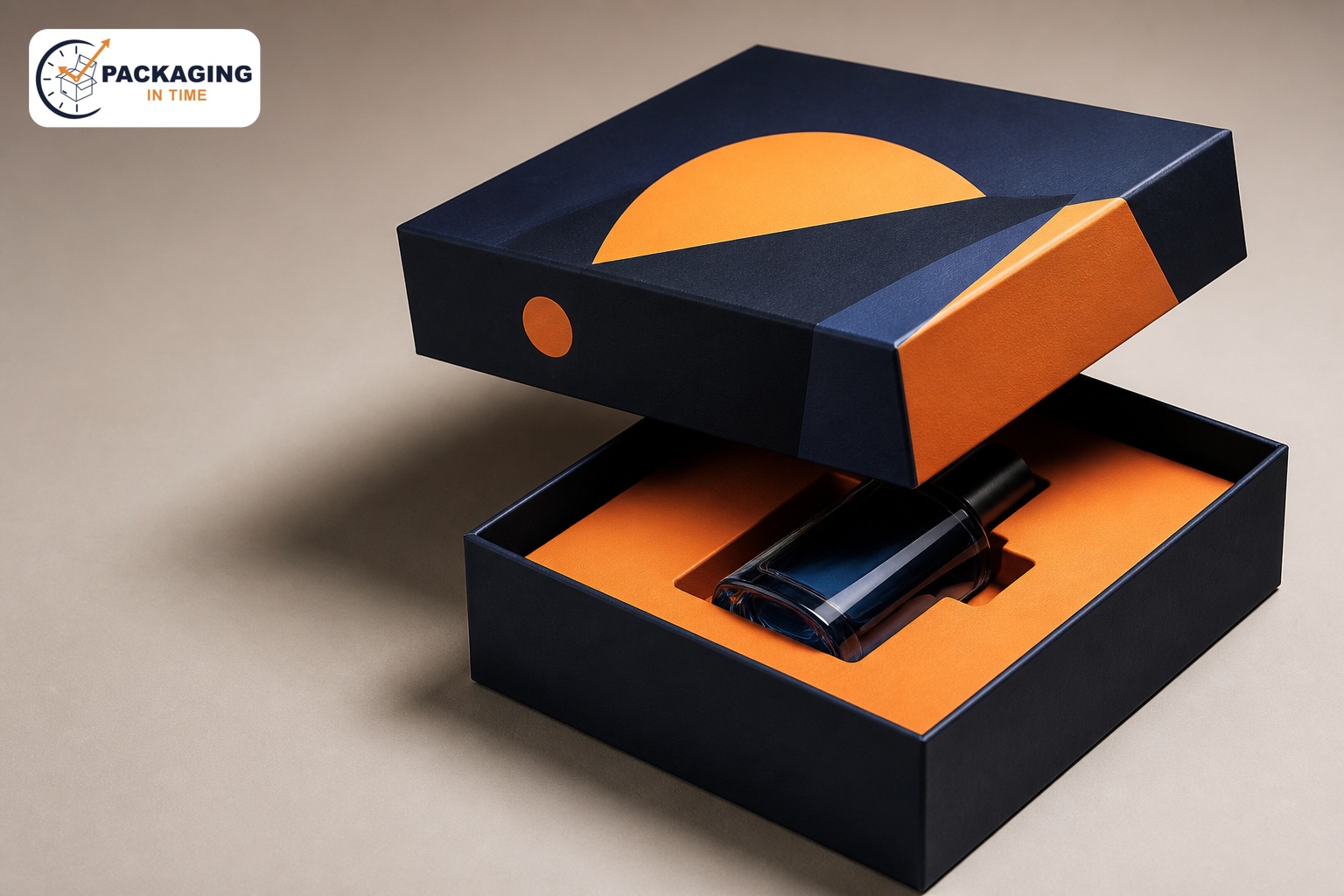
Custom two-piece boxes use a separate lid and base to create a deliberate opening sequence and a more permanent presentation than a lightweight folding carton. They are often chosen for cosmetics, fragrance, jewellery, electronics accessories, premium food gifts and product sets where the package is part of the perceived value of the item.
A two-piece box needs to be specified around more than its outside dimensions. The product, insert, lid depth, base depth, board thickness, wrap paper and opening resistance all influence how the finished pack feels and performs. A physical sample is especially useful where alignment, tactile finish or fitted product presentation matters.
What is a two-piece box?
A two-piece box has a separate base and lid. In a rigid version, the base and lid are built from thick paperboard, often called greyboard or chipboard, then wrapped with printed or coloured paper. Unlike a folding carton, it normally ships assembled rather than flat. The construction can protect the product from ordinary retail handling and create a controlled reveal when the lid is removed.
Common two-piece constructions
Telescoping lid and base
A telescoping box uses a lid that fits over the base walls. The lid may cover part of the base or extend almost to the bottom, depending on the intended appearance and opening resistance. This structure suits gift boxes, product sets and premium retail packages where a straightforward lid-and-base interaction is required.
Shoulder-and-neck box
A shoulder-and-neck construction adds an inner raised section between the base and lid. The lid closes around the neck, which improves alignment and creates a layered reveal. It can suit fragrance, beauty and jewellery presentation, but the additional component must be specified with accurate tolerances and an approved sample.
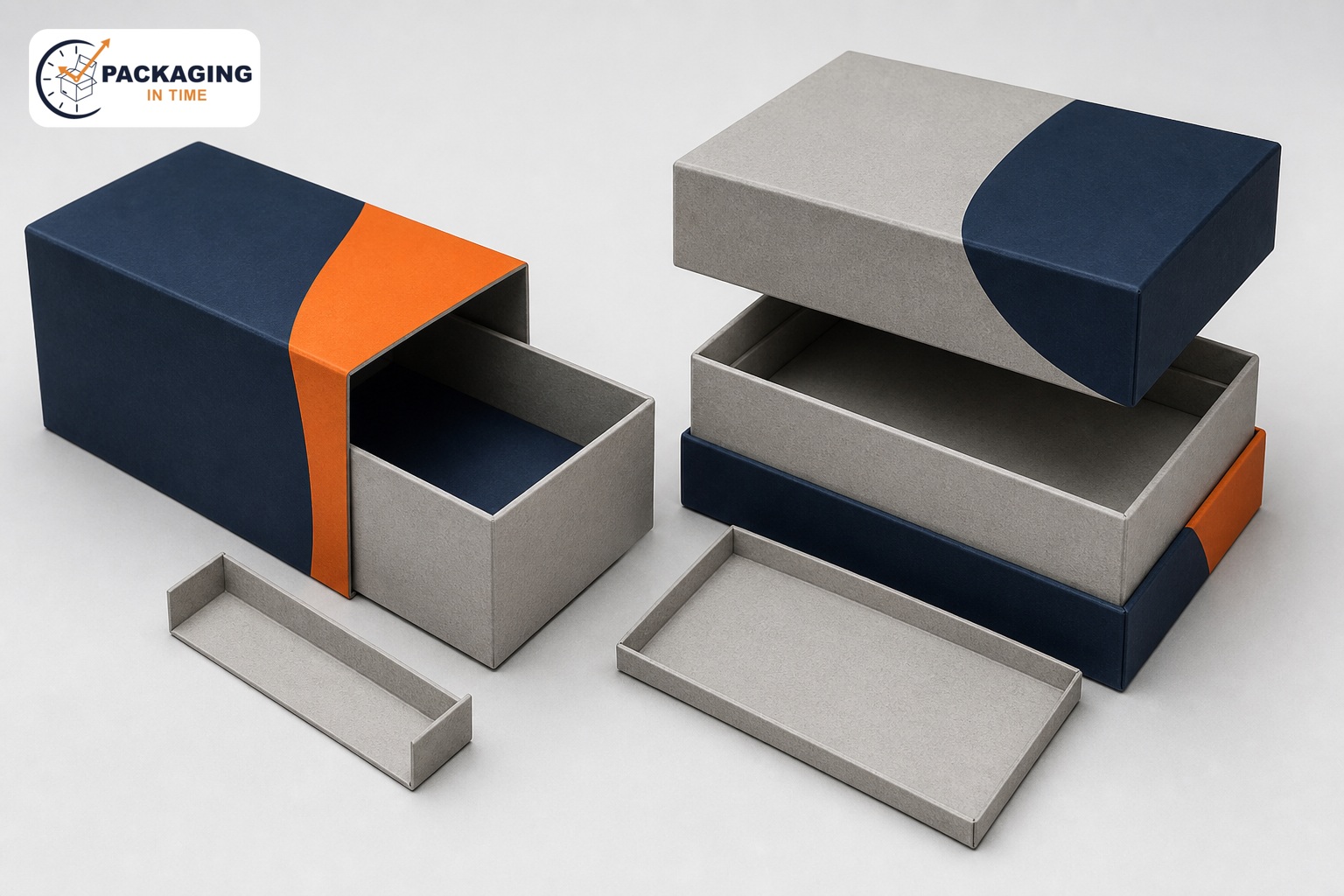
Two-piece structures: telescoping lid-and-base and shoulder-and-neck boxes.
Rigid board, wrap paper and inserts
The board gives the box its shape and stiffness; the wrap paper supplies the printed and tactile surface. Board thickness, box size and product weight should be considered together. A larger box or a heavy product may need more support than a small gift box, while a very thick board can affect the lid fit and wrap quality. A supplier sample confirms the intended feel more reliably than a board description alone.
An insert can hold a product in a fixed position, separate components or create a cleaner reveal. Paperboard, molded pulp, foam and fabric-wrapped options have different fit, protection and recovery considerations. Choose an insert after measuring the actual product, including the heaviest and most fragile variant, rather than using a generic cavity size.
Sizing, fit and opening experience
Specify internal length, width and depth, product height, clearance and insert compression before the structure is finalised. The lid needs enough clearance to lift smoothly without being loose. A box that is too tight can scuff wrap paper or frustrate the customer; one that is too loose can look misaligned and allow product movement. Verify fit with the intended finish, insert and product weight in a physical prototype.
For a wider comparison of consumer-facing structures, including folding cartons and mailer combinations, see . Two-piece boxes are usually a retail or gifting layer, not an automatic substitute for an outer transit shipper.
Lid coverage and opening feel
Lid depth is one of the first choices in a two-piece specification. A shallow lid leaves more of the base visible and opens with less friction. A deep telescoping lid creates a stronger block of color and can make the box feel more substantial, but it increases the area that must align and may change the opening force.
The right depth is tied to the product size, wrap thickness, base walls and intended customer interaction. Confirm whether the lid should stop at a visible reveal line, cover most of the base, or close around a raised neck. A sample with the final wrap is essential because paper thickness, seams and coatings affect fit.
Opening resistance should feel deliberate, not difficult. A lid that is too loose can shift in retail, look misaligned and reduce the sense of care. A lid that is too tight can tear wrap paper, trap air, frustrate the customer or make staff assume the box is defective.
The ideal fit depends on the area of contact, board thickness, depth of lid and base, and expected handling. Test the lid after the product and insert have been fitted, not just as empty components.
Where the customer will repeatedly open the package, test more than one cycle and check the edges, corners and wrap for visible wear.
Shoulder and neck structures
A shoulder-and-neck box adds an inner collar between the base and the lid. The exposed shoulder can create a clean reveal and guide the lid into place, while the neck helps maintain alignment. This construction can be useful for fragrance, cosmetics, jewellery and premium gift sets where the opening is part of the brand presentation.
It has more components than a simple telescoping box, so it needs clear dimensions, tolerances and assembly control. The height of the neck, the visible shoulder, the lid clearance and the product cavity all need to work together. A small adjustment to one element can change how smoothly the lid closes.
Choose a shoulder-and-neck structure for a defined presentation reason, not merely because it looks premium. It can improve the reveal, create a contrast color between layers or help a lid locate consistently on a larger box.
It can also add material, production steps and fit complexity. For a straightforward product set that needs a reliable cover, a conventional lid and base may be more efficient. Ask what the customer sees first after removing the lid, whether the box will be opened repeatedly, and whether the inner neck provides an operational benefit as well as visual detail.
Insert planning
An insert should solve a product-control problem. It can keep a bottle upright, separate a cable from an accessory, prevent a glass item from moving, or give a gift set a clear opening order. Start with the actual finished product, including caps, labels, cables, pouches and any variation between SKUs.
Record its weight, fragile points, preferred orientation and how a customer removes it. A cavity that looks accurate in a drawing can pinch a label or leave too much space once the real product is packed. Prototype the insert with the heaviest and least stable version before approving the final cut pattern.
Common insert choices include paperboard, moulded pulp, foam and fabric-wrapped components. Each gives a different balance of support, visual finish, assembly, material mix and recovery considerations. There is no universally premium or protective insert. A paperboard platform may suit a lightweight boxed accessory; a fitted support may be required for a fragile item; a fabric-wrapped surface may suit a particular gifting presentation.
State the function required, then select the material. If the product uses more than one component, confirm the loading order and whether staff can pack it consistently without damaging a wrap or forcing a product into a cavity.
Wrap paper and finishing
In a rigid two-piece box, the wrap paper is the visible surface. It carries the color, texture, graphics and much of the customer's first impression, while the rigid board underneath provides the structure. Specify the wrap as a real production component: color, finish, print method, coverage, grain direction where relevant, seam location and edge treatment.
Dark high-coverage wraps can make scuffs more visible; metallic details can require careful registration; soft-touch coatings can change the tactile result and handling marks. Review the planned wrap on the intended board, not only as a loose swatch or digital image.
Foil, embossing, debossing, spot varnish and lamination can add emphasis, but they should have a clear job in the visual hierarchy. Use a finish to direct attention to a mark, product name or opening detail rather than applying several effects without a reason.
Confirm the position of every treatment relative to edges, seams, corners and raised insert areas. A physical sample shows whether an effect retains its clean appearance across the lid corners and after ordinary retail handling.
It also gives the team an opportunity to check if the finish affects the material story they intend to communicate.
Product information and retail controls
Two-piece boxes are often used as a gifting or presentation layer around an individual product carton. The individual product pack may still carry the instructions, variant details, warnings and information a customer needs after the box is opened.
The outer lid and base can focus on the brand or collection, but they should not obscure or replace required product information. Decide which layer owns each message before final artwork. For broader individual-pack options, use the existing a related individual-carton page for further comparisons.
If barcodes are required on the two-piece box, reserve an appropriate flat panel and avoid seams, corners, foil-heavy backgrounds and areas likely to rub against a shelf or outer case. Final barcode verification depends on the finished substrate, print contrast, coating, placement and scanning environment.
A clear location in artwork is only the start. Retailers may also have requirements for labels, case marks, product orientation and pallet configuration, so obtain current guidance for the retailer and channel before locking the packaging specification.
Retail and gifting operations
A two-piece box is often chosen because the act of lifting the lid feels different from opening a folding carton. The product should reinforce that moment. Decide whether the lid reveals an insert, a tissue layer, a printed message, a product arranged at the center or a series of compartments.
The opening sequence should be easy for a customer and repeatable for the packing team. If a lid is set aside during use, make sure the base remains stable. If the product has a preferred orientation, the insert and pack-out should lead it into place naturally rather than relying on staff to turn it by hand every time.
For retail, assess how the box sits in a fixture and how it is replenished. A rigid lid-and-base structure may create a strong shelf block but can take more space than a flat-packed carton, so outer-case and shelf dimensions need to be checked.
High-value presentation packaging can be displayed closed, opened with a sample unit, or placed inside a retail tray depending on the store model. Test the real box in the intended shelf or counter position. Check the readable face, barcode location, likelihood of scuffing and whether the product box remains stable when customers lift it from a stack.
Distribution planning
Rigid boxes can protect the product from ordinary retail handling, but they should not be assumed to be a complete parcel or freight solution. A brittle product may need a fitted insert, and the finished two-piece box may need an outer corrugated shipper, cushioning and a defined pallet or parcel configuration.
The transport layer should be designed around the expected route. If transit performance is important, test the actual product, insert, rigid box, shipper and unit-load arrangement together. A test result for another box does not automatically demonstrate the performance of a new product configuration.
For direct-to-consumer orders, a two-piece box can provide the premium internal presentation while a separate outer mailer performs the parcel role.
Environmental language
Rigid box construction often uses several components: board, wrap paper, ink, coating, adhesive, foil, magnets, ribbon and an insert. Their combination matters when a brand discusses disposal, recycled content, certification or recyclability. A board-based outer box is not automatically recyclable in every local system, and a decorative component can change the practical recovery route.
Use clear, specific claims tied to documented material information and the relevant market. Broad environmental language may create a misleading expectation where the final configuration has a more qualified outcome.
The most useful material improvement often comes from eliminating a component that does not advance protection or presentation, improving insert efficiency, reducing excessive void space or choosing a configuration that lasts through its intended use.
Do not reduce board or remove support solely to make a simple claim if the change creates damage, scuffing or a need for extra transport packaging. Review the finished package system and state only what can be supported about its materials and end-of-life conditions.
Prototype and release
Approve a two-piece box with a complete physical sample. It should include the actual product, final insert, rigid board construction, wrap, print treatment, closure fit and any tissue, ribbon or accessory. Lift the lid, remove the product, reclose the box and inspect the corners, seams and surfaces.
Test the heaviest and most visually sensitive variant, not just a representative empty box. If the product will be held in inventory or sent to several retailers, check the packed configuration after a realistic storage interval and after the expected outer-case handling.
The release record should identify the approved dieline or structural drawing, board and wrap, insert pattern, product orientation, artwork version, finishing areas, outer-case arrangement and inspection points. Treat a change in product dimensions, wrap, coating, insert, lid depth or shipping route as a potential specification change.
This is not unnecessary paperwork; it gives the brand and supplier a clear shared reference for a reorder and prevents a successful package from changing through a series of small, unreviewed assumptions.
Sizing and product clearance
Measure the product in its finished state, including labels, caps, cables, pouches, seals and any components that change the real footprint. Then define internal length, width and depth, plus the product orientation and the clearance needed for an insert.
Rigid-board thickness and wrap layers change the relationship between external and internal size, so a product that appears to fit in a drawing may need adjustment in an assembled sample. Check the heaviest and tallest SKU, not only a nominal product, and confirm that the lid closes without touching or putting pressure on a sensitive surface.
The product should be easy to remove. A very tight cavity can look neat in a photograph but make a customer grip the product by a cap, label or fragile edge. A finger notch, pull ribbon, tray edge or different cavity geometry may improve access, but each feature changes the insert and opening experience.
Decide whether the customer removes one item, a complete tray or several components in sequence. This directly affects the useful interior dimensions and the amount of support the insert needs to provide.
Premium presentation without unnecessary complexity
A premium result does not require every available finish. It normally comes from clean alignment, consistent wrap quality, a lid that opens smoothly, an insert that holds the product confidently and one or two deliberate visual details.
Start with the product and the message the customer should notice first. Then use color, texture or foil only where it strengthens that hierarchy. This keeps the box readable and can make sampling and quality control easier than a specification with several effects competing on the same small surface.
The outside and inside should work together. The exterior may be quiet and brand-led, while the first opening reveals a contrast wrap, product card, tissue or insert. Make this choice based on the intended customer moment and packing process.
If staff must add tissue or place a card manually, prove that it can be done consistently. If the customer is expected to retain the box, consider whether the material and closure will stay presentable after repeated opening rather than assuming that every rigid box will be reused.
Quote and supplier questions
A direct quote request should state the product dimensions and weight, inside size, required lid coverage, construction type, insert function, artwork status, finish preferences, quantity and delivery destination. Add the retail or gifting context and identify whether the pack will ship loaded, be assembled at a fulfilment site or be placed into an outer shipper.
These details let a supplier evaluate the complete system. They also stop a comparison between prices that include different components, proofs, packing services or outer cases.
Ask for the structural assumptions behind a proposal. Clarify which board and wrap are included, how the insert is made, whether the box arrives assembled, what the lid fit has been based on and which proof or physical sample will be supplied.
If a material attribute or environmental claim is important, request the supporting documentation. If transit performance is important, define the actual test configuration and route. A clear answer is more useful than an early generic promise about strength, quality or sustainability.
Quality control at production
Production inspection should include the details a customer sees and feels: square corners, clean wrap seams, aligned lids, smooth edges, consistent color, secure insert placement and correct product orientation. It should also include operational items such as the correct barcode position, approved artwork version and outer-case packing pattern.
Use a signed physical reference sample when possible. It gives both the supplier and brand team a shared standard for acceptable construction and finish, especially when the box has a high-coverage wrap or detail-sensitive decoration.
Define what happens if a component changes. A new bottle supplier, revised label, thicker tissue, different coating, modified product count or alternative freight route can change fit and presentation. Rather than assuming the old approval applies, compare the new input to the approved sample and decide whether a focused prototype is needed.
This is particularly important in two-piece packaging because a small dimensional change can affect lid friction, insert access and the clean alignment that gives the box its premium appearance.
Frequently asked buyer decisions
Choose telescoping lid and base when the priority is a familiar, straightforward premium box with a defined amount of lid coverage. Choose shoulder and neck when the raised inner reveal or guided alignment supports the product presentation.
Choose an insert when product movement, orientation or removal needs control. Choose a separate outer shipper when the route requires transit protection. Each decision has a distinct job, and keeping these jobs separate makes the final specification easier to quote, test and approve.
Do not set a fixed opening force, board grade, test claim, lead time or minimum order quantity before the details are known. These outcomes depend on box size, product weight, construction, wrap, insert, finish, quantity and logistics. A supplier can propose appropriate options once the complete brief is available. The buyer then has a basis for choosing between presentation, protection, production complexity and cost without relying on assumptions.
Choosing the right construction for the product
Start with the product’s sales role. A compact fragrance bottle, a beauty set, a jewellery item and an electronics accessory may all suit a two-piece format, but they do not need the same construction. A bottle may need upright retention and a pull feature.
A jewellery item may need a shallow platform that keeps the product centred. An accessory bundle may need compartments and a clear loading order. The lid-and-base form is only the outer architecture; the product, insert and opening sequence determine whether the experience feels controlled.
A good brief says what the customer should see first, how the product should sit and how it should be removed.
Consider the intended ownership period too. A box used only to hand over a gift can be optimized for the first opening and short-term presentation. A box intended to store a product, be reused by a customer or sit on a shelf for an extended period needs cleaner wear resistance, an insert that continues to fit and a lid that remains aligned through repeat use.
These are not reasons to add complexity automatically. They are reasons to make the construction choice based on the actual customer journey rather than a generic premium-packaging reference.
Managing dimensions and tolerances
The visible external dimensions are not enough for a rigid set-up box. The board, wrap, seams, lining paper, insert and lid fit all consume space or affect the relationship between the lid and base. Provide product measurements and required usable interior dimensions, then let the structural sample confirm the outer size.
This is especially important for deep lids and shoulder-and-neck structures, where several layered layers influence the closing action. A very small clearance can create an attractive close fit in a design drawing but become difficult to assemble consistently in production.
Set tolerances around the functional areas, not only the biggest panel. Check the corners, neck, lid opening, cavity edges and product-removal feature. If a product is supplied by more than one manufacturer or varies by batch, record the full dimensional range.
If the product is temperature-sensitive, moisture-sensitive or has an easily scratched finish, include that in the sample review. The point is not to make the box excessively loose; it is to ensure that ordinary variation does not turn a finished package into a force-fit assembly or a visibly misaligned retail pack.
Artwork release and sample approval
Artwork approval should include the assembled box, not just a flat wrap layout. Confirm the position of logos, patterns, seams, foil, barcode areas and any message revealed on opening. Check what the customer sees when the lid is in place, lifted and set beside the base.
If a lid covers most of the base, make sure any required retail information is still accessible in the intended selling position. If a neck or insert carries print, examine alignment with the outer wrap.
An approved assembled proof makes these decisions tangible and prevents a design that reads correctly in a PDF from looking unbalanced in use.
Keep a clear version record. The approved specification should identify the structural drawing, artwork file, board, wrap, insert, product configuration and final physical reference. This helps when one SKU changes or a seasonal variant is introduced.
It also lets a supplier distinguish between a print-only refresh and a change that needs a new fit sample. Consistent version control is particularly valuable for two-piece boxes because a revised wrap, insert or product height can affect both the visual result and the lid interaction.
A practical production checklist
Before release, check product fit, insert access, lid alignment, wrap quality, corner condition, print registration, opening force, barcode placement, outer-case arrangement and product orientation. Confirm the actual product has been used in the review and that the heaviest or least stable SKU has not been omitted.
If the package needs tissue, a ribbon or an instruction card, load those components as they will be packed in production. The final sample should demonstrate the complete customer experience and the actual operations, not an idealised empty box.
During a first run, inspect units across the production batch rather than approving only an initial example. Look for consistent lid fit, clean seams, sharp corners and secure insert placement. Check whether the outer case protects the visible wrap and whether the product remains in the intended orientation after handling.
If a defect occurs, identify whether it is structural, material, artwork or packing-related before changing the specification. This approach helps correct the real cause without adding unnecessary components or making unsupported performance assumptions.
When a simpler box is the better answer
A two-piece rigid box is not always the best commercial choice. A folding carton may be more suitable where the product needs to ship flat, use extensive on-pack information, fit a high-volume retail operation or minimise storage volume.
A mailer may be better for direct delivery, while a display tray may be better for a multi-unit retail presentation. Choose a two-piece construction where the lid removal, tactile quality, product arrangement and retail or gifting role create a real benefit.
This keeps the packaging system purposeful and stops a brand paying for a premium structure where another format would serve the product more directly.
The clearest decision is usually made after comparing the product, channel, route, required information and desired opening moment. Once those inputs are explicit, a lid-and-base or shoulder-and-neck box can be specified with confidence. The result is a package that presents the product well, is feasible for the packing process and uses protective layers where they genuinely belong. That is the practical value of a complete two-piece-box brief.
Printing and finishing
The wrap paper can be printed with digital or offset processes and finished with foil, embossing, debossing, spot UV, laminations or coatings. Specify each finish by location and coverage. High-coverage dark wraps, metallic decoration and soft-touch surfaces should be sampled for scuffing, registration and edge quality. Keep required product information and any barcode on a flat, readable panel with adequate contrast and safe distance from seams and edges.
Retail, distribution and environmental caveats
A two-piece box can present a product well in retail, but it should not be assumed to protect against parcel impacts, vibration or compression without an outer shipper and representative evaluation. Define the package layer and shipping route early. Fragile or high-value products may need an insert plus an outer corrugated transport package.
Environmental claims should reflect the actual components. A rigid board box may include wrap paper, foil, magnets, ribbons, foam, coatings or adhesives, each of which can affect local recovery pathways. The FTC advises against broad, unqualified environmental benefit claims. Describe a supported material attribute and any applicable disposal conditions instead.
Custom two-piece box quotation checklist
Product dimensions, weight, fragility and product orientation
Internal size, lid depth, base depth and opening preference
Telescoping or shoulder-and-neck construction
Board, wrap paper, print method and finish requirements
Insert material, cavity geometry and product-retention need
Required product information, barcode and retail-facing panels
Outer shipping requirement, destination and required delivery date
Artwork, dieline, proof and physical-sample requirements
Frequently asked questions
Are two-piece boxes rigid boxes?
Many are rigid set-up boxes, but a two-piece format describes the separate lid and base rather than one fixed material. Confirm the required board, wrap, fit and insert with the intended product.
Can a two-piece box protect a fragile product in shipping?
It can support product presentation and internal restraint, but shipping protection depends on the complete packaging system and distribution route. Fragile products commonly need an insert and a separate outer shipper.
Can two-piece boxes be recycled?
That depends on the components and local facilities. Board alone may have a different recovery path from a box with film laminations, foil, magnets, ribbons or foam. Describe the verified component and local conditions rather than making a blanket claim.
Specify the opening as part of the product experience
A custom two-piece box can create a premium, reusable-feeling package when the lid fit, product insert, materials and finish work together. Confirm the structural choices with a physical sample before volume production, particularly where the product is heavy, fragile or visually sensitive.
Research references
FTC Green Guides summary , https://www.ftc.gov/business-guidance/resources/environmental-claims-summary-green-guides
GS1 barcode placement guidance , https://www.gs1.org/standards/barcodes/10-steps-to-barcode-your-product/english