
A practical guide from Packaging in Time to help you choose better materials, structure, printing, and finishing for custom boxes.

Custom Pillow Boxes Sizes Materials and Uses
Custom pillow boxes are compact, curved paperboard packages with two inward-folding end closures. Their silhouette makes a small product feel considered without the weight or formality of a rigid gift box. They are commonly used for jewellery, accessories, gift cards, wrapped confectionery, cosmetics, small apparel items, party favours and promotional samples.
They ship flat, use a by comparison small amount of board for a light presentation pack and provide front and back panels for artwork. Their best use is narrow: a pillow box is strongest when it contains a light, compact and reasonably non-fragile item that benefits from a quick retail or event handoff.
The curved construction gives the package its appeal, but it also changes what will fit and how the closure behaves.
A buyer should begin with the product rather than a preferred mock-up. The question is whether the actual item, any backing card, tissue, insert or wrapping can sit comfortably inside the curved form and close without constant pressure on the end flaps.
A pillow box is not a generic small box with rounded decoration. Its usable interior is reduced near the ends, its tuck closures can open if they are overstressed, and its curved panels do not offer the same stacking or compression resistance as a conventional rectangular carton.
This guide explains how to define those limits, select an appropriate board and finish, arrange the internal contents and separate the presentation layer from product protection and parcel transit.
What is a pillow box
A pillow box is a die-cut folding carton with a shallow curved profile and opposing tuck ends. When the end panels fold inward, the blank becomes a compact enclosed package with the characteristic pillow shape.
Most versions are supplied flat, erected by hand and opened by flexing one of the curved ends. The closure can be convenient for a customer to open and reclose, but it must be matched to the product and intended handling.
The base is not a hard rectangular tray: the panel curve and end geometry govern the available clearance and the pressure applied to the contents.
The term identifies a structural format, not a performance claim. A pillow box can be an outer presentation layer around a wrapped product, a retail pack for a light accessory, a secondary gift component or a party-favor container.
It is not automatically suitable for direct food contact, heavy products, fragile objects, controlled labels, moisture exposure or parcel shipping. Those requirements may need another packaging layer. Identifying the package role early makes later choices clearer: individual products may need a separate retail carton, the pillow box may provide the gifting experience, and a master case or mailer may protect the complete pack on the route to the customer.
This separation is especially useful for products that will be removed from the pillow box. The individual saleable pack still needs to identify the item and carry any required information once the presentation layer has been discarded. The pillow box can focus on the gift, campaign or sample experience. A clear map of product pack, pillow box, insert and outer shipper prevents artwork or performance requirements from being assigned to the wrong component.
Where pillow boxes work well
Pillow boxes are well suited to small accessories and giftable products that are light enough to be carried and compact enough to sit within the curved interior. Jewellery on a backing card, socks, hair accessories, small stationery pieces, gift cards, wrapped sweets and trial-size cosmetic products are common examples.
Retail counters and pop-up events are natural settings because the format is quick to hand over, easy to display in a shallow basket or tray and visually distinct from a standard rectangular carton. For a seasonal campaign, a pillow box can create a coordinated family look across several variants while keeping the structure simple.
The format is less appropriate when the item has sharp corners, a tall profile, a high weight, a sensitive surface or several components that must remain precisely arranged. A large bundle can push against the curved ends, and a fragile item may need a fitted insert or a more protective carton.
Products that require extensive instructions, several retail panels or a very stable shelf-standing form may be better served by a conventional carton. Where the individual retail package needs that more conventional role, compare it with a conventional retail carton before choosing a pillow box as a presentation layer.
Product fit and curved-end clearance
Measure the finished product, not only a nominal specification. Include labels, caps, closures, backing cards, wrappers, ribbon, tissue and any component that affects the true footprint. Record length, width, height and weight, then check a sample at the center of the pillow box and near both tuck ends.
An item can fit through the middle of the blank yet interfere with the curved panels when the package is closed. The product should not need to force the ends into position or put permanent stress on the tuck tabs. That pressure can cause visible bulging, accidental opening or scuffing during handling.
Interior clearance should allow a practical loading process. A box that only fits when one item is inserted at a precise angle can be slow and inconsistent to pack. Think about the order in which components enter, whether the product needs to face a particular direction and whether a customer should see a specific panel at opening.
A backing card can make a small item feel more substantial and can reduce movement, but it also uses interior space. Tissue can soften the presentation but should not be the only thing controlling a product that can shift. Test the intended product count and the heaviest SKU in the actual board and assembled geometry.
Product weight changes the decision too. A pillow box may look stable while empty but deform if a dense item presses into one curved end. Keep the center of gravity low and balanced where possible.
If a product is narrow but heavy, a different orientation, divider or package format may be needed. The goal is a pack that closes easily, stays visually clean and can be picked up without the product moving or stressing the closure.
Board and closure decisions
Paperboard is a natural choice for many pillow boxes because it produces a clean print surface and folds accurately into a compact form. Board selection depends on the box size, product weight, print coverage, desired feel, humidity exposure and expected handling.
A lightweight gift-card holder needs a different construction from a pillow box holding a small accessory set. Coated white board may support particular color reproduction, while uncoated or kraft-look board may serve a different visual direction.
Material descriptors such as premium, strong or eco-friendly do not replace a review of the actual packed load and route.
The opposing tuck ends are both the closure and the feature that creates the pillow profile. Their engagement should be checked after the box has been filled. Tuck tabs that are too loose can spring open; tabs that are too tight can make the package difficult to close or tear the board through repeated use.
A product that presses into the end panels can reduce closure security even if the tabs themselves appear correct. Review the physical sample through the complete sequence: erect, load, close, carry, open and, if relevant, reclose. This reveals whether the closure, score and board recovery are appropriate for the actual use.
Pillow boxes should not be used as a substitute for an engineered shipping case. The curved panels and tuck ends are designed for presentation and light handling, not for unspecified compression or parcel impacts. If product protection is important, put the pillow box inside an outer component designed for that route and evaluate the whole packed configuration.
Printing and artwork
A pillow box offers useful exterior panels, but artwork has to respect the curved geometry. The dieline should identify cuts, scores, tuck tabs, glue areas, safe zones and non-print regions before final design work begins.
Keep critical small type, legal information, barcodes and registration-sensitive graphics clear of folds and end closures. A flat artwork file can hide the way a pattern bends as the box is erected, so review an assembled printed sample from the customer's normal viewing angle.
The design should look intentional when the box is flat for storage, curved on a counter and held in a customer's hand.
The graphic hierarchy should suit a compact object. One clear brand or occasion cue, a simple product name and a visible variant marker often work better than too much copy. If multiple designs use the same structure, use color, iconography or short naming consistently so packing teams and customers can distinguish them.
Reserve any barcode area on a flat, high-contrast panel where it will not crease or rub. Barcode scanning depends on the final substrate, ink, coating, placement and retail environment, so verification should use the finished production configuration rather than a screen preview.
Finishes should be specified for their function. A coating may be selected for rub resistance, a foil detail for a focal point, an emboss for tactile contrast or a window for product visibility. Each choice can affect cost, scuff visibility, production preparation and the end-of-life pathway of the final construction. Review a physical proof when the feel, color matching or print-on-board result is important.
Windows, inserts and presentation details
A window can let a customer see a wrapped product, color or assortment before opening the package. It is useful only when visibility advances the purchase decision and the opening does not weaken a stressed panel or expose the product to unsuitable conditions.
A window introduces its own film, adhesive and production considerations. It can also change the material mix of the finished pack, so environmental language should describe the full configuration rather than the board alone. If the customer needs full product visibility, a different open display or carton structure may be more effective than cutting a very large window into a curved pillow box.
Inserts and backing cards can improve product control. A jewellery item may need a card that keeps it centred; a gift card can sit in a fitted sleeve; a small cosmetic item may need a simple divider to prevent rolling.
These components should be planned with the pillow-box interior in mind. An insert that works in a rectangular test box may collide with the curved ends or consume the clearance the tuck closure needs. Confirm whether the insert arrives flat, is assembled by a packing team or is loaded with the product. The added component affects operations, quote cost and the final customer experience.
Ribbons, stickers and belly bands can add occasion-specific decoration, but they should not conceal a closure problem. A package should stay closed through its intended customer journey without relying on an unplanned decorative element. If a seal is desired, define whether it is purely visual, tamper-evident for a particular application or part of the closure process, and validate it accordingly.
Retail, events and operations
Pillow boxes work well at counters, in gift collections, on event tables and within promotional kits because they offer a small, recognisable handoff format. Store and event teams still need a repeatable packing sequence. Test how a flat box is erected, how the product is loaded, how tissue or an insert is added, which end closes first and how staff confirm a neat finished result.
A package that is simple for one designer to assemble can be difficult when hundreds are prepared in a short period. A product photo, approved sample and concise assembly reference help retain consistency across locations.
Display and storage should be considered too. The curved profile can make pillow boxes visually attractive in shallow trays or baskets, but it may not stack as efficiently as rectangular cartons. Confirm the retail fixture, product count, orientation and whether the package must remain tidy as customers pick up individual units.
The box can sit flat or stand on its curved side depending on the structure and contents; use an actual sample to decide whether a secondary tray is needed. For event favours, check how the form behaves when arranged in rows and whether printed names or occasion details remain visible.
A customer handoff is the final operational test. The package should feel complete, close securely and avoid awkward protrusions at the ends. If an item will be carried alongside other purchases, consider whether the box needs a bag or another outer layer. The pillow box is a presentation component, not necessarily the sole carry solution for every use case.
Food contact, claims and environmental language
Pillow boxes are sometimes used around confectionery, bakery treats or samples, but the food-contact boundary must be defined. A box carrying individually wrapped goods has a different role from a structure that might directly touch unwrapped food.
Board, coatings, inks, adhesives, window film, inserts and liners may each need assessment based on the food, contact time, temperature and market. Do not call a complete pillow box food-safe or FDA-compliant as a broad shorthand. Obtain the relevant documentation and review the actual application, including moisture, grease and handling conditions where applicable.
Environmental claims need the same care. Paperboard can be a valuable fibre-based material, but recyclability, recycled content, compostability and disposal outcomes depend on the finished components and local systems. Coatings, windows, adhesives, inks, product contamination and collection rules can matter.
State the verified attribute and conditions rather than making an unqualified broad claim. Material reduction can be a reasonable goal, but it should not lead to a box that tears, opens or requires extra protective packaging because the product fit and route were not defined properly.
Category-specific labels, warnings and claims belong on the appropriate product layer. A pillow box may carry campaign artwork or a simple assortment message, while the individual product pack carries information a customer needs after the pillow box is removed. This distinction helps a brand avoid hiding required details inside a presentation package that may be discarded quickly.
Distribution and parcel protection
A pillow box designed for a counter or event handoff should not be assumed to withstand parcel delivery as an outer pack. Parcel routes can include drops, compression, vibration, changing orientation and contact with other shipments.
The curved ends and tuck closures may catch, deform or open under conditions that are irrelevant to a short retail handoff. If the product is sold online, use an outer transit component and assess the full configuration: product, pillow box, inserts, protective material, shipper and expected route. Any performance claim should be tied to documented testing of the actual configuration.
The pillow box can still play an important role in a direct-to-consumer order. It can provide the gift or unboxing layer after the outer package has protected the shipment. In that system, a protective outer mailer can carry the parcel role while the pillow box remains focused on presentation.
For retail distribution, decide whether pillow boxes ship flat to a packing site, pre-assembled, loaded with product or inside a master case. Flat shipment reduces cube but creates an assembly task. Loaded packs need protection from scuffing, pressure and accidental opening.
Review the whole flow from packing through warehousing, delivery, fixture placement and customer handoff. The lowest-cost blank is not always the most efficient delivered system if it requires complex assembly, excessive protective materials or high store labor.
Prototype and quote inputs
A physical sample is essential before release. Use the actual product, heaviest SKU, intended insert, tissue, window and closure. Erect the box, load it, close both ends, assess the artwork, carry it as intended and open it from the customer's perspective.
Look for bulging at the curved ends, loss of closure engagement, product movement, rubbing on printed areas and interference with an insert or backing card. If products vary, test the least stable or tallest item rather than assuming one sample covers the range.
A printed sample should also confirm color, panel hierarchy, small text, barcode placement and the appearance of any coating or foil.
A quote request should include product dimensions and weight, required inside dimensions, product orientation, package role, artwork status, finish requirements, insert or window needs, target quantity and destination. Explain whether the boxes ship flat, are assembled at a packing site, are loaded with products, go inside a master case or will form part of an online order.
Do not invent a board grade, minimum order quantity, production lead time, food-contact claim or transit performance result before the supplier has the relevant inputs. Ask what structure, material, packing service, outer case and proofing scope are included so quotations can be compared fairly.
For product lines that need broader retail panels or a stronger conventional form, compare before choosing a pillow-box presentation layer.
Choosing dimensions for retail display
Retail dimensions should include the shelf or counter context as well as the product itself. A pillow box may be presented flat in a tray, leaned in a small display, stacked in a basket or handed directly to a customer.
Its curved profile creates visual character but can also let products roll or nest unpredictably if the fixture gives them no support. Confirm the display footprint, number of visible units, orientation and replenishment method before approving a final size.
A shallow counter tray can keep individual packs aligned while making the front artwork visible; a loose basket can suit a casual gift offer but may cause scuffing if the finish is sensitive. Photograph or review the actual product in the intended retail setting, not only on a white sample table.
Variant management deserves attention when several pillow boxes share a campaign. Use a controlled color, product-name or icon system so customers can distinguish flavours, scents, sizes or themes without relying on small type near a curved end.
The individual product inside may remain the source of detailed information, while the outer pillow box gives the collection a fast, recognisable cue. Confirm which SKU belongs in which artwork and which orientation it should sit inside the box.
This avoids an operational error where a beautiful outer pack is loaded with the wrong product or an item is inverted when the customer opens the tuck end. A packing guide linked to the approved dieline is valuable where different staff or locations prepare the assortment.
If the pillow box includes a retail barcode, coordinate the code with the relevant product and retailer requirements. The barcode needs a flat, sufficiently clear print region, an appropriate quiet zone and a location that will not be heavily creased or rubbed during opening.
Coatings, dark artwork, metallic effects and curved panels can affect scan performance. A code that appears correct in a digital proof is not necessarily verified on the final substrate. Reserve the space early and check the production result under the intended scanning conditions.
The same discipline applies to product codes, price labels, lot information and any retailer marks that must remain legible after the package has been handled.
A pillow-box structure should be evaluated for its shelf life as a package, not only at the point of initial assembly. Board can relax, absorb moisture or show scuffing depending on storage conditions and finish.
Tuck closures can lose engagement if the product presses continuously against them. If the product is packed weeks before an event or seasonal launch, retain samples for a representative period and inspect the closures and appearance before volume release.
This is particularly useful for packs with high ink coverage, windows, tissue, ribbon or inserts because each can affect pressure, abrasion or material behavior. The result is not a generic shelf-life claim; it is evidence about the approved product and packaging configuration.
For premium small goods, the opening sequence can be as important as the exterior. Consider which end the customer opens, whether the product slides out too quickly, whether a backing card presents the product first and whether tissue creates a clean reveal without hiding the item.
The curved closure should feel deliberate rather than difficult. If a customer needs to reopen the box to return an item or retain a keepsake, test repeated opening with the actual board and finish. If the package is designed to be single use, focus on a clean first opening and avoid adding a closure feature that creates false expectations of repeated durability. These choices should be described in the brief so design, packing and customer-service teams share the same expectation.
The cost of a pillow box is influenced by more than its length and width. Board type, print coverage, number of colors, finishing, windows, inserts, assembly, quantity, delivery destination and outer packing all influence the final system.
A decorative treatment may be appropriate for a limited gift run but less suitable for a large promotional giveaway. An insert may be necessary for product control but may also add loading time. Rather than reducing or adding features one at a time by appearance, compare them against the product protection, brand presentation and operational benefit they create.
A detailed supplier quote should explain the supplied blank, printing, added components, packing expectations and delivery configuration so alternatives can be compared on an equivalent basis.
For a retailer or event organiser, the human process often sets the practical limit. A pillow box that takes seconds to erect on a sample can become slow if staff must also wrap the product, align an insert, add a sticker and place it in a display.
Time the real workflow with the intended materials. Check whether flat blanks can be stored near the packing station, whether completed boxes can be staged without collapsing and whether the team can identify different artwork versions.
A simple, consistent setup can be more valuable than a complicated design that requires specialist assembly. The physical sample should therefore be reviewed by the people who will actually pack and hand over the product, not only by the people who approved the visual concept.
Quality control can be concise but specific. Agree what a completed pillow box should look like: correct product and SKU, centred or approved orientation, closure engagement, clean artwork, no visible scuffing, correct barcode position and any insert or tissue in its intended location.
If the boxes travel in a master case, identify how printed faces are protected and how the case prevents pressure on the curved ends. A sample retained with the purchase or production file provides a reference for reorders.
When a product, board, finish, dimensions, product count or route changes, review whether the previous approval still applies. Small changes can alter closure tension and internal fit even if the front artwork stays the same.
Environmental decisions should also be evaluated at system level. A smaller pillow box may use less board than a larger carton, but that does not automatically make it a better option if the product needs excessive filler, a separate plastic insert or a much larger outer shipper.
Consider product fit, the number of packaging layers, the board and finishing components, local collection routes and the risk of damage or rework. Where a claim is proposed, document its scope and support. A precise statement about a material attribute is more useful than a broad promise that may not apply to every finish, window or destination market. This approach lets a brand make packaging decisions that are both practical and defensible.
Before production, complete a final approval using the full configuration: finished product, pillow box, insert, artwork, closure, outer case and planned retail or shipping route. Confirm the dieline revision, board, print files, product orientation, approved proof, pack-out and inspection points.
This record makes reorders safer and makes changes visible. A pillow box is a simple-looking format, but its curved ends, light board and presentation role make it sensitive to assumptions. A controlled prototype and complete brief keep the final result aligned with the product and customer experience it is meant to support.
Practical decision checklist before production
Confirm the product's finished dimensions and weight using a real sample, then test the size at the pillow box center and at both curved ends. Include cards, sleeves, labels, tissue and closures in this check. The test should show that the ends close naturally and that the product can be packed without forcing the board or relying on a decorative seal to keep the structure closed.
Confirm the intended package layer. Decide whether the pillow box is the individual saleable pack, a retail presentation cover, an event favor or an interior gift component. Then identify the separate product pack, food-contact layer and outer shipper where they are needed. This prevents an attractive small box from being asked to carry requirements that belong to another component.
Confirm the artwork against the approved dieline. Check folds, tucks, safe zones, barcode area, critical type, cut-outs and direction of reading after assembly. A panel can appear correct on a flat blank while moving out of sight on the curved end. The supplier and brand team should approve the same version of the production file and the same product orientation before a production run begins.
Confirm the packing and retail workflow. Check flat-blank storage, assembly, loading, closure, quality checks, master-case packing, fixture placement and customer handoff. If several sites will prepare the boxes, provide a concise visual reference based on the final sample. Test the process at realistic speed rather than assuming an occasional hand assembly represents a campaign or store rollout.
Confirm which claims are supported. If the pack is described with a material, recycled-content, food-contact or environmental attribute, identify the exact component, scope, evidence and relevant condition. Avoid broad terms that cannot be supported for the finished configuration. This final review helps the pillow box remain a useful, accurate brand presentation instead of a source of operational or compliance uncertainty.
Common specification mistakes to avoid
Do not size a pillow box from a flat dieline measurement alone. The assembled curved end panels reduce usable space and can press on the product or closure. Do not select a board only from a color or texture sample without checking the loaded package, and do not treat the tuck ends as an unspecified locking mechanism. A physical sample with the finished product is the fastest way to identify these issues.
Do not mix a presentation brief with a transit brief. A small curved retail box can make a product feel gift-ready, but it needs a separate outer protection layer when the route includes parcel handling or other demanding distribution conditions. Do not make a transit-tested statement without a documented result for the actual packed configuration. Treat the pillow box, product pack and shipper as linked but distinct components.
Finally, do not leave artwork, product orientation and packing instructions to interpretation. The final approved package should state which product belongs in which design, how it is loaded, what the correct finished closure looks like and which inserts or protective components are used. This small amount of control turns an attractive concept into a reliable packaging system that can be repeated for a retail launch, event or promotional run.
Pillow boxes are often selected because they look simple, but their simplicity is most effective when the constraints are made explicit. The creative direction, size, product, board, end closure, printing, insert, packing method and delivery layer should agree with one another.
Once those choices are tested on a complete sample, the format gives brands a compact way to present lightweight items without adding more structure than the product requires. The finished pack can then be used confidently in its intended retail, event or gift setting, with performance and claims kept aligned to the evidence available for that actual configuration.
For procurement teams, the final value of a pillow-box specification is repeatability. The approved sample should show the full product arrangement, not an empty structure, and the production record should state the approved board, dieline, print version, closure, components and pack-out.
This keeps a reorder aligned with the launch sample and makes changes visible before they affect customer presentation. If an item, insert, finish or delivery route changes, review the fit and closure again. The curve that creates the distinctive pillow profile is also the feature most sensitive to product dimensions and handling, so a brief recheck protects both appearance and function.
Use the approved configuration as the decision record for future work. It links the visual design to the real dimensions, contents and operating steps that made the package successful. That is what turns a small pillow box from an attractive graphic format into a dependable component of a brand's packaging system.
That discipline protects quality across every future reorder.
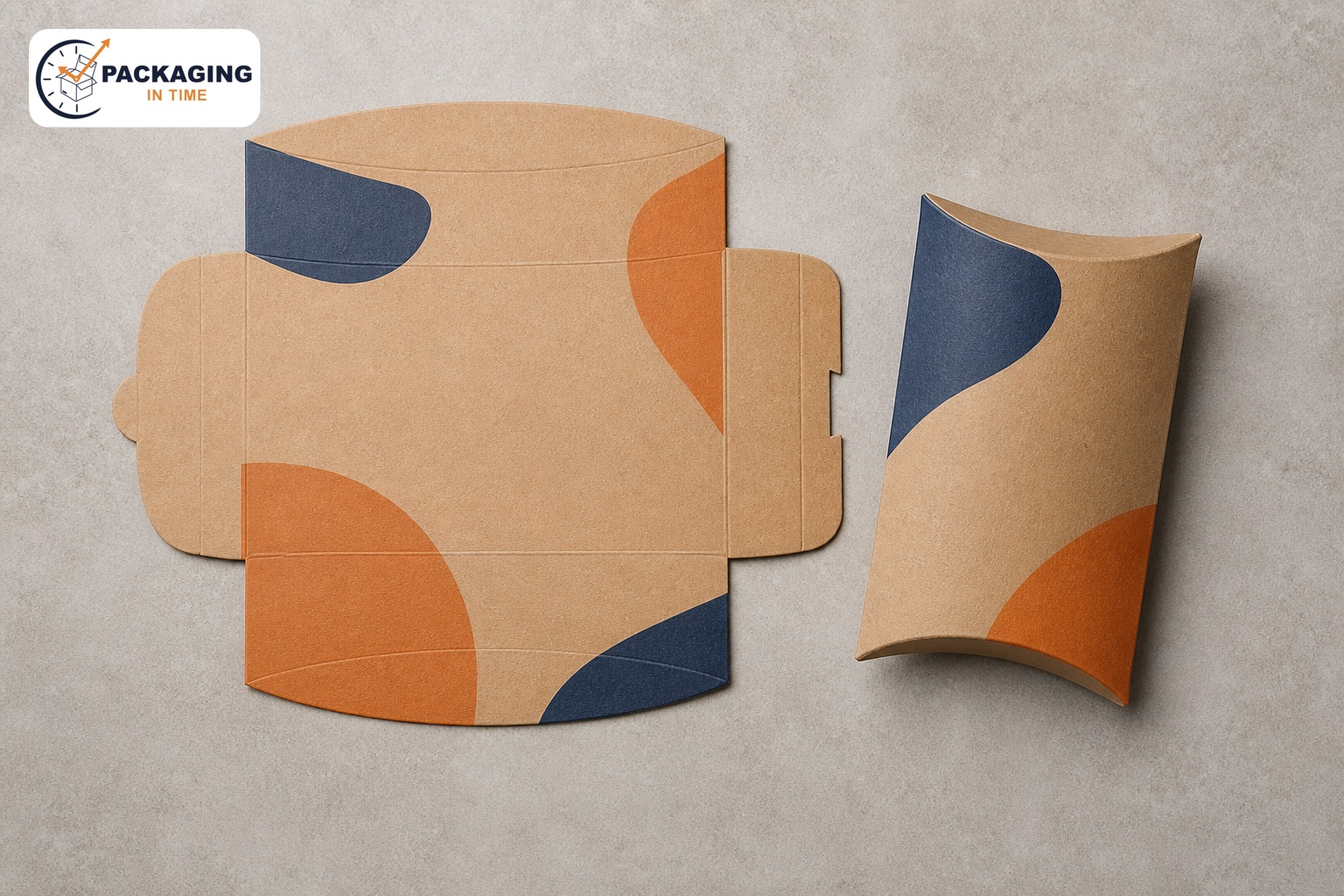
Construction reference: pillow-box blank and assembled curved tuck-end package.
Frequently asked questions
What products fit a pillow box?
Light, compact and reasonably non-fragile items such as accessories, gift cards, small wrapped goods and sample sets are common fits. Test the actual product at the curved ends and closure.
Are pillow boxes suitable for heavy items?
They are generally presentation packs for light products. Board, size and tuck geometry affect performance. Test the heaviest actual configuration and use another format or outer pack where the load demands it.
Can pillow boxes be used for food?
They can carry sealed or wrapped food, and some applications may need food-contact review. Confirm components and conditions for the actual food rather than applying a generic claim.
Can I use a pillow box for shipping?
Use it as an interior presentation layer if appropriate, but do not assume it is an outer parcel shipper. Protect the complete configuration with an appropriate transit component.
Can a pillow box have a window?
Yes, where visibility helps and the opening does not compromise fit or structure. Define the film, adhesive and full finished-material implications.
What makes a quotation accurate?
Product sample details, inside size, weight, board appearance, artwork, inserts, assembly, quantity and delivery route allow a supplier to recommend a complete solution.
Specify the curved package around the real product
A custom pillow box is most effective when the product, curved clearance, tuck closures and presentation role are designed together. Its compact shape can make a gift, retail item or event sample feel distinctive, but it should not be asked to provide unsupported food-contact, shipping or sustainability performance.
Measure the contents, review a real sample and define the outer packaging layer where needed. With a complete brief, the finished pillow box can give customers a clean, memorable handoff while remaining practical to pack and procure.