
A practical guide from Packaging in Time to help you choose better materials, structure, printing, and finishing for custom boxes.
Custom Gable Boxes Uses Materials and Printing Guide
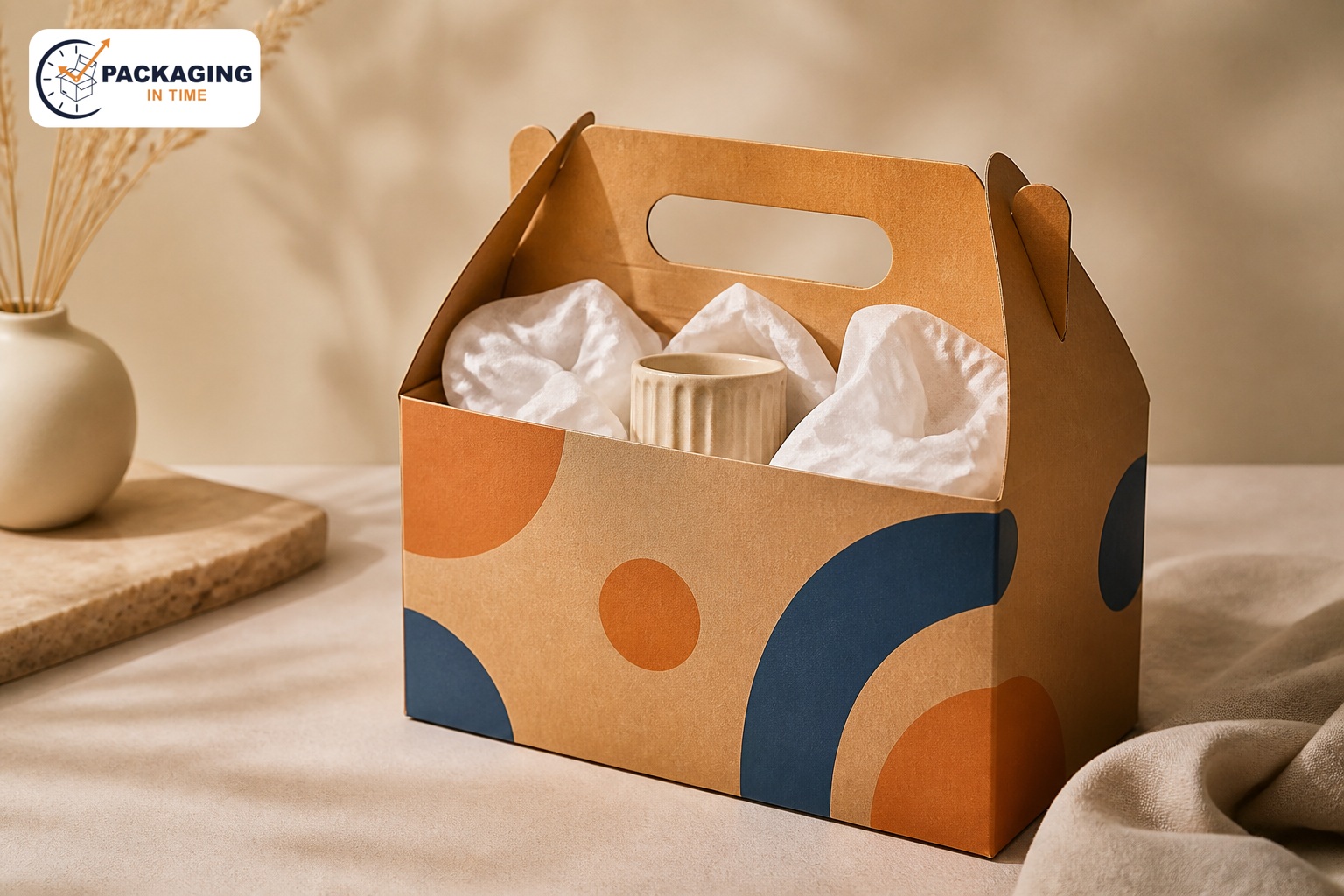
Custom gable boxes combine a container with a built-in carrying handle. The signature peaked top gives a package an immediate takeaway, gift or event character, while the upright panels create useful surfaces for brand artwork. Brands use the format for party favours, collection packs, small retail bundles, bakery takeaways, catered-event kits and lightweight promotional items. The familiar form is only the start of the specification, however.
A gable box has to support the contents, close correctly, remain comfortable to carry and arrive in a condition that matches the customer experience. The best design comes from identifying the product, packed load, package layer, carrying distance and route to the customer before selecting board, size, closure or finish.
For a buyer, the important decision is not whether a gable silhouette is attractive. It is whether this particular handled structure is the right tool for the job. A pack collected from a counter and carried a short distance has a different risk profile from a pre-packed retail bundle, a food-service order, a promotional gift delivered to an event or a product moving through a parcel network.
The outer package may look similar in each situation, but the product retention, handle stress, food-contact requirements, shipping protection and printing needs can change substantially. This guide gives a practical framework for defining those differences and for turning them into a more complete packaging brief.
What is a custom gable box
A gable box is a folding package with two upper panels that rise and meet to form a handle. It is commonly die-cut from a single blank, supplied flat and assembled by folding the base, sides and top panels into a contained package.
The handle may lock through slots, fold into an interlocking configuration or use another closure designed for the chosen structure. The base holds the product; the upper gable creates the carrying feature and completes the visual shape.
Because the handle is part of the box rather than an attached accessory, the board, scoring, locks and loaded weight must be considered together. A product that fits comfortably inside can still make the overall pack unsuitable if it strains the handle or distorts the upper panels.
The term describes a structural format, not a universal performance class. A gable box can be a consumer-facing outer pack, a carry pack around individually wrapped items, a secondary package for a gift assortment or a takeaway container for a defined product application.
It is not automatically a direct food-contact pack, a transit-tested shipper, a child-resistant package, a sustainable option or a solution for heavy contents. Those properties arise only when the actual material, components, product, loading method, claims and testing support them.
Keeping the gable box in its correct package layer is the simplest way to avoid asking a decorative carry pack to perform a job that needs a separate product carton or outer shipping case.
A useful packaging map usually has three layers. The product layer contains or directly protects the individual item. The gable box may group and present several items while allowing a customer to carry the purchase.
A master shipper, if needed, protects the packed gable boxes through warehouse and distribution handling. In a food-service setting, an inner wrap, tray or liner may sit between the food and outer gable structure. In a retail gift setting, tissue, an insert or dividers can separate the items within the gable box.
Once these components are stated separately, it becomes much easier to assign the right approval, label, material and performance requirements to each one.
Where gable boxes fit well
Gift sets and retail bundles
Gable boxes suit small gift assortments where a customer benefits from a ready-to-carry presentation. The peaked handle makes the package feel purposeful at collection, and the front and side panels can introduce the brand, occasion or product collection.
The format can work for a single product with supporting samples, a small set of individually boxed goods or a limited campaign bundle. Product arrangement matters: packs should sit in a stable orientation, use the available interior height and leave enough clearance for the upper panels to close without crushing the contents.
An interior insert, folded card or tissue layer can improve the opening experience, but it should be specified as part of the complete pack-out rather than added after the box dimensions are finalised.
The gable format is not automatically the best choice for every gift. A heavy, fragile or high-value item may need a stronger rigid structure, a fitted insert, a separate handle solution or a protective transport case.
A gable box is particularly effective when the customer is meant to collect, carry and open the package soon after purchase. If the product will sit for a long period in a premium display or needs a perfectly rectangular presentation, another box style may be more appropriate.
Define whether the carry experience, the gift reveal, the shelf display or the delivery route is the priority, then select a structure that supports that priority rather than forcing one format to do everything.
Events, samples and promotional packs
For events, gable boxes can organize a welcome pack, party favor, sample selection or staff kit into a portable format. The exterior can be tailored to an occasion, while the handle helps attendees carry the package without an additional bag.
Event use adds its own operational questions: who assembles the boxes, where products are loaded, how long packages wait before distribution, whether the venue is humid or crowded, and whether users will carry the pack alongside other items.
A visually strong box that is slow to erect or difficult to close at scale can create pressure during event preparation. Request an assembly sample and ask the real packing team to complete the intended sequence before confirming the final structure.
Promotional packs often contain products with different dimensions. Treat the interior as a layout problem, not a void to be filled with loose items. Record the dimensions, weight and breakability of each component, identify which item should be visible when the box opens, and decide whether a divider, insert or paper fill is needed.
Loose promotional materials can shift, scuff each other and put uneven stress on the box during carrying. A simple partition may help keep a collection orderly, but it also affects packing time and the internal dimensions available to the product.
The right solution is the one that gives users a tidy, usable experience without adding complexity that the event team cannot execute reliably.
Food service and takeaway use
Gable boxes are often considered for bakery, confectionery and takeaway presentations because they are easy to carry and can be printed for a branded handoff. The specification needs an extra step in these applications: separate food that is sealed or wrapped from food that directly contacts a packaging component.
If the gable box simply carries wrapped goods, the outer board may have a different role from a tray, liner, bag or wrap that touches the food. If food may contact the box, coatings, inks, adhesives, paperboard and any windows must be assessed for the intended food, time and temperature conditions. The word food-safe alone does not explain those conditions or provide the required evidence.
Takeaway usage also changes the mechanical brief. Warm products, moisture, sauces, grease, stacked contents and short-distance carrying can affect board behavior, closure retention and the customer's experience. A generic gable box should not be assumed to suit every prepared-food application.
Use the actual filled product, including likely temperature and moisture conditions, when reviewing samples. Check whether the base stays flat, whether upper panels remain dry enough to close, whether a liner is required and whether the customer can carry the pack without the handle tearing or the contents moving. Any food-contact documentation should be obtained for the complete relevant material system and conditions of use.
The handle is a structural feature
The handle is the highest-stress part of a typical gable box. When a customer lifts the package, the load transfers from the base through the side walls and upper panels to the handle bridges and locking points.
The result depends on the packed weight, center of gravity, handle width, board stiffness, score quality, humidity, closure geometry and how the package is carried. A box may feel secure when empty yet deform as soon as a concentrated product load is added.
Handles should therefore be evaluated with the real heaviest pack configuration, not with a nominal weight estimate or a digitally rendered model.
A balanced load makes a gable box easier to carry and reduces uneven stress. If one product is tall, dense or positioned near a side wall, it can pull the base out of square or put more force on one handle bridge.
Interior dividers, a different product orientation or an adjusted box footprint may improve the balance. The customer path matters too. A pack carried a few metres from a counter has different demands from a package that may be held in a queue, carried outdoors or passed between people.
If the required carrying distance, repeated handling or total load is significant, include those conditions in the prototype review and consider whether a separate bag, reinforced structure or alternative format is more suitable.
Handle slots, locking tabs and cut-outs need careful dieline control. Very narrow bridges can look delicate but may reduce tear resistance; overly tight locking points can make the box awkward to close; loose locks can allow the top to open when lifted.
Printing and finishing around a score or handle opening can also influence the visible condition of a repeatedly handled pack. Keep essential small text away from high-flex areas, cut edges and handle openings. If an upper panel carries a logo, confirm how it looks when the handle is raised, when the box is closed, and when the package is viewed from the side. The structural and visual reviews should happen together because customers experience both at the same moment.
Material selection and board behavior
Paperboard is often selected for smaller, lightweight gable boxes because it folds precisely and provides a clean print surface. It can support detailed graphics, color work and a crisp gift or retail appearance when the product load and route are suitable.
Corrugated board can add stiffness and cushioning for larger or more protective carry packs, though it has a different visual texture and may require a different print approach. Kraft-look board can create a natural fibre appearance, while coated white board may be chosen for particular color reproduction or finish requirements.
None of these material descriptions substitutes for an assessment of the actual size, packed weight, handle geometry, humidity exposure, pack-out and shipping method.
A board choice should be discussed in terms of the job it performs. Does the structure need to stand upright on a counter? Does it need to resist a wet or humid environment? Does a large front panel need to remain flat for a campaign image?
Does the gable box ship flat, assembled empty, loaded with product or inside a master carton? Is the package carried once or handled repeatedly? These questions identify the loads and surfaces that matter. Selecting a board only because it appears premium, sturdy or eco-friendly can create a mismatch between expectation and performance. A packaging supplier can make a more useful recommendation when those operational details accompany the aesthetic direction.
Material claims deserve the same precision. Paper-based packaging may have a recovery route in some locations, but windows, coatings, adhesives, printing, product contamination and the local collection system can affect end-of-life outcomes. Recycled content or fibre certification must be supported by relevant documentation and the actual supplied material.
Do not represent a gable box as broadly recyclable, compostable or sustainably sourced without defining the attribute, scope and conditions. Specific, substantiated language is more credible than a broad label and allows a brand to communicate accurately across the markets where the pack will be used.
Dimensions, product fit and internal layout
Begin the size brief with the product rather than a stock-looking box. Measure the finished outer dimensions, weight and vulnerable features of each item that will sit inside. Include labels, caps, closures, pouches, seals, individual cartons and any component likely to add to the true footprint.
Record whether the contents need to remain upright, whether a customer should see a particular face when the box opens and whether the products are likely to vary by SKU. Then add reasonable clearance for loading, internal presentation and closure. A box that barely accommodates its contents can be difficult to pack and can place unnecessary force on the side walls or gable panels.
Internal length, width and depth should be written clearly in the quote request, along with the maximum product height below the handle area. Gable geometry reduces usable space at the top, so the internal rectangular base does not tell the entire story. A tall bottle, jar or carton may fit within the nominal height but interfere with the folding top panels.
Build a sample with the actual contents and close it as it will be closed in production. Check for contact at the handle, crushing at corners, pressure on closures and gaps that let products move. If tissue, shred, dividers, a window or an insert are part of the intended experience, include them during this fit test.
The internal layout should also account for the order in which products are loaded and removed. For a gift set, the hero item might sit centred under the handle with supporting items beside it. For a food-service pack, an insert may keep a container level. For event kits, paperwork may need to rest flat above or below the product.
Avoid relying on loose fill to control a large, heavy item; it can compress or shift during carrying. A fitted insert can improve presentation and stability, but it should not make packing impractically slow. The aim is an internal arrangement that is repeatable for the production team and intuitive for the customer when the handle is opened.
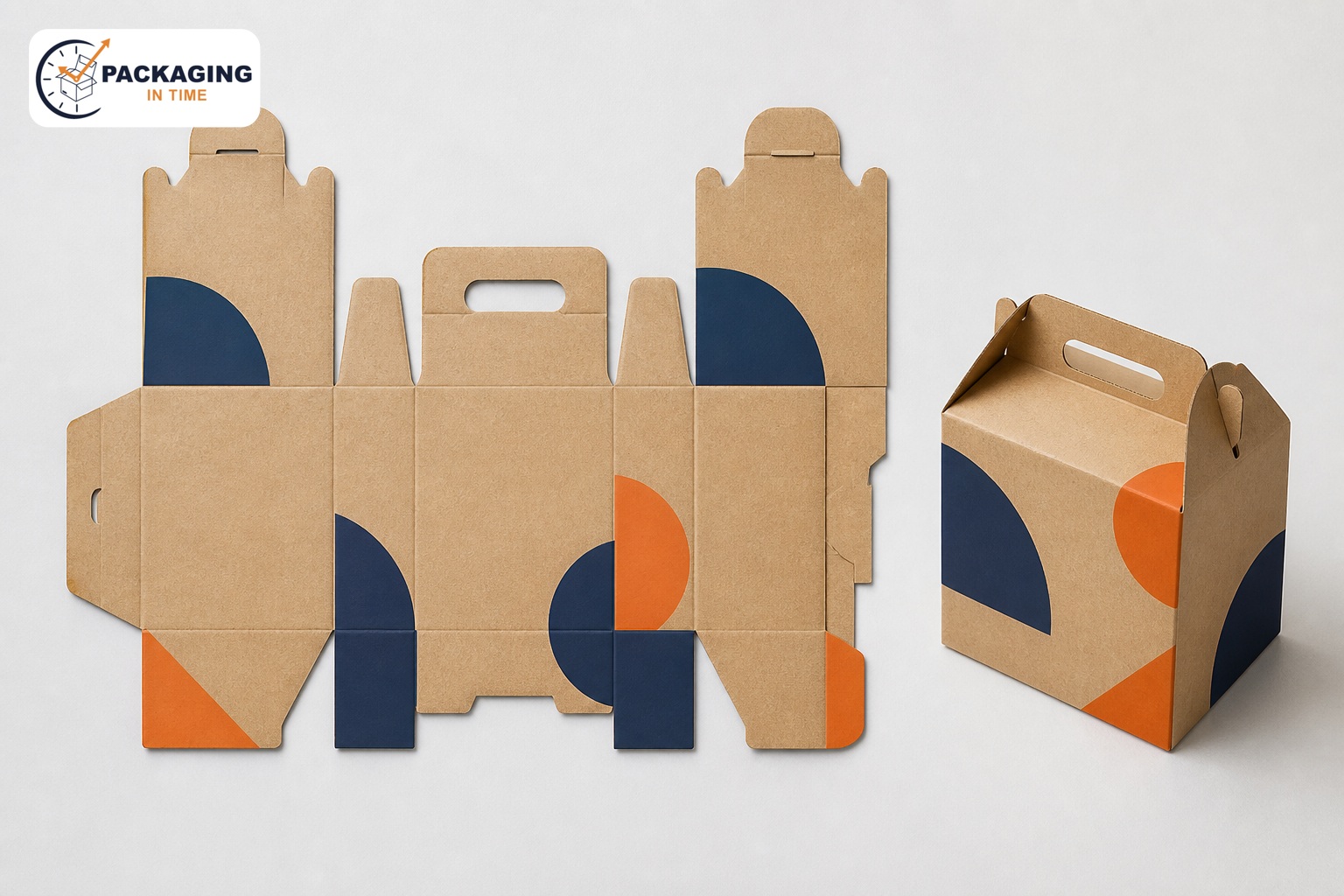
Construction reference: a flat gable-box blank and the assembled handled package.
Closures, windows and inserts
Closure design governs both security and ease of use. Interlocking gable handles can create a neat all-board closure, but they need enough engagement to stay closed under the intended carrying load. Tuck tabs can be practical for some structures, while adhesive closures may be considered for a particular permanent or semi-permanent assembly process.
The correct method depends on whether the customer needs to reopen the box, whether the pack is loaded by hand or machinery, and whether the closure is expected to resist repeated handling. Confirm the sequence with a physical sample. A closure that is clear in a flat dieline may be awkward for an event team or retail associate working quickly.
Windows can create product visibility but add separate material, adhesive and production considerations. They may be useful where a customer needs to see a wrapped product, a gift assortment or a color variation before purchase.
A window should not be placed where it weakens a stressed handle panel or exposes a product to conditions it cannot tolerate. It can also alter the recovery pathway of the finished pack, so environmental statements should reflect the full construction rather than only the board. If product visibility is the main requirement, compare a windowed gable design with a different format that presents the product openly while still providing the appropriate protection.
Inserts, dividers and tissue can turn a simple carry pack into a more controlled presentation. A divider can keep variants separated, prevent products from colliding and make an assortment easier to understand. Tissue can soften the opening reveal and reduce minor abrasion for some items.
Neither is a substitute for fit: products should remain stable even after a customer removes a layer of tissue or takes one item from a set. Identify whether the insert is supplied flat, pre-assembled or packed with the product, because this affects operations and quotation. Any added component should have a defined material, dimension, position and purpose rather than being described only as premium packaging fill.
Printing, artwork and finishing
Gable boxes have several useful artwork panels: front and side faces, the sloped upper panels and, in some designs, an interior reveal. The dieline is the authority for where print can appear. Mark cut lines, scores, folds, glue areas, lock tabs, handle openings and any non-print zones before beginning final artwork.
Keep critical brand names, product information and fine details clear of high-flex regions. A design that looks balanced on a rectangular mock-up can become distorted when the upper panels fold together or when a handle is raised. Review the artwork in both flat and assembled positions, including the normal viewing angle at retail or handoff.
The most effective print hierarchy usually starts with the core brand or occasion message, then identifies the product or assortment, then supports the opening experience with secondary details. A gable box may be seen at distance on a counter, close-up in a customer's hand and later at home after the product is opened.
Artwork should remain coherent across those moments. If several variants use one structure, establish a repeatable system for color, iconography or naming so packing teams and customers can distinguish them. Do not place a barcode, legal copy or other essential operational information in a fold, on the underside of a handle or across a cut-out where scanning or reading becomes unreliable.
Finishes should be selected for a named purpose, such as color appearance, rub resistance, tactile contrast or a focal brand detail. Foil, coatings, films, embossing and other treatments can affect cost, scuff visibility, print preparation and the finished construction.
A proof is useful for checking artwork content, but a physical sample is more reliable for assessing the board feel, closure action, handle comfort, real lighting and handling wear. Where color accuracy is important, review a production-representative proof on the intended substrate. Do not assume that a finish used on a different board or box style will behave the same way on a handled gable structure.
Product cartons and the carrying layer
In many retail applications, a gable box is an outer carrying layer around individual saleable products. The individual carton still needs to identify the product, carry the necessary information and remain presentable after a customer removes it from the gable box.
The gable exterior can focus on the collection, campaign or gifting occasion instead of duplicating every detail from the product pack. Brands building both layers can use a approach to define the individual shopper unit first, then arrange those units inside the chosen handled presentation.
This separation makes the packaging system easier to maintain. A product formula, variant name or required label can change on the individual pack without forcing a complete redesign of a generic seasonal carry box, provided the items still fit and the arrangement remains appropriate. Conversely, a campaign gable box can change its artwork for a particular event while the saleable product cartons remain consistent.
Document which information belongs on each layer, which stakeholder approves it and which files control the production version. This protects against a common error: assuming an outer gift or carry package replaces information that a shopper must have once the product is used or separated from the set.
Food contact, claims and category-specific checks
When a gable box is considered for food, begin by identifying the actual food-contact boundary. A box carrying sealed confectionery has a different material role from a box holding unwrapped baked goods, hot food or products with oily or wet surfaces. The board, coating, printing, adhesive, liner, window and any insert may each need consideration based on the food and conditions of use.
The appropriate evidence comes from the relevant material documentation and application review. Statements such as food-grade or FDA-compliant can be misleading if they do not specify which component, food type, contact condition and market requirement they address.
Product categories can add other requirements. Cosmetics may need protection from scuffing or leakage; pharmaceutical or regulated products can require controlled labels and tamper-evidence decisions; CBD products may be subject to jurisdictional and retailer rules; a children's product may need packaging reviewed for a particular safety context.
A gable shape does not supply these properties by itself. Keep product labels, claims, warnings, child-safety decisions and retailer rules under the appropriate product-specific review. The gable box can support the customer experience, but it should not obscure required information or make a claim the product owner cannot substantiate.
Barcode treatment is another packaging-layer decision. An individual retail unit may need a GS1 barcode in a defined location and quality condition, while an outer shipping case may require a different identifier. The gable box may or may not need a code depending on the retailer and sales model.
If a barcode is printed on the gable box, reserve a flat, high-contrast area with appropriate quiet zones and avoid scores, curves, cuts and high-scuff locations. Final verification should consider the actual board, ink, coating, placement and intended scanning environment rather than relying only on how the code looks in artwork.
Distribution, parcel transit and delivery
A gable box designed for customer carry should not automatically be treated as the outer package for parcel delivery. Parcel networks can expose packs to drops, compression, vibration, changing orientation and interactions with other shipments. A handle that works perfectly for a short handoff may catch or crush when it moves through an uncontrolled route.
If the product is sold online, use a transport component designed for that delivery environment and evaluate the full configuration: product, gable box, protective material, outer shipper, pack-out and expected route. The test and specification should reflect the actual configuration, not a broadly similar package from a previous campaign.
For direct-to-consumer fulfilment, the gable box may still be valuable as an interior presentation layer. It can create the intended unboxing or gifting moment after the outer delivery packaging has protected the order. In that case, keep the roles clear: a solution can be considered for the parcel layer, while the gable box carries the presentation and short-distance handling role inside the shipment.
This separation can reduce the temptation to over-engineer the gable handle for a transit job it was not designed to perform.
Distribution planning also applies to retail and event deliveries. Decide whether gable boxes ship flat to a packing location, pre-assembled empty, loaded with products or within an outer master case. Flat shipment can reduce cube but shifts assembly work to the destination.
Pre-assembled boxes can simplify packing but use more transport volume. Loaded presentation packs need protection for their upper panels, handles, windows and printed surfaces. Compare the whole process, including warehouse storage, assembly time, outer-case fit, pallet pattern and final handoff, before choosing the configuration. The cheapest flat blank is not necessarily the most efficient delivered packaging system.
Store operations and the customer handoff
The moment a customer receives a gable box is an operational moment as well as a branding moment. In a retail environment, staff may need to assemble the box, load products, close the handle and hand it over during a busy period. A design with several ambiguous folds, loose locking points or an insert that has no obvious orientation can cause inconsistent presentation from one store or shift to another.
Work through the real sequence from flat blank to filled package. Identify which panel is folded first, where the product sits, when tissue or an insert is added, how the closure engages and how staff confirm that the handle is secure. A simple assembly guide can be valuable for a multi-location rollout, but it should be based on the approved production dieline and a process the team can actually complete.
The final handoff also affects what should be visible. If the box is collected at a counter, the front panel, handle position and product arrangement should look finished from the customer's side of the transaction. If it is placed on a display table, the box may need to stand reliably when partly filled and allow customers to lift it without disturbing nearby packages.
If it is used as a party favor, the name or occasion detail may need to be readable while boxes are arranged in rows. Consider how the gable top changes the silhouette when packages are packed together. A tall handle can create a strong presence, but it can also limit stacking, obstruct a view or make it harder to fit the pack into a secondary bag or master case.
Replenishment and returns should not be forgotten. For a retail bundle made in store, staff need access to replacement components, correct product counts and an approved way to manage any damaged or incomplete package.
For event packs, a partly assembled box may need to be stored temporarily without losing its shape. For food service, a customer may carry the box only briefly, but staff still need a repeatable closure check before handoff. The better the package design reflects these everyday actions, the less likely it is that a visually good box will be undermined by misfolded handles, inconsistent product orientation or a rushed assembly process.
Cost drivers and specification choices
A gable-box price is shaped by the full specification, not just the printed dimensions. Structure complexity, board type, print coverage, number of colors, coatings, foils, windows, inserts, assembly expectations, quantity, delivery destination and the need for master cases can each affect the commercial outcome.
An added divider may protect a fragile product but increase material and packing time; a larger handle opening may improve comfort but change board use and structure; an elaborate interior print may improve a campaign but require a different production approach.
Compare these choices against the customer experience and handling benefit they provide. It is more useful to value a feature by the role it serves than to add it because it appears on a visual reference.
When considering variants, look for opportunities to reuse a proven structural platform while changing the artwork or internal pack-out only where the product fit remains valid. This can make a seasonal series or event range easier to manage, but it should not override load and dimension checks.
A new product that is slightly taller, heavier or less stable can change handle stress and closure clearance even if it looks similar to the original set. Maintain a controlled record of the approved structure, product configuration and artwork version. That record gives procurement teams a clear basis for reorders and helps suppliers identify when a proposed update requires a new sample rather than a simple print-file change.
Prototype and approve the complete experience
A physical prototype should test more than whether the product fits. Load the intended product count, close the upper panels, lift the box by the handle, carry it in a realistic way and set it down repeatedly. Check the base, side walls, handle bridges, closure locks and any dividers.
Review an empty box and a fully loaded box because the structural behavior changes under weight. If several SKUs are intended, test the heaviest and least stable variants. If the package may encounter moisture, warmth or long dwell time before handoff, include representative conditions in the evaluation. Record the result and any limitation so the approved structure is tied to its real use case.
The artwork sample deserves the same attention. Assemble the printed sample, assess the brand hierarchy when the box is closed and open, inspect critical type near folds, and look for visible scuffing at the handle and front panels.
If a barcode, legal copy or retailer mark appears on the pack, verify its position with the final substrate and finish. For food or regulated applications, route the relevant materials and claims through the appropriate review before production.
The final release should identify the dieline revision, board or material specification, print files, inserts, product configuration, assembly process, outer-case arrangement and approved sample. Changes to any of these inputs should trigger a focused review rather than being treated as a minor artwork adjustment.
Frequently asked questions
Are gable boxes strong enough for heavy products?
They can be designed for a defined moderate load, but strength depends on board, dimensions, handle geometry, closure, product arrangement and conditions of use. Test the actual heaviest packed configuration. Heavy, fragile or parcel-shipped products may need an outer shipping case, reinforcement or another package format.
Can gable boxes be used for food?
They can carry sealed or wrapped food, and some configurations may be specified for intended food-contact use. The food, contact time, temperature, board, coatings, inks, adhesives, liners and local requirements all matter. Confirm the relevant material documentation for the actual application.
What size gable box do I need?
Start with the finished product dimensions, product count, clearance for loading and the usable height below the gable panels. Build a sample with all intended components, including any insert or tissue, then check that the top closes without crushing or stressing the contents.
Can I print inside a gable box?
Interior printing can be used where it improves the opening experience. Confirm the usable panels, closure overlap, print method and whether the interior might contact a product or food layer before finalising the artwork.
Can gable boxes be shipped through parcel delivery?
A gable box may be an interior presentation layer, but it should not be assumed to be the outer parcel shipper. Use a transport component designed for the route and assess the complete packed configuration when delivery performance is important.
Are gable boxes recyclable?
The answer depends on the finished materials, coatings, adhesives, windows, contamination and local collection capability. Use specific, supportable language for the configuration and market rather than an unqualified environmental claim.
Does the handle need a special test?
The handle should be reviewed by lifting and carrying the real loaded package under representative conditions. If testing is specified, document the configuration, method and result. A result for another size or product weight should not be treated as evidence for a new pack.
What improves quote accuracy?
Provide product dimensions and weight, inside dimensions, package role, handle and closure requirements, materials, artwork, insert needs, delivery route, quantity and destination. A sample or product photo can further help a supplier recommend the right structure.
Design the handle and the whole package system together
A custom gable box works best when its carrying feature, contents and presentation are designed as one system. The product must fit and stay stable, the handle must suit the loaded pack, the closure must work for the real assembly process and the material must match the retail, event, food-service or gifting role.
Graphics can then use the distinctive gable form to create a strong handoff moment without asking decoration to solve a structural problem. Clear inputs, a physical sample and controlled approval are the route to a package that feels easy and dependable in the customer's hand.
Define the package layer and route first, then choose the dimensions, board, closure, print and internal components. This order keeps claims about food contact, delivery performance and environmental attributes tied to evidence rather than to assumptions.
With a complete brief, packaging designers and suppliers can develop a gable box that protects the intended contents, supports the desired brand experience and remains workable from packing through final carry.