
A practical guide from Packaging in Time to help you choose better materials, structure, printing, and finishing for custom boxes.
What Are Custom CBD and Hemp Boxes?
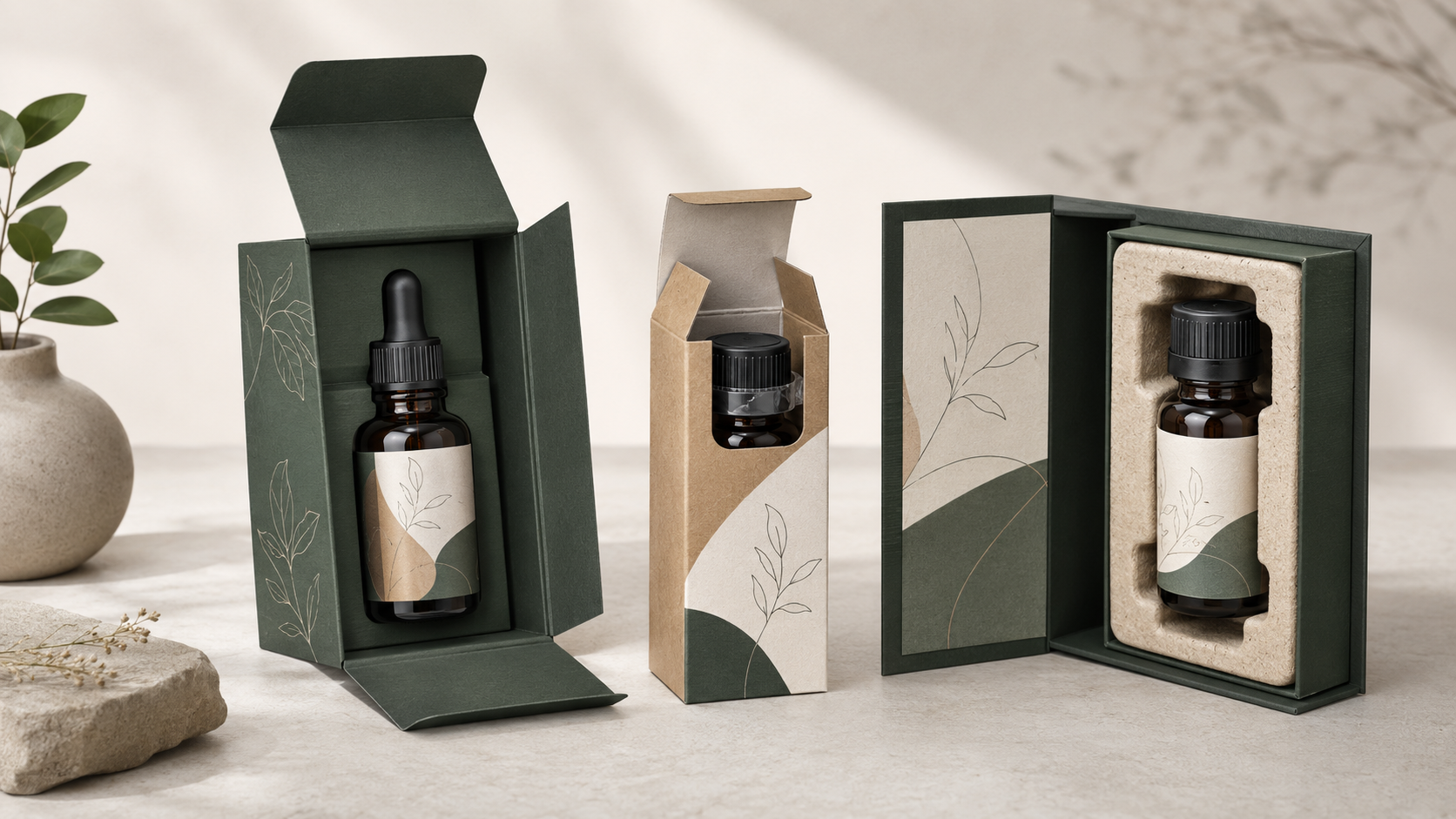
Custom CBD and hemp boxes are product-specific packages made around a defined primary container. A bottle, jar, tube, pouch, or device is the primary package because it directly holds the product. A folding carton or rigid box around it is usually the secondary package. A corrugated case that carries multiple finished cartons through a carrier network is a tertiary or shipping package. Each layer solves a different problem.
The primary container controls closure integrity, compatibility, and direct contact with the product. The retail carton provides brand space, a predictable shelf shape, product information panels, and surface protection. The outer shipper manages pack count, stacking, vibration, abrasion, and drop exposure. Treating one layer as a replacement for another is a common source of damaged product and unclear requirements.
For instance, a 30 mL glass dropper bottle may need a small folding carton with a paperboard neck collar for shelf presentation. That same carton may still travel inside a corrugated mailer with void control. A rigid gift box can improve a launch-kit presentation, but it still needs a shipping method designed for carrier handling. The package specification starts by naming every layer and its job.
Why Does the Destination Market Change the Specification?
CBD and hemp are not one packaging category under a single national design rule. The product format, intended use, sales route, and destination can change required copy, symbols, warning space, closure expectations, laboratory-information workflow, and retailer acceptance. An artwork file should therefore include its market, product SKU, version number, approver, and effective date.
Do not use a carton as evidence that a product is lawful in a location. FDA explains that products containing cannabis-derived compounds remain subject to applicable federal requirements, even if the material meets the federal hemp definition. FDA also distinguishes specific approved drug products from products broadly marketed as CBD. A carton should not carry unapproved disease-treatment or FDA-approval claims. The person responsible for the product must approve all regulated language before print.
State and local rules can change. For that reason, a production brief should state the destination market before a dieline is approved. A brand selling into several markets may need controlled artwork versions rather than one generic carton with crowded copy. This approach reduces the chance that outdated mandatory text becomes inventory that cannot be used.
Which CBD and Hemp Box Structures Fit Different Products?
No box style is best for every CBD or hemp item. The right choice follows the product geometry, filled weight, sales channel, decoration level, packing method, and expected handling.
Tuck-End and Auto-Bottom Folding Cartons
Tuck-end folding cartons suit many bottles, jars, tubes, and small topical products. They ship flat, use a die-cut paperboard blank, and are erected during filling or packing. Straight tuck ends place the top and bottom closures on the same side of the carton. Reverse tuck ends place them on opposite sides. Both can work for lightweight retail products when the closure and board selection match the product.
An auto-bottom or crash-lock carton has a pre-glued base that opens into a locking bottom. It can speed hand packing and may suit a heavier bottle than a standard tuck closure, but the final choice depends on the filled weight, base footprint, packing direction, and test sample. A stronger-looking closure does not eliminate the need for an insert or outer shipper.
Folding cartons are useful when the product needs clear printed panels, several SKU versions, and economical flat storage. They can support CMYK graphics, spot colors, white ink on darker boards, and selected finishes. The tradeoff is that a paperboard carton has limited impact resistance by itself. A heavy glass vessel needs controlled clearance and, in many cases, a retaining feature.
Sleeves, Trays, and Drawer Boxes
A sleeve slides over a tray or product card. It can give a small jar, topical tube, or kit a clean opening sequence while keeping the product accessible. A tray-and-sleeve box uses two components, so it needs a clear assembly plan, pull direction, friction check, and barcode location. The tray must not bind after coating, humidity changes, or small product-tolerance shifts.
Drawer boxes use an outer shell and an inner tray. They work for gift sets and higher-value programs that need a reveal sequence, but they require more material, assembly, and storage than a basic carton. Before choosing a drawer box, test product removal, tray travel, insert grip, ribbon function, and the chance that a bottle rotates during transit.
Rigid Gift Boxes and Subscription Presentation Boxes
Rigid set-up boxes use a thick greyboard structure wrapped with printed or colored paper. They are normally shipped assembled and do not collapse like folding cartons. That fixed form can support a premium presentation, a multi-unit kit, or a subscription gift, especially when a tray or divider holds each component in a set position.
The cost and logistics tradeoff matters. Rigid boxes take more warehouse volume, have several material components, and need a planned outer shipper. Magnetic closures, ribbons, foam, and laminated wraps can also change recycling instructions. Specify the product and end-of-life objective before calling a finished rigid box recyclable or sustainable.
Window Boxes and Display Trays
A window can show a bottle color, a jar, or a pump shape without opening the carton. It adds a die-cut aperture, a film or open edge, adhesive, and a strength decision. Large windows remove board area from a side panel and can make a carton more prone to buckling. A physical sample should test whether the product looks centered, whether it rotates, and whether the window scratches in retail handling.
Display trays and PDQ-style units are for retailer or dispensary presentation. Their dimensions, case pack, shelf lip, product-facing count, replenishment method, and retailer barcode requirements need confirmation from the destination channel. A display can hold individual cartons, but it is not automatically a transport case.
Corrugated Mailers and Master Cases
Corrugated mailers support direct-to-consumer fulfillment. Their fluted structure adds stiffness and protects the retail carton from routine transit. The mailer still needs a packout plan for movement, compression, and product leakage. A master case supports wholesale shipment and must be built around finished pack count, stacked load, pallet pattern, and the route to market.

How Do Product Formats Change the Box Design?
The best time to specify the box is after measuring the final production product. A digitally drawn bottle or an empty sample may not represent the filled height, label edge, cap profile, pump lock, tamper band, or center of gravity. Use the heaviest, tallest, widest, most fragile, and most leak-prone approved product variant in the sample process.
Dropper Bottles, Pumps, and Glass Jars
Glass dropper bottles concentrate weight at a small base and can strike the carton wall when there is too much clearance. A paperboard base lock, neck collar, molded-pulp cavity, or well-designed insert can restrain the bottle. The insert must protect the label and cap while allowing practical removal. It should not squeeze a glass shoulder or push against a dropper bulb.
Pump bottles add height and a possible lock position. Their carton needs enough headspace to avoid loading the actuator. Jars can be short and heavy, which increases base stress and carton tipping risk. Measure the jar lid as part of the product. A tight box can scuff a metallic lid or loosen it during packing; an oversized box lets it rotate.
Tubes, Topicals, and Personal-Care Products
Topical tubes often work in narrower cartons, but their crimp, cap, and sealed shoulder need clearance. A carton can include a paperboard platform or a folded divider for a tube and accessory. It should not bend a flexible tube into a shape it cannot recover from. If the product may leak, orient the primary container according to the manufacturer's approved handling direction and test it in the intended packout.
The package must not imply that a topical is a drug, an approved treatment, or medically proven unless the product team has established that specific claim. The carton is a printing surface, not a substitute for a regulatory review.
Vape Hardware and Fragile Accessories
Hardware, glass components, chargers, and small accessories need a different engineering brief. Product fragility, battery transport status, ESD need, accessory count, protective film, and retailer rules must be confirmed for the actual item. A paperboard divider might separate components. A molded tray could control a device cavity. The relevant hazard is not the name of the product category but how its parts move, crush, scratch, or create regulatory obligations.
Multi-Unit Kits and Sample Sets
Sets can combine bottles, jars, tubes, information cards, and accessories. The insert is the organizing structure. It sets cavity location, removal force, product order, and load distribution. A kit needs sampling with every component installed. Leaving one accessory out during a test can change the space around every other item.
What Do Child-Resistant and Tamper-Evident Packaging Mean?
These terms are often used together, but they describe different functions. Keeping them separate makes procurement and artwork more accurate.
Why an Outer Carton Is Not Automatically Child-Resistant
Under the CPSC framework, special packaging is designed to be significantly difficult for children under five to open or obtain a harmful amount within a reasonable time, while remaining usable by normal adults. The applicable regulation contains performance and test requirements. A printed statement, a difficult tuck flap, or a carton with a warning icon does not establish that performance.
The relevant package layer matters. CPSC's special-packaging guidance says it does not approve or certify a particular package. Where a product requires child-resistant packaging under a specific rule or state program, the brand must identify the actual closure, exit bag, pouch, or whole-package system that carries the claim and maintain the appropriate validation. If an outer carton is not part of that child-resistant design, do not market it as child-resistant.
Closures, Exit Bags, and Whole-Package Validation
Some products use a push-and-turn cap, a squeeze-and-turn closure, a child-resistant pouch, or an exit bag. The box can be built around that primary package. It may protect the closure from damage, hold the container upright, and reserve required label space. It does not replace the approved access-control component.
For a claim that applies to the whole package, validate the actual closed package in its market configuration. A cap sample tested without the carton may not represent a system that requires the carton to remain attached. The opposite is also true. The brief should identify the claimed package layer, test or validation owner, required documents, and the approved final closure supplier.
Shrink Bands, Seals, and Other Opening Evidence
Tamper-evident packaging provides visible evidence that a package has been opened or altered. Examples include a shrink band around a cap, a neck seal, a perforated label, a tear strip, or a sealed pouch. The feature must be specified with the primary package and packing process. The retail carton can show or protect the feature, but it is not necessarily the feature itself.
Avoid calling every seal tamper-proof. It may deter casual opening or show evidence after opening, but it is not a promise that no interference is possible. The product manufacturer should define the required language and approve the final construction.
Which Materials and Inserts Work for CBD Packaging?
Board choice changes print quality, fold response, stiffness, surface feel, and end-of-life options. The selection should follow product weight and channel conditions, not a broad assumption that one material is safer or greener.
SBS, Kraft, Recycled Board, E-Flute, and Greyboard
SBS is a smooth white paperboard that supports detailed printing and crisp color reproduction. Kraft board has a brown fiber-colored surface that can fit a specific brand treatment, but brown color alone does not prove recycled content, compostability, FSC certification, or lower impact. Recycled paperboard can support an approved recycled-content objective, provided the brand obtains the actual material claim from the supply chain.
E-flute corrugated board adds a fluted medium between liners and can increase rigidity for a mailer or protective presentation carton. Greyboard is used inside many rigid set-up boxes. It gives the box its fixed shape, while wrap paper provides the visible surface. These structures are not interchangeable. A rigid box can present a premium kit, and a corrugated mailer can protect it through transit.
Paperboard Inserts, Molded Pulp, Foam, and Dividers
Paperboard inserts can fold into bases, neck collars, dividers, and platforms. They are useful for flat shipping, simple assembly, and matching the box material system. Molded pulp can form a three-dimensional cavity for a bottle or kit. Foam can cushion delicate components, but it is a separate material with a different recovery pathway. Thermoformed trays can hold consistent cavities where appropriate, but they also add a separate component.
Choose the insert by function. Ask whether it must locate a bottle, prevent rotation, separate multiple jars, cushion an impact, hold an accessory, or create a premium reveal. Then test removal force and shipping performance. An insert that photographs well can still scratch a label or make the product difficult to remove.
Windows, Coatings, and Mixed-Material Decisions
Film windows, foil, lamination, magnets, and adhesives can improve product presentation or surface performance, but they create a mixed-material package. Define the desired functional outcome first. For example, specify scuff resistance for a dark carton, visibility through a window, or moisture resistance during fulfillment. Then confirm whether the finished construction can be separated or accepted by the intended recovery system.
The FTC's environmental marketing guidance requires claims to be truthful and supported. Use qualified language such as recyclable where local facilities accept the finished construction. Do not describe a complex package as eco-friendly simply because it has a kraft surface.
How Should CBD Box Dimensions and Fit Be Specified?
Dimensions should be stated in length, width, and depth, with a clear note that they are internal or external. The important measure is usable internal space after folds, inserts, coatings, and glue areas. Product dimensions must include the cap, pump, shrink band, label seam, and any decorative protrusion.
Internal Dimensions, Product Tolerances, and Headspace
Start with an approved physical product. Record its maximum measured length, width, height, filled weight, and permitted manufacturing tolerance. Next, decide the desired clearance and insert compression. There is no universal extra-space amount because material thickness, board fold behavior, product shape, and packing method all change the result.
Headspace protects a cap, pump, dropper bulb, lid, and label edge from contact with the top closure. Side clearance controls rotation. Base support controls impact transfer. A physical sample should use production-representative materials. A loose unprinted prototype may not show how coating thickness or final insert stock affects fit.
Bottle Retention, Leak Orientation, and Removal Force
Retention should hold the product during normal handling without making it difficult to remove. Check that the product can be inserted without striking a glass shoulder, catching a label edge, or forcing a cap. For a liquid product, use the product manufacturer's approved orientation and evaluate whether the closure and tamper-evident feature remain protected through packing and transit.
Removal force is part of the customer experience. A bottle that falls out can break. A bottle that requires excessive force can cause spills or damage the carton. Finger notches, pull ribbons, and insert openings can improve access, but each needs a test with the exact product.
Retail Box Versus Parcel-Shipping Protection
A retail carton can be designed for shelf handling, but a parcel network adds drops, vibration, compression, and other hazards. For e-commerce, specify an outer mailer, master-carton relationship, void-control material, orientation, and test plan. The ISTA design and testing framework is useful for planning distribution testing around the product and route.
Right-sizing matters because oversized mailers use more material and can increase movement. It can also affect dimensional-weight cost. The solution is not to make every package tight. It is to size the retail carton, insert, and outer shipper around the product and actual handling conditions.
How Are Custom CBD Boxes Printed and Finished?
Print method and decoration should be selected after structure and artwork requirements are clear. The main variables are run length, number of variants, board surface, color targets, fine-detail needs, version control, and finishing.
Digital, Offset, and Flexographic Printing
Digital printing can be useful for lower volumes, multiple artwork versions, and rapid color or copy changes. Offset printing can be used for larger controlled runs and detailed paperboard graphics. Flexographic printing is common in corrugated packaging and can suit mailers and shipping cases. There is no reliable public break-even quantity that applies to every job. Tooling, substrate, coverage, finishing, number of versions, and schedule change the commercial decision.
CMYK, Spot Color, White Ink, and Color Approval
CMYK builds images and many brand colors from process inks. A spot color is separately specified ink. White ink can provide contrast beneath color on a darker board. A color match should be approved using the actual board, print process, proof method, and viewing condition. A digital screen image is useful for copy review but does not guarantee finished color on kraft, coated paperboard, or a foil surface.
Matte, Gloss, Foil, Embossing, Debossing, and Spot UV
Matte, gloss, aqueous coating, varnish, soft-touch surfaces, foil, embossing, debossing, and spot UV all change appearance and handling. A dark soft-touch carton may show fingerprints or scuffs. Foil can crack across a fold or be marked by friction. Embossing needs the right board and location so it does not interfere with a barcode, small type, or carton score.
Use decoration where it has a job. A limited foil mark can help a brand identifier stand out. A protected plain panel may be better for variable data. A final decorated sample should be tested for rub, scuff, fold behavior, closure function, and packout speed before production approval.
Artwork Versions for Markets and Product Variants
A CBD program may have several formulas, scents, potencies, product forms, or market versions. Treat each printed variant as a controlled artwork record. Include an SKU, version, destination market, dieline revision, source file, proof status, approval owner, and effective date. Do not duplicate copy manually between files where a controlled source can be used.
What Label and Compliance Space Should CBD Boxes Reserve?
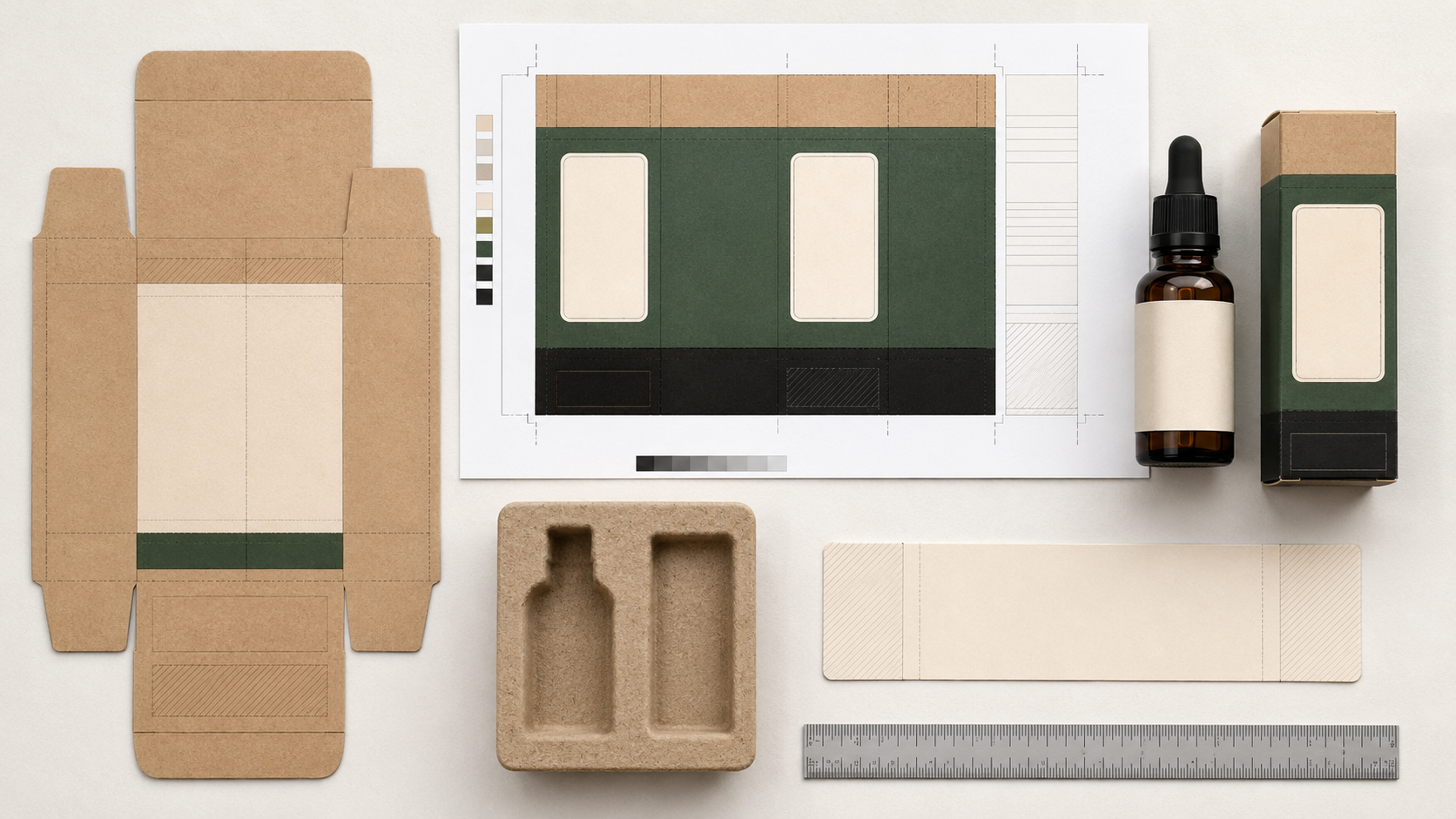
Label planning should happen before graphic decoration. A buyer may want a large logo panel, but legal copy, product identity, net quantity, barcode contrast, warning text, batch identification, and retailer information need readable reserved locations. The brand or responsible person determines what must appear for the product and market. The packaging supplier makes those approved areas printable and structurally usable.
Identity, Net Quantity, Responsible Business Information, and Barcode Areas
The FTC's Fair Packaging and Labeling Act regulations describe basic information for covered household consumer commodities, including identity, responsible business information, and net quantity. The product category matters, and products under FDA jurisdiction follow different routes. Therefore, the safest specification is to identify the governing category and obtain approved copy from the responsible team before print.
A barcode needs a flat, clean area with adequate contrast, quiet zones, and no fold, seam, heavy texture, or reflective decoration that affects scanning. The retailer may also specify orientation, symbology, location, and packaging level. Allow room for these requirements instead of adding a barcode at the end of design.
Batch Codes, Dates, QR Codes, and Laboratory Information
Batch or lot codes, dates, QR codes, and laboratory links can require variable data or a dedicated printed panel. Their placement is not only a design choice. The field must remain readable after coating, folding, handling, and shipment. It should be protected from rub and not be hidden under a tuck flap or shipping label.
QR codes should lead to a controlled destination that the brand maintains. They do not replace required label copy. Any laboratory result, certificate, or product statement accessed through a code must still be reviewed for the applicable market and product type.
Product Claims, Warnings, and Market-Specific Symbols
The safest carton language is specific and approved. Do not use disease-treatment claims, broad medical promises, or statements that imply FDA approval for a general CBD product. FDA states that most consumer CBD products are not FDA-approved drug products and takes action against unsubstantiated therapeutic marketing. A paperboard carton should not make a claim that the underlying product cannot support.
Market-specific symbols, warnings, and age restrictions should be supplied by the brand's legal or compliance reviewer for the destination. These elements change more often than a box structure. Build the artwork process so a region-specific panel can be reviewed and updated without creating a full redesign.
Who Approves the Final Artwork?
The final release should have a clear owner. Packaging, brand, product, regulatory, sales, and retailer teams may all review different parts of the file, but one approval workflow should confirm that the right approved copy is on the right SKU and market version. Keep the signed proof, dieline revision, color reference, sample result, and production file together.
How Do CBD Boxes Perform in Retail, Fulfillment, and Transit?
The customer sees the retail carton. The product team must also account for warehouse bins, shelf replenishment, wholesale case packing, pick-and-pack handling, temperature exposure, and returns. These conditions can change the box before the first print run.
Shelf Handling, Display Trays, and Retailer Requirements
Retailers may require a barcode position, case-pack configuration, shelf-ready tray, printed case label, or display dimensions. Dispensaries can have their own acceptance requirements. Confirm the retailer or channel guide instead of assuming the retail carton will be accepted. A shallow display tray, for example, needs a stable footprint, front-lip height, product-facing count, and replenishment method.
E-Commerce Packout, Dimensional Weight, and Returns
E-commerce orders need a mailer or outer corrugated shipper that fits the retail box with controlled void space. A product with a heavy bottle needs more than a branded mailer. It may need a corrugated divider, wrap, insert, or orientation control. Test the mailer with the actual product, retail carton, and void fill.
Returns create another condition. A carton that opens once and cannot be reclosed may make inspection difficult. A tamper-evident feature may deliberately show opening, which changes whether the product is resalable. Decide the returns policy and packaging evidence requirements before selecting the feature.
Drop, Vibration, Compression, Rub, and Leak Testing
Testing should match the product and channel. A glass bottle program may require a drop, vibration, compression, leak, and closure check. A decorated rigid box may need rub and scuff review. A display tray may need shelf-loading confirmation. The sample should include final board, insert, coating, closure, filled product, and shipper configuration. A digital proof cannot answer these questions.
Which Environmental Claims Need Evidence?
Environmental language should describe an actual attribute. It should not be a color choice or a general brand tone.
Recycled Content, Recyclability, and Material Reduction
Recycled content needs a defined percentage and supply-chain support. Recyclability depends on the complete construction and local collection or processing access. Material reduction can be measured by comparing approved constructions, but it should not weaken the product protection or make damage rates worse. The FTC Green Guides provide the broad standard: claims must be truthful, not misleading, and supported.
FSC Claims and Chain of Custody
FSC certification and logo use are controlled claims. A carton can use FSC-certified material only when the correct chain of custody and claim route support it. Do not add an FSC logo to artwork because the board is described as kraft or paper-based. Confirm certification status and approved label artwork with the responsible supplier.
Windows, Foil, Lamination, Magnets, and Recovery Conditions
A carton with film, foil, lamination, magnetic closures, foam, or a mixed-material insert may be harder to recover through some local systems. That does not make each component unusable. It means the end-of-life statement should match the actual construction and relevant local route. Where separation is possible, design the package so the consumer can understand the components without making a claim the local system cannot support.
What Common CBD Packaging Failures Should Buyers Prevent?
Several failures appear late because the first review focuses on appearance rather than the complete package system.
Unapproved Artwork and Obsolete Jurisdictional Copy
Do not send a file to production without a current version number, destination-market check, approved warning and claim copy, barcode review, and named sign-off owner. Keep market-specific variations separate. A packaging printer can make an accurate copy of the file provided. It cannot decide whether the regulatory content is current.
Loose Bottles, Crushed Corners, and Leaks
Loose fit causes rotation and impact. An overly tight cavity can scuff labels, stress a closure, or slow packout. Crushed corners can result from an underspecified retail carton or a missing outer shipper. Leaks can arise from the primary closure, handling orientation, or a product compatibility issue. Test each layer together.
Hidden Barcodes and Unreadable Variable Data
Avoid variable data areas that cross folds, sit under flaps, or receive heavy texture or foil. Check contrast, quiet space, line readability, and scanner performance on a physical production sample. The retailer's specification controls any specific barcode requirement.
Misleading Child-Resistant or Health Claims
Do not print child-resistant, FDA approved, medically proven, or disease-treatment language unless the responsible product and regulatory team has supplied written support for that exact product, market, and package configuration. These are not decoration choices. They are claims with proof and jurisdictional consequences.
How Do You Order Custom CBD and Hemp Boxes?
The fastest route to a usable quote is a complete technical brief. It reduces rounds of rework and makes the sample more meaningful.
Prepare the Product, Market, and Channel Brief
Provide the product format, primary container drawings or samples, maximum dimensions, filled weight, closure, label location, leak or fragility risk, quantity, destination, sales channel, required date, and artwork status. State whether the item is a single SKU, a kit, a subscription program, or a wholesale display. Name the destination market and the party responsible for regulated copy.
Approve Structure, Dieline, Materials, and Artwork
Select a structure around the product, not a stock picture. Then approve the dieline, internal dimensions, board, insert, print method, finish, and outer shipping method. Reserve barcode, batch-code, warning, and approved market-specific areas before decoration is finalized.
Review Digital Proofs and Physical Samples
A digital proof checks copy, layout, and basic artwork representation. A physical sample checks fit, closure, product removal, insert retention, color, finish, and packout. A pre-production sample can add production-representative materials and decoration. Use the right sample for the question being answered.
Validate Production, Packout, and Reorder Controls
Before production, confirm the signed artwork, product sample, approved color reference, packout procedure, shipping configuration, and reorder file. Record the SKU, dieline revision, board, finish, insert, approved closure, market version, and sample result. This record makes future repeat orders more stable.
Choosing Custom CBD and Hemp Boxes for Your Product and Market
Custom CBD and hemp boxes work best when the package is specified as a system. Start with the actual product and primary container. Then define the market, the sales channel, the intended package layers, the approved label panels, and the protection needed for transit. Select the carton, insert, materials, printing, and finish against those inputs.
Packaging in Time can help turn that brief into a structure, dieline, proof, sample, and production-ready box specification. For a useful quote, share the product dimensions, filled weight, container and closure, quantity, destination, sales channel, required date, and approved artwork status. That information keeps the package focused on real product and market conditions instead of generic claims.