
A practical guide from Packaging in Time to help you choose better materials, structure, printing, and finishing for custom boxes.
What Are Custom Candle Boxes?
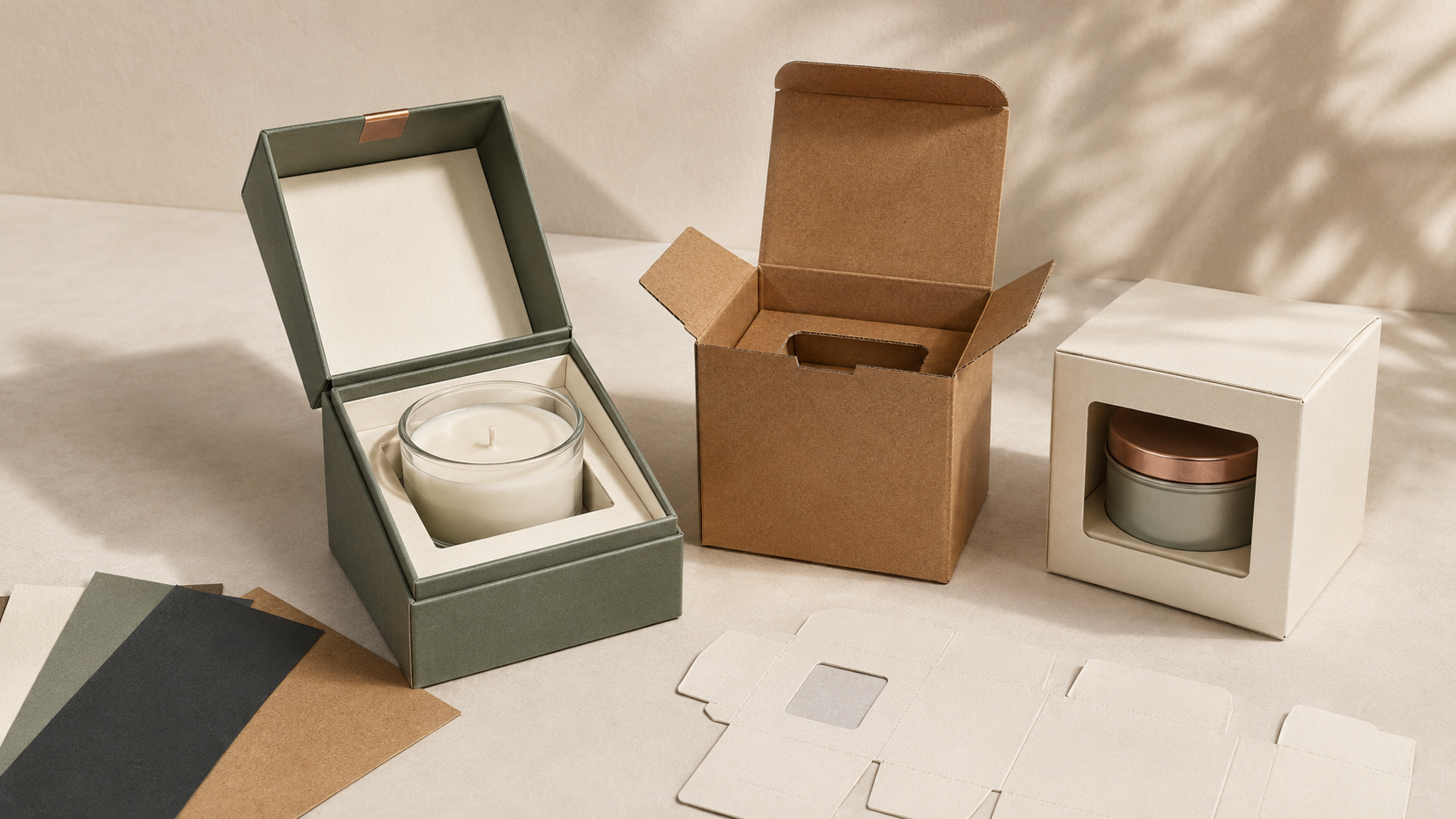
Custom candle boxes are product-specific secondary packages that contain, protect, identify, and present individual candles or candle sets. They include folding cartons, rigid setup boxes, tray-and-sleeve packages, window cartons, and corrugated presentation boxes. Each format starts with dimensions and a structural drawing that match the candle, its primary container, and the intended opening experience.
The box belongs within a larger custom packaging boxes system. Its retail role differs from the role of a master case or parcel shipper. The candle box can preserve presentation and carry required information, but carrier-level protection usually comes from an outer corrugated package.
Candle Products, Primary Containers, and Secondary Boxes
The candle is the product that burns. Container candles place wax and one or more wicks inside a glass, ceramic, concrete, or metal vessel. Other formats include pillars, tapers, votives, tealights, molded decorative candles, and wax-filled gift components.
The primary container directly holds the wax for a container candle. A glass jar, ceramic vessel, or metal tin controls product containment and much of the product's physical safety system. A lid, dust cover, wick clip, label, or protective sleeve can form part of the packed product.
The secondary candle box surrounds that product. It adds printed area, surface protection, product retention, light control, gifting value, and space for warnings or commercial information. The box does not approve the wax, wick, fragrance load, vessel, burn behavior, or fire-safety performance.
The shipping package forms another level. A master case groups several retail units for pallet or wholesale movement. A parcel shipper protects one or more units through small-package distribution. A decorated rigid candle box can still need cushioning and a fitted corrugated shipper.
How Does the Sales Channel Change the Candle Box Specification?
Retail shelves favor a compact footprint, stable base, clear product identity, readable scent information, and a barcode that scans at checkout. A boutique or department-store package may also use foil, embossing, textured wrap, or a rigid structure to distinguish a gift line.
E-commerce exposes the packed candle to repeated changes in orientation, impact, vibration, compression, and abrasion. A folding carton that works on a shelf may need an insert plus an outer mailer. A rigid presentation box may need corner protection or cushioning inside a shipper.
Subscription programs introduce recurring artwork versions, mixed scents, packout labor, and inventory timing. Corporate gifts and seasonal sets add multi-product inserts, cards, ribbons, or accessories. Wholesale cases require repeatable case counts and consistent outer dimensions.
Which Candle Box Structures Fit Different Products?
Candle box structures control assembly, closure, access, display, storage, and the path by which a filled product transfers load. The structure should follow the candle format, vessel geometry, filled weight, decoration, packing method, and distribution route.
Tuck-End and Auto-Lock Folding Candle Cartons
Tuck-end folding cartons are cut and creased paperboard boxes supplied flat. Straight tuck end cartons place the top and bottom tuck openings on the same side. Reverse tuck end cartons place them on opposite sides. Both can fit jar candles, tins, pillars, and single-product retail units.
An auto-lock bottom uses pre-glued base panels that form a locking base as the carton opens. It can reduce bottom-assembly steps for a filled jar, but the lock pattern, board caliper, product weight, and load path require a physical sample. A heavy candle should not rest on an unverified base.
Tuck friction changes with board thickness, score quality, coating, tolerance, and panel alignment. A loose tuck can open during handling. A tight tuck can tear the edge, crack print, or deform the panel. A seal label or other closure can be added where the brand's packing and tamper-evidence plan requires it.
Kraft Candle Boxes
Kraft candle boxes normally use unbleached paperboard with a brown fiber-colored surface. Coated unbleached kraft, often abbreviated CUK, is one paperboard category used for folding cartons. The visible surface can carry direct print, a white-ink base, a label, a sleeve, foil, or a restrained one-color design.
Kraft is a material description, not a structural style. The same kraft board can form a tuck-end carton, sleeve, window box, or insert, subject to board grade and converting limits. A kraft carton still needs a defined base, closure, internal clearance, and sample.
The brown substrate changes printed color. Transparent inks interact with the fiber tone, and light colors may appear muted without an opaque white layer. A screen preview on a white background does not approve the result on kraft board.
Kraft appearance also does not establish recycled content, recyclability, compostability, or fiber certification. Those are separate attributes supported by supplier documents and the finished construction.
Tray-and-Sleeve and Drawer Candle Boxes
Tray-and-sleeve boxes place the candle in an inner tray that slides into an outer printed sleeve. Drawer boxes add a pull direction and may use a ribbon, tab, or finger notch. The tray can be folding paperboard, rigid board, molded pulp, foam, or thermoformed plastic.
Sleeve friction should retain the tray during carrying and shelf handling without making the box difficult to open. A heavy candle can cause a loose vertical tray to slide. A tight sleeve can scuff a dark wrap, foil, or soft-touch surface.
The inner tray should keep the vessel centered and prevent its lid from contacting the sleeve. A stop, end wall, or fitted cavity can prevent accidental removal.
Rigid Lid-and-Base and Shoulder Boxes
Rigid setup boxes use dense board, commonly called greyboard, wrapped with printed, colored, or textured paper. Lid-and-base boxes have a separate top and bottom. Shoulder boxes add an inner collar or platform that controls lid alignment and creates a visible reveal.
Rigid candle boxes maintain a fixed assembled shape. They support deep inserts and gift presentation, but they occupy more inbound freight and storage space than flat folding cartons. Wrapped corners, joint gaps, turn-ins, lid fit, and insert placement create tolerances that need a representative sample.
A heavy jar can pull against the base when the customer lifts the box by its lid. The lid fit should support the intended opening experience without acting as the only transit closure. A sleeve, band, seal, or outer shipper may still be needed.
Window Candle Boxes
Window candle boxes use a die-cut aperture to reveal part of the vessel, label, wax, or lid. The aperture can remain open or use a transparent film. A window creates product visibility, but it removes board area and introduces another edge, adhesive, and material decision.
The candle should remain centered behind the opening. A base lock, collar, platform, or side rails can prevent rotation and settling. A clear vessel can reveal an unintended back panel, insert tab, or glue area unless the complete view is checked on an assembled sample.
The opening should remain clear of scores, glue flaps, narrow bridges, and high-load corners. A large window can reduce panel stiffness or cause bowing. The structural sample should be tested with the filled product rather than an empty visual mockup.
Corrugated Presentation Boxes and Mailers
Corrugated presentation boxes use liners bonded to a fluted medium. E-flute is a thin profile often used where a printed package needs more wall rigidity than a single paperboard sheet. The complete board grade, not the flute name alone, controls performance.
A die-cut mailer can contain a candle set, gift bundle, or subscription shipment. Direct flexographic printing, digital printing, or litho-lamination can apply graphics. Litho-lamination bonds a separately printed sheet to corrugated board and changes thickness, folding, and moisture balance.
Corrugated presentation boxes can support retail and parcel roles when engineered and tested for the intended route.
Multi-Candle Gift Sets
Multi-candle gift sets place two or more vessels, tins, votives, or accessories in one package. Different weights and shapes create an uneven load. A heavy glass jar can shift toward a light tin unless the insert separates and retains each component.
The insert should hold every product when the box is upright, on its side, or inverted during handling. Finger access should allow each candle to be removed without tearing the platform or pulling adjacent units free.
Which Structure Works for Both Retail and E-Commerce?
A shared retail structure works best when the candle box provides product fit and surface protection while an outer shipper handles parcel hazards. The retail box should not grow excessively just to imitate a shipping box.
A folding carton with a paperboard collar can support a jar on a shelf. A fitted corrugated mailer can then protect that carton during delivery. A rigid gift box can hold a premium set and sit inside a cushioned shipper.
The following comparison helps narrow the first sample:
Candle box structure | Storage state | Typical product fit | Main strength | Main constraint |
|---|---|---|---|---|
Tuck-end folding carton | Flat | Single jar, tin, pillar, or small set | Efficient storage and broad print area | May need an insert and outer shipper |
Kraft folding carton | Flat | Natural-surface retail line or gift candle | Brown fiber surface and flat storage | Printed colors interact with the substrate |
Tray and sleeve | Flat or assembled by component | Jar, tin, or controlled reveal | Separate tray and outer graphic sleeve | Sleeve friction and tray stop need control |
Rigid lid-and-base box | Assembled | Heavy jar or gift set | Fixed presentation and deep insert | Higher storage volume and separate transit protection |
Window carton | Flat | Visible vessel, label, wax, or lid | Direct product view | Reduced board area and added film or open edge |
Corrugated presentation mailer | Flat | Gift set, subscription, or protected retail unit | Added wall rigidity | Board grade and shipping route need testing |

How Should Candle Box Size, Fit, and Orientation Be Specified?
Candle box dimensions establish usable clearance around the actual filled product, lid, wick cover, label, and insert. Internal dimensions should be separated from external dimensions and stated in the intended packed orientation.
Internal Dimensions, External Dimensions, and Product Tolerances
Internal length, width, and depth describe usable space inside the erected box. External dimensions include board thickness, folds, seams, wrap, and construction. A folding carton and rigid box with the same internal cavity can have different outside dimensions.
Product tolerances include the smallest and largest vessel diameter or width, height, lid variation, label overlap, base variation, decorative protrusions, and filled-weight range. Box tolerances include cutting, scoring, folding, gluing, wrapping, and insert position.
A nominal zero-clearance fit can fail when the candle and box both reach the tight side of their tolerance ranges. The sample should use several production containers where variation is meaningful.
Glass Jars, Ceramic Vessels, and Metal Tins
Glass jars concentrate mass at their base and can carry vulnerable rims, shoulders, or corners. Round jars can rotate behind a front window. Square jars can load corner areas and need clearance around labels or coating.
Ceramic and concrete vessels can have greater dimensional variation than a highly controlled molded container. Their surface texture can rub against a tight paperboard cavity. A protective tissue, sleeve, coating-compatible pad, or wider clearance may be needed, subject to the product finish.
Metal tins have rolled rims and friction-fit or slip lids. An insert that presses against the lid can lift it. A tight carton can scratch decorated metal or deform a light-gauge wall. The sample should use the final labeled and lidded tin.
Pillars, Tapers, Votives, and Tealight Sets
Pillar candles place exposed wax against the packaging system. Rough board edges, dust, tissue fibers, or excessive pressure can mark the surface. A smooth wrap, sleeve, liner, or separated insert can protect the wax.
Taper candles require length control and end protection. They can bow or break when held only at the middle. A set may need support near both ends plus spacing between pieces.
Votives and tealights are small but often sold in multiples. A partition or tray controls count, spacing, and orientation. A window should not allow units to fall against the film or escape through an open aperture.
Lid, Wick, and Wax-Surface Clearance
Headspace is the vertical clearance or protected zone above the product. It prevents the box, insert, or stacked load from pressing on a lid, wick, wick cover, or decorative wax surface.
A top pad can control movement, but it should load a stable lid or vessel shoulder rather than a fragile wick or ornament. A collar can restrain a jar below the rim. A platform can keep the base located without touching the wax.
Excess headspace permits movement. Insufficient headspace creates pressure. The correct value depends on product tolerance, insert compression, box construction, and the intended packed orientation.
How Does Filled Weight Change the Box?
Filled weight changes base load, drop energy, shelf stability, carrying force, and insert deflection. An empty vessel may fit correctly while failing to represent the mass and center of gravity of the sold candle.
A tall, heavy jar can tip inside a shallow platform. A wide vessel can bow a paperboard base. A rigid box lid that stays closed when empty can lift when the box is carried with a filled set.
The specification should state unit weight, set weight, product orientation, and any top-heavy or edge-heavy condition. Physical samples and distribution testing should use the filled product or a representative mass with equivalent geometry.
Which Inserts Protect Candles Inside the Box?
Candle box inserts locate the vessel, distribute filled weight, protect surfaces, and control product removal. Insert design begins with the product geometry and load path, not with a generic circular hole.
Paperboard Platforms, Neck Collars, and Base Locks
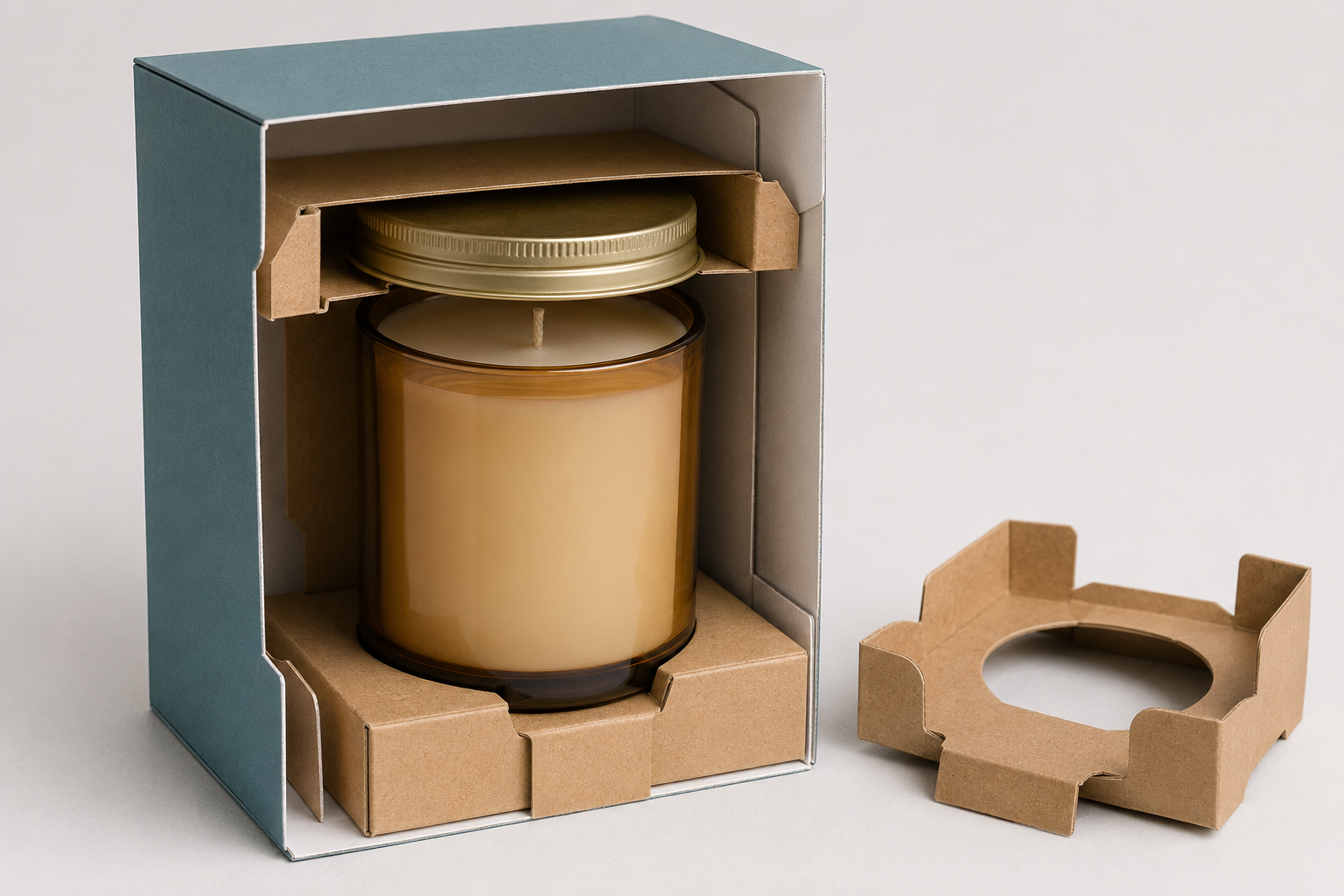
Paperboard inserts fold into platforms, side rails, base locks, and collars. A platform raises the candle and supports its base. A neck or shoulder collar controls lateral movement near the top of a jar. Side rails create space between the vessel and carton walls.
Paperboard can carry print and remain within a mainly fiber-based construction, subject to coatings and adhesives. Its fold direction, grain, caliper, cut geometry, and locking tabs affect stiffness.
A circular cutout that fits the jar body may still catch a lid, label edge, or vessel shoulder during removal. Relief cuts, tapered tabs, and finger access should be checked against the final product.
Molded Pulp and Corrugated Inserts
Molded pulp forms a fiber cavity around a jar, tin, or set. It can distribute load across a broader shape and provide surface separation. Its texture, color, draft angle, and dimensional tolerance differ from folded paperboard.
Corrugated inserts use fluted board as pads, partitions, or folded cradles. They can support heavier products and separate glass units. Cut edges and flute direction should not abrade decorated surfaces.
Both systems need product-specific sampling. A cavity that fits one vessel supplier may not fit another vessel with the same nominal size.
Foam and Thermoformed Trays
Foam inserts create cut or molded cavities with controlled cushioning and surface contact. Density, thickness, compression, chemical compatibility, odor, and appearance vary by foam type. A dark foam can provide contrast but may show dust or transfer particles.
Thermoformed trays use heated plastic sheet formed over tooling. They can create repeatable cavities, clips, and clear or colored presentation. The tray needs draft, flange space, and removal access.
Foam and thermoformed plastic introduce separate material systems. Their protective value, disposal path, and customer expectations should be considered together. A material should not be selected only because it looks premium in a mockup.
Finger Notches, Pull Ribbons, and Removal Force
Finger notches create access around the base, side, shoulder, or lid. Their position should let the customer lift the candle without pulling the wick, scraping the label, or twisting a loose lid.
Pull ribbons can lift a product from a deep cavity. The ribbon path should not sit under a sharp glass edge or create a lump that destabilizes the jar. Attachment and length need consistency.
Removal force should remain usable across product and insert tolerances. A vessel that requires excessive force can release suddenly and fall. A cavity that is too loose can fail during handling.
When Does an Insert Need a New Sample?
An insert needs renewed review when the vessel, lid, label, filled weight, box material, cavity material, product orientation, or packing method changes. A small diameter change can alter grip. A taller lid can remove headspace. A new label stock can increase friction.
The approved sample should identify the exact product revision and insert drawing. Reorders should reference both.
Which Materials Work for Custom Candle Packaging?
Candle box materials determine stiffness, print surface, fold response, wrap quality, window integration, storage, and insert behavior. Paperboard, corrugated board, and rigid greyboard are different constructions.
SBS Paperboard for Printed Folding Cartons
Solid bleached sulfate, or SBS, is a white paperboard with a smooth print surface. It supports fine text, process color, spot color, foil, embossing, coatings, die cutting, and folding-carton construction.
Caliper is the sheet thickness. It affects stiffness, score depth, fold force, internal space, and finish response. A thicker board can support a larger carton, but nominal thickness alone does not define compression or drop performance.
CUK and Kraft Paperboard for a Brown Fiber Surface
Coated unbleached kraft uses unbleached fibers and presents a brown surface. It can support retail cartons where the substrate color is part of the visual plan. Print contrast and white-ink opacity should be physically approved.
Kraft board can vary in shade, visible fiber, surface smoothness, and print holdout. A digitally printed sample from one board should not approve another grade without review.
Recycled Paperboard for Defined Material Goals
Recycled paperboard can contain recovered fiber and may have a coated front with a grey or brown reverse. Coated recycled board is used for selected retail cartons, depending on appearance and performance needs.
The reverse-side shade may be visible at tuck ends, windows, or unprinted interiors. Surface smoothness, stiffness, odor, and score response depend on the grade.
E-Flute Corrugated Board for Added Wall Rigidity
E-flute corrugated board combines liners with a thin fluted medium. It provides more wall rigidity than a single paperboard sheet and can suit gift sets, larger candles, presentation mailers, and retail-ready packages.
Flute profile does not define the complete board grade. Liner and medium specifications, adhesive, combined-board thickness, box style, product weight, and humidity affect performance.
Printing can be applied directly or through a printed litho-laminated sheet. Each method changes surface detail, fold behavior, and production setup.
Greyboard and Wrap Paper for Rigid Boxes
Greyboard forms the core of many rigid setup boxes. Printed, colored, or textured wrap paper covers the core and turns over its edges. The core creates the fixed shape, while the wrap establishes the visible surface.
Core thickness, joint gaps, wrap stretch, adhesive, corner construction, turn-in width, and drying affect lid fit and appearance. Light wraps can reveal exposed greyboard at edges. Dark wraps can show adhesive marks, rub, or corner variation.
Rigid candle box samples should use production-representative core, wrap, finish, and insert when appearance is an approval criterion.
Window Film, Adhesive, and Open-Aperture Options
Window film covers an aperture with a transparent sheet. Film type, thickness, clarity, scratch resistance, static, and adhesive compatibility affect the result. Glue should not haze the visible area or release under expected storage conditions.
An open aperture removes the film component but exposes the candle or vessel to touch, dust, and edge contact. The opening must remain too small for the product to escape and large enough to avoid fragile paper bridges.
Material and disposal instructions should reflect the actual film, adhesive, coatings, and local recovery system. The word "paper box" does not describe a mixed window construction completely.
How Are Custom Candle Boxes Printed and Finished?
Candle box printing applies brand graphics, scent versions, warnings, and machine-readable content to defined panels. The process depends on substrate, quantity, artwork versions, color target, detail, and finishing.
Digital, Offset, and Flexographic Printing
Digital printing transfers artwork without conventional printing plates. It can support short setups and multiple scent versions, subject to press, substrate, coating, sheet size, and finishing limits.
Offset lithography uses plates and a blanket to print detailed graphics on paperboard or rigid-box wrap sheets. It can support repeat color control across longer runs.
Flexographic printing uses flexible relief plates and is common on corrugated board and selected packaging materials. Graphic detail, ink coverage, board surface, and registration differ from offset or digital systems.
CMYK, Spot Color, White Ink, and Physical Color References
CMYK process printing combines cyan, magenta, yellow, and black to reproduce images and many colors. Spot colors use specified inks or physical references for selected brand targets. A CMYK simulation does not use the same ink as a spot-color print.
White ink can create a base on kraft, colored paper, metallic stock, or transparent film. Opacity and registration depend on the press, ink system, substrate, and number of passes.
A monitor cannot verify foil reflectivity, kraft interaction, or matte surface behavior.
Matte, Gloss, Aqueous, and Varnish Treatments
Aqueous coating is a water-based press coating applied to protect and modify the printed surface. Varnish is another clear printed coating that can be applied overall or selectively. Matte and gloss options change reflection, color appearance, and handling marks.
Film lamination bonds a plastic film to the printed sheet. It can change scuff resistance and feel, but it also changes material construction, folds, glue areas, and recycling instructions.
A high-gloss panel can show scratches and glare. A matte dark panel can show edge rub. A coated glue flap may need an exclusion or compatible adhesive.
Foil Stamping, Embossing, Debossing, and Spot UV
Foil stamping uses a die, pressure, and controlled heat to transfer a metallic or pigmented film. Embossing raises an area through matched tooling, while debossing presses it below the surrounding surface. Spot UV applies a glossy cured coating to selected graphics.
Tooling needs clearance from scores, cuts, windows, glue flaps, small type, and barcodes. A deep emboss near a fold can distort the carton. Foil can crack across a score or lose registration around a small element.
Rigid wraps and folding cartons respond differently to these processes. The selected board, wrap, coating, and artwork should be sampled together.
Interior Printing and Scent-Based Artwork Versions
Interior printing can carry burn instructions, scent notes, gift messages, or collection graphics. It also changes ink coverage and production setup. Glue and insert-contact areas may need print exclusions.
Scent versions often share one structure while changing names, colors, codes, and ingredient or product information. Version control should identify each SKU, quantity, barcode, batch-code zone, and approved artwork file.
How Do Dark Colors and Soft-Touch Surfaces Wear?
Dark colors show light-colored scuffs, exposed board at edges, fingerprints, and rub more readily than many mid-tone designs. Heavy ink coverage can also reveal cracking at poorly controlled scores.
Soft-touch film or coating changes surface feel and light reflection. It may show oils from handling or resist some adhesives and overprints. Spot UV or foil on top needs a compatible production sequence.
What Label and Warning Space Should a Candle Box Reserve?
Candle box artwork reserves readable areas for commercial, safety, operational, and retailer information approved by the responsible candle business. The converter positions approved content but should not invent warnings or determine the candle's legal status.
Product Identity, Business Information, and Net Quantity
The FTC's Fair Packaging and Labeling Act guidance states that covered household consumer commodities bear the identity of the commodity, the name and place of business of the manufacturer, packer, or distributor, and the net quantity of contents. Placement, wording, units, and exemptions depend on the applicable rules and product.
The principal display panel is the part of the package most likely to be shown to the customer under normal retail display. Product identity and net quantity need an approved relationship to that panel. The business-information panel also needs readable space.
Certain tapered and irregularly shaped decorative candles receive a limited dimension-expression exemption under 16 CFR 501.7. The responsible business should confirm whether that provision applies rather than transferring it to every candle format.
Candle Fire-Safety Warnings and Burn Instructions
The CPSC candles business guidance identifies ASTM F2058 for candle fire-safety labeling and ASTM F2417 for candle fire safety. It also lists standards for glass candle containers, candle accessories, terminology, and visible emissions.
Warning information may appear on the candle label, tag, package, or another approved component according to the applicable standard and product plan. The box should not hide a warning that the customer must retain or read. Interior copy can repeat instructions, but repetition does not correct a missing or nonconforming primary warning.
The candle brand, manufacturer, importer, or other responsible party should approve warning language, symbols, placement, size, and permanence. The packaging supplier should use the approved artwork and preserve designated clear areas.
Barcode, Batch Code, Scent, and Retailer Areas
A retail barcode needs sufficient contrast and clear quiet zones. A quiet zone is the unprinted margin around a barcode that helps the scanner distinguish the symbol from nearby graphics. GS1 guidance advises against placing symbols across folds, seams, edges, perforations, die cuts, overlaps, and rough textures.
Foil, glossy film, and highly reflective coatings can create glare. A barcode should be checked on the final substrate and finish, not only in artwork software.
Batch, lot, date, or variable-code areas need a printable or label-compatible surface. The code area should remain accessible after the insert is loaded and should not sit on a score or glue seam. Retailer labels, security devices, and price stickers need planned space as well.
Why Does the Candle Brand Approve Regulatory Artwork?
The candle business controls the product identity, net quantity, business details, warning basis, market, claims, and version history. A packaging converter normally receives approved text and places it on the production artwork.
A box supplier can flag a fold, window, low-contrast area, or finishing conflict. It cannot determine whether the candle passes a burn standard, whether a warning is legally sufficient, or whether the product qualifies for a specific exemption.
Artwork approval should include brand, regulatory or quality, packaging, and retailer stakeholders where applicable. A released PDF should not be the only control if variable codes or multiple scent versions remain unresolved.

How Should Window Candle Boxes Be Designed?
Window candle boxes reveal the product while changing panel stiffness, material construction, adhesive interfaces, and disposal instructions. The opening should be designed with the insert and artwork, not cut into a finished layout later.
Aperture Size, Panel Strength, and Product Visibility
The aperture should show the intended feature, such as a vessel label, wax color, lid, or texture. A round jar may rotate, so the insert must control orientation if the front label needs to remain centered.
Paper bridges between the window and nearby cuts or scores need enough width to survive die cutting, folding, and handling. The exact allowance depends on board, aperture shape, and tooling.
A large window reduces printed area and can weaken the panel. A structural sample should be erected, loaded, stacked, and handled before the artwork is finalized.
Film Clarity, Glue, Static, and Scratch Risk
Clear film can show scratches, dust, static, adhesive haze, and fingerprints.
Adhesive should remain outside the visible aperture and bond to the selected board or coating. A film that releases at one corner can catch during packing or make the box look used.
Static can attract fibers or dust from tissue and corrugated materials. The packout area and film handling should be considered in the sample review.
Product Rotation Behind the Window
Round vessels can rotate within a square carton. A flat label face, seam, or decorative mark may move away from the window. Side tabs, a neck collar, a keyed base, or a shaped cavity can control orientation.
The retention feature should not scratch the vessel or label. A clear jar can reveal the feature itself, so the insert color and geometry become part of the view.
The final review should include minimum and maximum vessel dimensions.
How Does a Window Change Recycling Instructions?
A film window adds a non-paper component unless the selected system is paper-based. Lamination, adhesive, foil, and labels can also affect sorting and pulping.
Disposal instructions should follow supplier evidence and the recovery conditions where the package is sold. A consumer-removable film can change the instruction only if removal is practical and clearly communicated.
An open aperture removes the film but does not prove the remaining carton is recyclable in every market. Coatings, adhesives, metallic decoration, and local collection still matter.
How Do Candle Boxes Perform in Storage and Distribution?
Candle box performance depends on the complete packed system, including the insert, master case, pallet pattern, parcel shipper, climate exposure, and handling route. A shelf-ready sample does not represent every distribution hazard.
Glass Breakage, Lid Movement, and Surface Abrasion
Glass breakage risk increases when a jar can strike a wall, another jar, or a hard accessory. Separation, movement control, and cushioning should prevent concentrated contact. A decorative retail carton alone may not provide enough distance.
Lids can loosen, lift, or rub during vibration. A top pad can hold a stable lid, but it should not damage the surface or transfer pressure to the wick. Tin lids need different contact control from glass or wood lids.
Abrasion appears where coated cartons rub against partitions, master-case walls, or each other. Tissue, sleeves, divider coatings, protective bags, or a changed case count can reduce contact, subject to the material plan.
Heat, Wax Softening, and Fragrance-Oil Exposure
Candles can encounter elevated temperatures in warehouses, trailers, parcel networks, and delivery locations. Wax response depends on formulation and product conditions. The box cannot compensate for a candle that is not suitable for its distribution environment.
Warm or softened wax can mark a dust cover, window, or exposed board. Fragrance-oil residue can stain paper, affect adhesive, or change printed surfaces. Products should be packed under an approved process after filling, cooling, cleaning, and inspection.
Conditioned testing can examine the complete package after expected temperature and humidity exposure. The candle manufacturer should define relevant product limits.
Master Cases, Parcel Shippers, and Dimensional Weight
A master case groups retail candle boxes for storage and wholesale distribution. Case dimensions, board grade, case count, dividers, stacking pattern, and pallet arrangement affect compression and abrasion.
A parcel shipper protects individual orders through carrier handling. Cushioning and clearance should keep the candle box away from exterior impacts. The shipper should not be so loose that the product gains momentum before contact.
Dimensional weight is a carrier billing value based on package volume relative to actual weight. UPS explains that dimensional weight uses length multiplied by width multiplied by height, divided by the applicable divisor. The divisor and rate rules depend on service and account terms. Right-sizing the outer shipper can reduce unused volume, but protection comes first.
Drop, Vibration, Compression, Rub, and Scuff Testing
Drop testing applies defined impacts to a packaged product. Vibration testing simulates repeated motion. Compression testing evaluates load under stacking or handling. Rub and scuff checks examine printed and finished surfaces.
A test plan should represent the distribution route, package size, weight, orientation, and expected hazards. The International Safe Transit Association describes distribution testing as part of package design and validation.
The test item should match production materials and assembly as closely as practical. A sample made from another board, insert, or outer shipper can produce a misleading result.
Why Does a Retail Box Still Need a Shipping Package?
A retail box prioritizes display, information, and customer opening. Its exposed corners, foil, windows, wrap paper, and tuck closures may not tolerate direct parcel handling.
A shipping package prioritizes impact separation, compression, closure, and carrier labels. It can protect the candle box without replacing the retail presentation.
Using both levels allows each structure to perform a clear role. The final distribution test should include the exact retail box inside the intended shipper.
Which Material and Environmental Claims Need Evidence?
Candle packaging claims need evidence for the actual construction, not its color or visual style. The outer box, insert, window, lamination, magnet, ribbon, adhesive, and protective materials can each change the supported statement.
Recycled Content, Recyclability, and Material Reduction
Recycled content describes the proportion of recovered material used to make a component. Recyclability describes whether the finished package can be collected, sorted, and processed into another material in the relevant system. These are not the same attribute.
Material reduction compares the new package with a defined baseline. A smaller box, lighter board, or simplified insert can reduce material, but the claim should state what changed and how it was measured.
The FTC's Green Guides address environmental marketing claims and the need for qualification where claims could mislead. Brand teams should review the final construction and market before printing a broad statement.
FSC-Certified Fiber and Chain of Custody
FSC chain of custody tracks certified forest-based material through the supply chain. The FSC label on finished packaging depends on eligible material, chain-of-custody controls, and authorized trademark use.
A board supplier's certified product does not automatically authorize any buyer or converter to place the FSC mark. The sourcing and production chain needs the applicable status and approval.
Artwork should reserve an FSC area only after the certificate, claim type, license code, label artwork, and approval path are confirmed.
Lamination, Windows, Magnets, Foam, and Mixed Materials
Film lamination bonds plastic to paperboard. Window film adds another polymer. Magnets add metal and magnetic components. Foam and thermoformed trays create separate insert materials.
These components can provide a defined protective or presentation function, but they can complicate separation and recovery. Disposal instructions should identify removable and nonremovable parts where supported.
Why Does Kraft Color Not Prove an Environmental Attribute?
Kraft color describes the visible brown fiber tone. A white board can contain recycled fiber, and a brown board can use virgin fiber. Either can be certified or uncertified.
Natural-looking print, twine, muted ink, or a leaf graphic does not prove recyclability, compostability, reduced impact, or responsible sourcing. Those claims need separate evidence.
Buyers should request the material grade, recycled-content statement, certification details, coating, lamination, window, adhesive, and disposal guidance before approving packaging claims.
What Common Candle Box Failures Should Buyers Prevent?
Candle box failures usually connect to missing product data, an untested structure, incomplete artwork control, or a shipping role that the retail box was not designed to perform.
Loose Jars and Crushed Corners
A loose jar gains movement before striking the box or insert. The impact can crush a corner, chip glass, scuff a label, or dislodge the platform. Lateral and vertical clearances need separate control.
Crushed corners can also result from master-case pressure, parcel impacts, or weak board around a window. A thicker-looking board is not a substitute for a tested construction.
Tight Inserts and Difficult Product Removal
A tight cavity can grip the label, rim, lid, or vessel coating. The customer may pull harder, release the candle suddenly, or tear the insert.
Tolerance testing should include several product and insert samples. Finger access, tapered contact, relief cuts, or a pull ribbon can reduce removal force.
Scuffed Print, Cracked Foil, and Rubbed Edges
Scuffing can occur during conversion, packing, case loading, shipping, or retail handling. Dark ink, matte film, foil, and raised decoration show different failure patterns.
Foil can crack at a score, bridge over texture, or lose small details. Embossing can distort a nearby fold. Rub checks and packed-product handling should be part of finish approval.
Hidden Warnings and Unscannable Barcodes
A warning can disappear beneath a sleeve, insert, price label, or closed flap. A barcode can cross a fold, sit too close to a window, or lose contrast on foil or dark print.
Artwork reviews should use an assembled package. The final scan check should use production-representative substrate and finish.
Oversized Boxes and Excess Packing Material
An oversized retail box allows movement unless an insert fills the gap. It also increases board use, storage volume, master-case size, and possible dimensional-weight exposure.
Extra tissue or loose fill can slow packing without controlling the heaviest load path. Right-sizing should begin with the actual filled candle and the minimum protective clearance established through sampling and testing.
How Do You Order Custom Candle Boxes?
Ordering custom candle boxes requires a controlled product specification, structural decision, artwork release, physical sample, and production approval. Price and schedule follow the defined job.
Prepare the Candle and Container Specification
Record the candle format, vessel material, filled weight, minimum and maximum dimensions, lid, wick cover, label, decorative features, fragile areas, wax exposure, and intended orientation. Provide a production sample or dimensioned drawing where possible.
List every SKU, scent, size, color, and set configuration. Identify shared structures and changed artwork versions.
State the sales channels, master-case plan, parcel route, storage conditions, packing method, and delivery destinations. These details shape the sample and test plan.
Choose the Structure, Material, Insert, and Window
Select a folding carton, kraft carton, sleeve, rigid box, window box, or corrugated presentation format. Then specify internal dimensions, board or core, wrap, insert material, closure, and opening direction.
Define whether the window is open or film-covered. State the visible product feature and required orientation. Place insert contact on stable product areas.
The broader custom product boxes category provides related structure and material comparisons for teams evaluating one box platform across several product lines.
Submit Artwork and Label-Control Files
Artwork should separate dieline, print, white ink, varnish, foil, embossing, window, glue, barcode, and variable-code layers. Nonprinting technical notes should remain outside the visible graphics.
Label-control files should identify approved product identity, net quantity, business information, warnings, symbols, scent, barcode, lot area, country-of-origin text where applicable, and retailer requirements.
Fonts, linked images, color references, and version names should be complete. Artwork orientation should be reviewed on a three-dimensional sample.
Review Proofs and Physical Samples
A digital proof checks text, graphics, page sequence, and technical layers. A structural sample checks dimensions, assembly, closure, insert, window, product access, and packout.
A color proof checks the selected substrate and print target within the limits of the proofing method. A decorated sample checks foil, embossing, coating, wrap, and surface behavior.
The approval record should state what each proof approves and what it does not. A digital proof cannot approve filled-product fit.
Approve Production and Reorder Controls
Production approval should identify the box drawing, insert drawing, material grade, print method, colors, finishes, window, adhesive, artwork revision, quantity by version, packing method, and inspection criteria.
Reorder controls should preserve approved dimensions, tooling, artwork, and material. A supplier, board, coating, label, or vessel change may need renewed review.
Version history prevents an old scent, barcode, warning, or product size from returning to production.
What Information Should a Candle Box Quote Include?
A quote request should include:
Candle format and vessel material
Filled product dimensions and weight
Lid, wick, label, and fragile-area details
Box style and internal dimensions
Material or performance preference
Insert material and cavity requirements
Open or film-covered window details
Exterior and interior printing
CMYK, spot color, white ink, and physical color references
Coating, lamination, foil, embossing, debossing, or spot UV
Quantity by SKU and artwork version
Proof and physical-sample requirements
Packing, master-case, and parcel configuration
Delivery destination and required schedule
MOQ, unit price, tooling, sample cost, freight, and production timing depend on those variables. A quote without the complete specification cannot establish a comparable finished package.
Choosing Custom Candle Boxes for Retail, Gifting, and Shipping
Custom candle boxes work when structure, material, fit, decoration, labeling, and distribution are approved as one package system. Kraft candle boxes and white folding cartons suit flat storage and efficient packing. Rigid candle boxes support fixed gift presentation.
Window candle boxes add product visibility but require an approved aperture, film or open-window decision, and product restraint. Candle box inserts must locate the filled vessel without scratching the label, lifting the lid, loading the rim, or making removal difficult.
The final specification should state the candle format, filled weight, container tolerances, lid and wick clearance, internal dimensions, structure, board, insert, window, print method, finishes, artwork versions, label areas, packing method, and shipping configuration. Proofs establish content and layout, while physical samples establish fit, access, surface quality, and assembly.
Packaging in Time can quote against those confirmed details. Submit the candle dimensions, filled weight, product sample or drawing, quantity, artwork, insert needs, window preference, finish requirements, and delivery destination to request a custom packaging quote.