
A practical guide from Packaging in Time to help you choose better materials, structure, printing, and finishing for custom boxes.
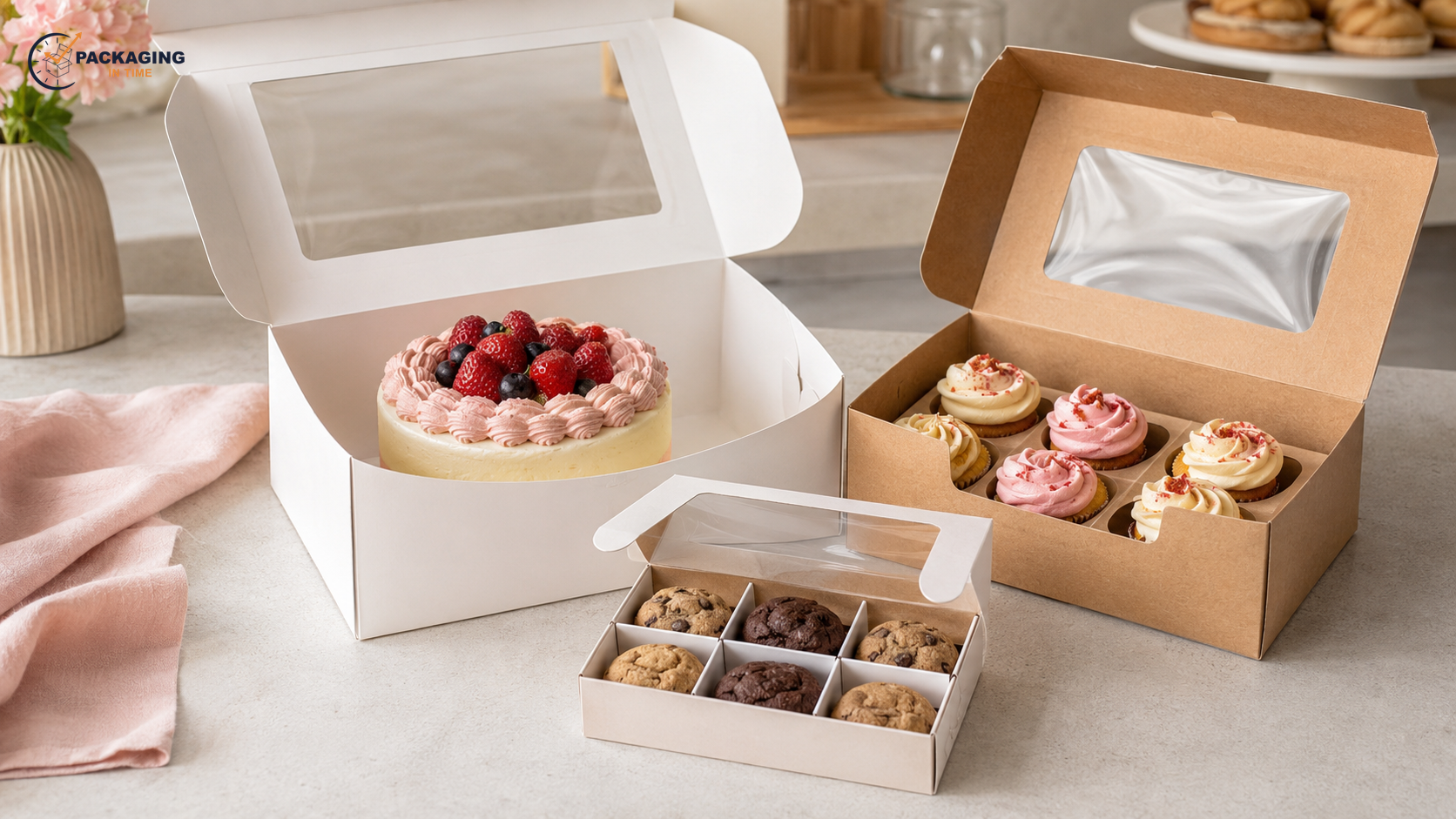
A practical specification guide for bakeries, cafés, caterers, and food brands
Buttercream, chocolate, fruit filling, steam, and delivery movement put pressure on bakery packaging in different ways. A cookie box that works for a dry product may not work for a warm pastry. A cake box with attractive printing may still fail if the cake board can slide or the lid has too little height. For that reason, a custom bakery box should start with the product and its handling conditions, then move to structure, food-contact materials, printing, and distribution.
Packaging in Time helps bakery brands specify custom printed boxes for cakes, pastries, cookies, cupcakes, donuts, and confectionery. The right specification combines the bakery item, the contact relationship, dimensions, product restraint, display needs, and the route from packing bench to customer.
What Are Custom Bakery Boxes?
Custom bakery boxes are paperboard or corrugated packages made to a defined size, structure, print layout, and packing method for bakery products. They can provide product presentation, basic physical protection, label space, carry-out convenience, and a consistent brand surface. Common formats include cake boxes, window cartons, cupcake boxes, cookie boxes, gable boxes, sleeves, and corrugated delivery cases.
The box is only one part of the package system. A decorated cake may also need a cake board, collar, pad, and outer shipping case. Cupcakes may need paper cups and a cavity insert. Cookies may use a food liner, divider, or sealed inner bag. Each part has a separate job.
Direct Food Contact, Liners, and Secondary Bakery Cartons
Direct-contact packaging can touch the food during filling, holding, display, or customer use. A secondary carton holds a sealed or separated primary pack. For example, a cookie carton around an inner bag is a secondary box. A pastry box lined with a suitable sheet or cup uses the liner to create separation between the food and the printed outer board.
This distinction changes the material review. The FDA describes packaging components, adhesives, and colorants that contact food as food-contact substances. The selected material must match its intended use. A food-contact statement for one component or condition does not cover every board, coating, adhesive, window film, ink, or liner in a finished bakery package.
Why Bakery Packaging Must Match Product Conditions
Bakery products can be dry, moist, fatty, warm, chilled, or frozen. A plain biscotti carton has a different exposure from a warm glazed donut box. A butter-rich croissant can transfer oil over time. A refrigerated cheesecake may create condensation after it leaves cold storage. A delivery cake can shift even when the board itself is strong.
Start with the actual product condition, not only the product category. Record the food type, whether it touches the box or liner, expected contact duration, filling temperature, storage temperature, moisture and fat exposure, and sales route. This gives the packaging supplier and material suppliers the information needed to select the construction and records.
Which Bakery Products Need Different Box Specifications?
Cakes and Cheesecakes
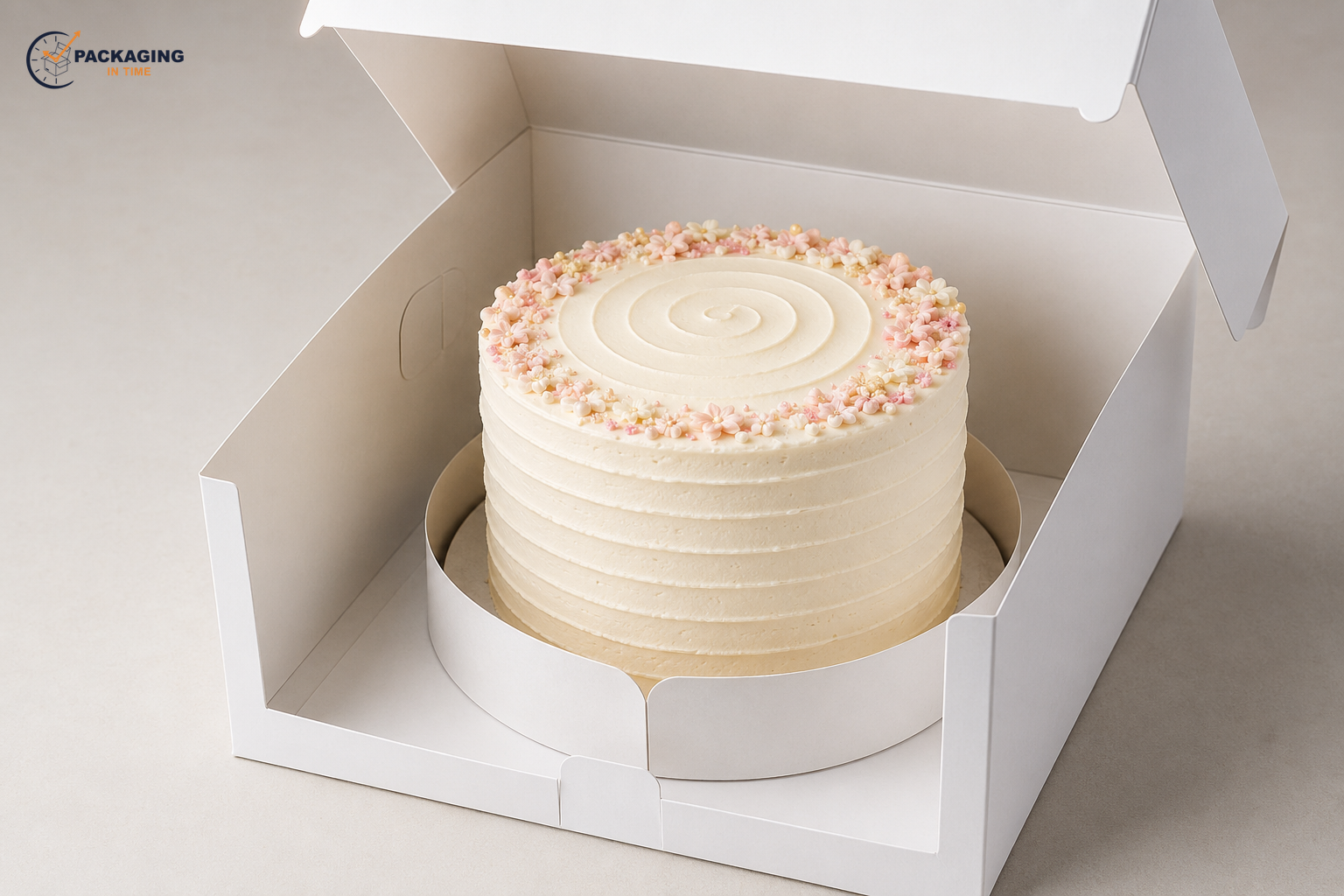
Cake packaging needs stable support and enough headroom for decoration. Measure the cake diameter or length, the cake board, the highest topping, and the expected clearance around the sides. The internal box dimensions should fit the board first. If the board can slide, the cake can shift with it.
A hinged-lid or lock-corner cake box works well for many counter and carry-out uses. The board caliper and corner design must support the product mass without the side walls bowing. A taller cake may need a high-wall structure, while a heavy cheesecake may need a stronger base or an outer corrugated case for delivery.
Cupcakes, Cookies, Pastries, and Donuts
Cupcakes move differently from cookies. A cupcake insert places each item in a cavity and limits lateral movement. The cavity diameter, depth, frosting height, paper-cup size, and box depth must work together. A loose insert may shift under the lid, while an over-tight cavity can damage the paper cup or frosting.
Cookies, macarons, and small confectionery often benefit from dividers, cups, trays, or a liner. The right component depends on product breakage, grease, stacking, and removal. A single box for several flavors may also need separation to keep toppings or fillings from transferring.
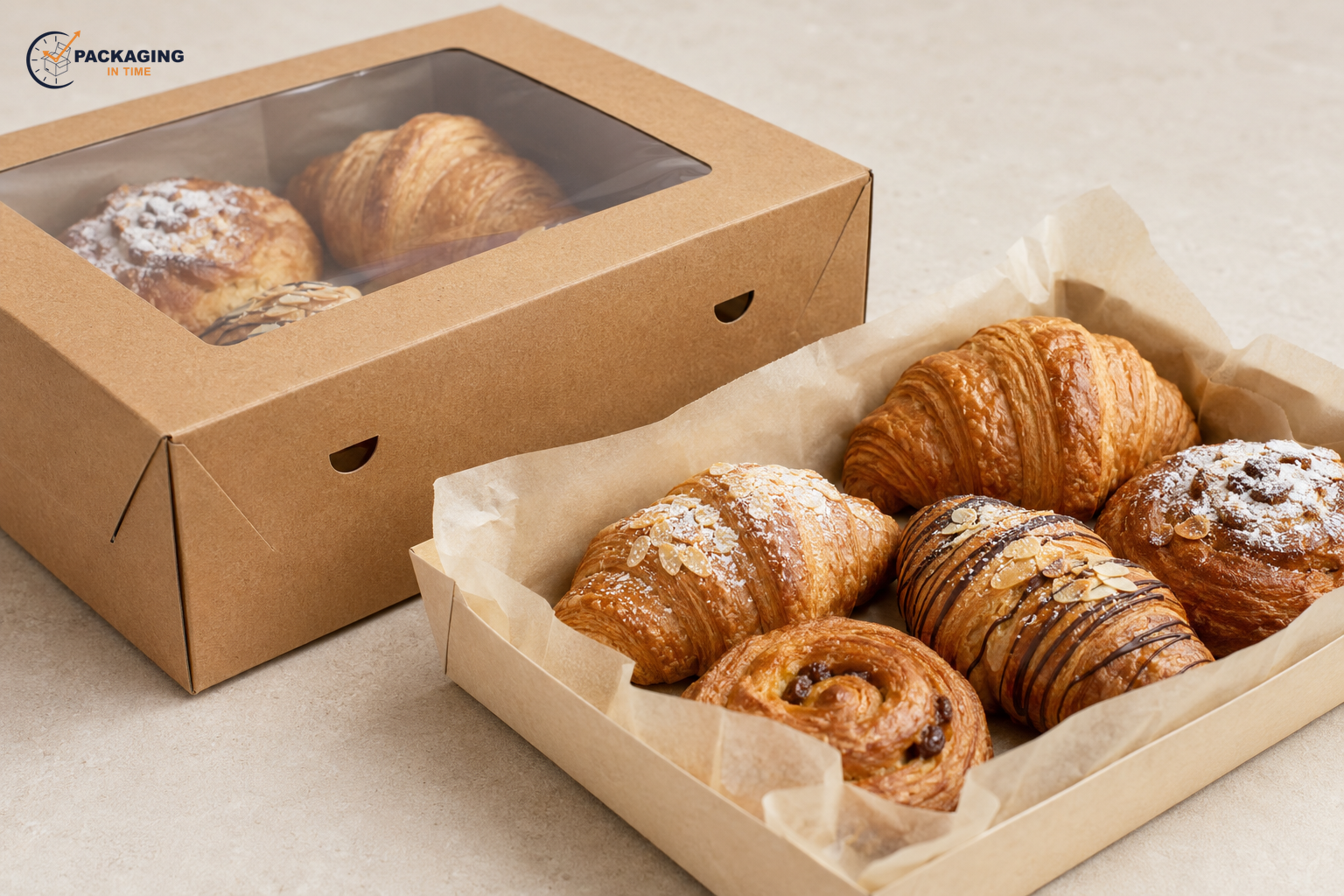
Pastries and donuts can introduce steam and grease. A liner can separate the food from the outer printed box. Venting can help a hot product avoid trapped steam, but it also removes board area and opens a path for heat loss, crumbs, and contamination. The vent size and placement should reflect the product and route.
Chilled, Frozen, and Delivery-Ready Bakery Products
Cold products bring condensation risk. Water can collect at cut edges, folds, seams, and window bonds. A package that remains firm at room temperature may soften after refrigeration, thawing, or a humid delivery route. Frozen storage can also affect fold behavior, adhesive performance, and film flexibility.
Delivery adds acceleration, vibration, stacking, and uneven vehicle conditions. Separate the retail bakery box from the delivery shipper. A branded cake box may serve as the customer-facing package, while a corrugated outer case manages transit loads. Test the actual product and package configuration for the intended route, especially for fragile or chilled assortments.
Which Custom Bakery Box Styles Work Best?
Quick structure match
Bakery product | Typical box system | Check before production |
|---|---|---|
Decorated cake | Hinged-lid or lock-corner box, cake board, optional collar | Board fit, topper clearance, base movement, carry-out route |
Cupcakes | Folding box with cavity insert | Cup diameter, frosting height, insert retention, lid clearance |
Cookies or macarons | Window carton, tray, liner, or divider | Breakage, grease, count, window placement, shelf display |
Warm pastries or donuts | Lined folding box with selected ventilation | Steam, grease, hold time, opening placement, containment |
Delivery orders | Retail bakery box inside corrugated shipper | Stacking, void control, orientation, route and damage check |
Hinged-Lid and Lock-Corner Cake Boxes
Hinged-lid cake boxes are one-piece structures with an attached lid. They can ship flat and assemble quickly at a bakery counter. Lock-corner styles use corner tabs that hold the base square. Both formats can work for round cakes, sheet cakes, pastries, or cookies, depending on board grade, size, and product weight.
The closure is not a liquid seal. Foods with loose syrup, melted topping, or heavy oil may need a separate liner, tray, bag, or sealed primary pack. The decision should include the base, corners, fold lines, and expected holding time, not only the front-panel appearance.
Window Boxes for Pastries and Cookies
A window box has a die-cut aperture and a display window film. It gives shoppers product visibility while leaving space for a printed brand panel. It also adds a material interface: the film, its adhesive, the overlap area, and the edge around the cutout.
Place the window away from zones where frosting, chocolate, or oily toppings can press against it. The food should sit on a board, liner, tray, or insert rather than against the printed exterior. Condensation can fog a clear window, and a large cutout reduces panel stiffness. The window size therefore needs to balance product visibility with strength and containment.
Cupcake Inserts, Dividers, and Confectionery Trays
Inserts and dividers reduce movement and give each item a defined position. Paperboard inserts suit many cupcakes, cookies, and confectionery assortments. A tray or cup may improve separation where crumbs, coatings, or fillings could transfer. The insert should be designed with the box, not selected after the outer carton is complete.
Define the product count, dimensions, cup diameter, fill height, base profile, and removal method. Check how the insert loads, whether it stays in place after opening, and whether it creates hard edges near delicate decorations. For premium assortments, a tray and sleeve can add presentation while maintaining product position.
Gable Boxes, Sleeves, and Retail Cartons
Gable boxes have an integrated handle and carrier-style top. They can be useful for cookies, small pastries, party favors, or sealed foods that customers carry away. Handle performance depends on product weight, board grade, cut geometry, moisture exposure, and the way the package is held.
Sleeves add branding around a tray, cup, bag, or inner carton. They provide more print space without enclosing every side. A sleeve must remain positioned during stocking and transport. A folding retail carton can provide larger label panels and light protection around a sealed inner pouch or tray.
Corrugated Bakery Shippers and Catering Cases
Corrugated board combines liners with a fluted medium and is often used for outer shippers, catering cases, and delivery packaging. It can protect retail cartons and create separation from stacking loads. It should not be treated as the same layer as the direct-contact bakery box unless the relevant material and use conditions have been reviewed.
For recurring delivery or parcel shipping, specify the number of retail boxes per case, loading pattern, pallet or parcel orientation, expected stack height, temperature exposure, and return risk. A real sample of the product should be used for validation. ISTA guidance frames testing around the actual product and distribution environment, rather than a generic transit badge.
How Do Food-Contact Materials and Grease Resistance Work?
Dry, Aqueous, and Fatty Food Conditions
Food type is part of the packaging specification. FDA regulations distinguish paper and paperboard components for use with aqueous and fatty foods from those for dry-food contact. The relevant provisions, including 21 CFR 176.170 and 21 CFR 176.180, apply under stated conditions. A dry-food carton should not be assumed suitable for a moist or fatty bakery product.
Moist bakery products with free surface fat or oil need closer review than dry, low-fat products. Time and temperature also matter. A product held for an hour at room temperature may behave differently from the same product held warm, refrigerated overnight, or delivered in summer heat.
Board, Coating, Adhesive, Film, and Liner Review
Solid bleached sulfate, often called SBS, gives a smooth white print surface and clean scoring for folding cartons. Kraft board gives a natural brown appearance and different print behavior. E-flute corrugated board can add rigidity for selected bakery formats and delivery packaging. The material name alone does not establish contact suitability.
Review every component that can contact the food or affect the food-contact layer: board, coating, adhesive, ink, film, paper cup, liner, tray, and insert. Ask the relevant supplier for the material specification and supporting food-contact documentation for the intended food and use conditions. The brand or food producer remains responsible for confirming that the final package and product meet applicable requirements.
Grease Holdout, Moisture, Steam, and Condensation
Grease holdout, liquid-water resistance, and water-vapor control are different properties. A coating that handles a brief water splash may not resist oil during a long hold. A film can block liquid water while cut edges, fold lines, and glue seams remain vulnerable. A liner can give the food a separate contact surface while the outer carton carries the print and structure.
FDA reported that the U.S. market phase-out of certain PFAS-containing grease-proofing agents for paper and paperboard food packaging was completed in 2024, and later actions addressed related notifications. That does not turn every current grease-resistant box into a verified PFAS-free product. Ask for the current specification, composition statement, test basis, and conditions of use for the selected material.
How Should You Size a Custom Bakery Box?
Measure the Product, Base, Decoration, and Clearance
Use internal length, width, and depth. Measure the widest and tallest point after the product is fully decorated and placed on its normal base. For a round cake, record cake diameter, cake-board diameter, total height, decoration height, and any topper. For a cupcake assortment, record the base diameter, cup diameter, frosting height, cavity spacing, and lid clearance.
Add clearance for loading and removal, but do not add empty space without a plan. Excess clearance lets products shift. Too little clearance crushes frosting, catches a topper, or rubs a window. The dieline should show the finished internal size, score positions, board caliper, glue areas, window location, and insert geometry.
Use Inserts to Control Movement Instead of Oversizing
Right-sizing does not mean making every box tight. It means giving the product suitable clearance, then using a cake board, collar, pad, divider, tray, or insert where movement needs control. The best method depends on the product's shape, fragility, and filling process.
A physical sample is useful when the product has high decoration, unusual geometry, or a narrow tolerance. It lets the bakery check filling speed, closure, appearance, product release, and delivery handling before the production run.
Can Bakery Boxes Include Windows, Printing, and Branding?
Window Placement and Product Visibility
The window must show the strongest product view without weakening a critical panel. A large top window can suit cookies and pastries. A side window may suit a tall cake carton. The film needs an attachment area that does not interfere with folding or food placement. Clear film can also show fingerprints, fogging, and scratches, so the packing workflow matters.
Printing, Finishes, and Label Space
Custom bakery boxes can use CMYK process printing, selected spot colors, white ink on kraft, and finishes chosen for the appearance and handling need. High-coverage dark printing can show scuffs more easily. Fine type needs enough contrast. A gloss or matte finish changes reflection and rub visibility, but it should be selected with the food-contact construction and disposal system in mind.
Reserve panels for required product information where applicable, such as identity, ingredient, allergen, net quantity, nutrition, date coding, handling, or business information. The product owner should approve label copy and classification before artwork is released. Keep barcodes, QR codes, and important label text away from folds, seams, windows, and areas likely to scuff.
How Do Bakery Boxes Perform in Carry-Out, Retail, and Delivery?
Ventilation Versus Strength and Containment
Vents can help release steam from selected warm bakery products. They can reduce trapped moisture, but they also reduce compression area and create openings. A vent near a corner, score, handle, or top stacking area can weaken the structure. For oily, loose, or crumb-heavy products, a vent can also affect containment.
Test the packed product at the expected holding time. Close the box, carry it, stack it as staff would, and inspect the product, folds, corners, windows, and exterior after the actual route. This simple check often shows whether a vent, liner, closure, or insert needs adjustment.
Retail Display, Case Packing, and Parcel Shipping
Retail display requires clear product visibility, consistent panel presentation, label space, and a box that stays square on shelf. For multi-unit retail, the retail carton and master case need to work together. Case dimensions, product count, board orientation, and loading pattern affect damage risk.
Parcel shipment adds impacts and drop exposure. A decorative retail carton should usually sit inside a protective shipping system that controls void space and outer loads. Carrier charges can also depend on dimensions as well as weight, so right-sizing the full delivery package matters.
What Can Go Wrong With Custom Bakery Boxes?
Grease Stains, Soft Panels, and Open Seams
Grease can travel through board or along cut edges. Moisture can soften panels and reduce stack strength. A lining or coating can perform well on a flat sample but fail at folds, seams, or window bonds. Prevent this by defining the product exposure, reviewing the complete material set, and checking a packed sample after the expected hold.
Crushed Icing, Sliding Cakes, and Fogged Windows
Crushed decoration usually points to insufficient lid clearance or uncontrolled movement. Sliding cakes point to an underspecified cake board, loose base, or oversized box. Fogged windows point to trapped moisture and a temperature difference. Each failure has a structural or process response. Avoid treating it as only a printing problem.
Artwork, Label, and Material-Control Errors
The wrong revision, a moved barcode, a changed coating, or a substituted window film can affect usability and compliance review. Keep approved dielines, material records, artwork files, proof dates, and change notes together. A substitution should be reviewed when it changes food contact, barrier behavior, fit, print, odor, stiffness, or recycling instructions.
How Do You Order Custom Bakery Boxes From Packaging in Time?
Start with a complete product brief. Share the bakery item, product dimensions, base or insert, product count, direct-contact or liner relationship, food conditions, target box style, print requirements, quantity, delivery location, and deadline. Reference photos and existing samples are useful because they reveal packing and presentation expectations that dimensions alone can miss.
Next, review the dieline and artwork proof. Confirm the internal dimensions, window location, product restraint, panel copy, label areas, print colors, and finish. For a new structure or delicate product, approve a physical sample before full production. It is the fastest way to assess loading, clearance, closure, and real handling.
Packaging in Time can help turn those inputs into a custom bakery box specification and quote. The goal is a box that fits the product, supports the packing process, and presents the brand without making unsupported material or regulatory claims.
Sources
FDA: Food Packaging and Other Substances That Come in Contact With Food
eCFR: 21 CFR 176.170, Components of Paper and Paperboard in Contact With Aqueous and Fatty Foods
eCFR: 21 CFR 176.180, Components of Paper and Paperboard in Contact With Dry Food
FDA: Food Types and Conditions of Use for Food Contact Substances