
A practical guide from Packaging in Time to help you choose better materials, structure, printing, and finishing for custom boxes.

Pharmaceutical packaging is often purchased as a print job. That approach breaks down as soon as a carton carries a strength, dosage form, expiry field, variable data, or package-level identifier. A wrong version can create a mixup risk, while a weak insert can let a glass container move during distribution.
Custom pharmaceutical boxes need a controlled specification before production begins. The product, immediate container, market, artwork, packaging line, storage condition, and distribution route all affect the final carton. Packaging in Time can help buyers turn those inputs into a defined box structure and printed packaging component. The brand, manufacturer, or quality organization retains responsibility for drug classification, label content, regulatory review, process validation, and product release.
What Are Custom Pharmaceutical Boxes?
Custom pharmaceutical boxes are secondary packaging components made around a particular drug product and sales channel. They can be unit cartons for bottles, vials, blisters, syringes, tubes, inhalers, kits, or diagnostic accessories. They can also be multipack cartons, sleeves, dividers, case inserts, and corrugated shipping cases.
Their job is broader than appearance. A unit carton can hold a primary container, carry approved labeling, reserve a barcode or data-carrier area, contain a patient leaflet, show opening evidence, separate strengths, and support a defined packout. A case can group finished units and protect them through warehousing and freight. These are different package layers with different requirements.
The Drug Product, Immediate Container, Carton, and Shipper
Start by naming the layer under discussion.
The drug product is the finished medicine or therapeutic product.
The immediate container directly holds the product, such as a bottle, vial, blister, tube, ampule, or prefilled device.
The unit carton is the printed secondary box around that immediate container.
A multipack groups unit cartons or primary packages.
The master case or shipper protects a defined number of packs during distribution.
One box does not replace the function of another. A folding carton may create label space and retail presentation, but a corrugated case usually manages compression and case-level movement. In the same way, an outer carton may carry copy while the immediate container provides the closure or barrier that the medicine requires.

Why Product Category and Market Change the Brief
“Pharmaceutical” is not a complete technical brief. First, identify whether the product is prescription, over-the-counter, investigational, a device accessory, or another category. Next, identify the destination market and the party that owns final artwork approval. The label language, mandatory content, data workflow, and testing plan may change by product and market.
For U.S. finished pharmaceuticals, current good manufacturing practice rules in 21 CFR Part 211 include packaging and labeling controls. The rule set expects written procedures for receipt, identification, storage, handling, sampling, examination, or testing of packaging and labeling materials. It also requires materials to meet written specifications before release for use. 21 CFR 211.122 is a useful starting point for the control logic, but it is not a product design template.
The supplier needs the approved inputs. The manufacturer or labeler needs the controlled system that governs those inputs. That separation should remain clear throughout the project.
Which Pharmaceutical Box Structures Fit Different Drug Products?
The right structure follows the product geometry, primary container, dispensing method, line equipment, and channel. A visually attractive carton that does not hold the product consistently is not a finished solution.
Folding Cartons for Bottles, Blisters, Tubes, and Vials
Folding cartons are common for routine pharmaceutical unit packaging because they ship flat, print well, and can be made in many closure styles. Straight-tuck and reverse-tuck cartons work for bottles, blister cards, tubes, and small devices when the bottom and top closure meet the load and line requirements. Auto-bottom and lock-bottom designs add support for heavier contents, but their suitability still depends on the actual product weight, center of gravity, and handling method.
For a bottle, the carton brief should include bottle diameter, shoulder profile, cap height, filled weight, label location, and whether the bottle must remain upright. For a blister, include card dimensions, pocket projection, number of panels, leaflet placement, and any restraint needed to prevent edge damage. For a vial or ampule, include breakage risk, secondary cushion requirement, and removal method.
Cartons can use internal locking tabs, neck collars, folded platforms, and paperboard inserts to limit movement. However, a feature should be tested with the production container, not a substitute object. Glass, plastic, aluminum, and composite containers behave differently under vibration and compression.
Multi-Pack Cartons, Sleeves, and Bundles
A multipack carton groups multiple primary packages or individual cartons. It can improve count control and shelf handling, but it creates additional risks. The pack must keep units separated, prevent rub damage, and maintain the required identification and code visibility. A sleeve may group a tray or several cartons, while a tray-and-sleeve format can add handling rigidity and product access.
Define the pack count, unit orientation, bundle method, and opening sequence before the dieline is finalized. Also define whether the multipack is sold to a consumer, a hospital, a wholesaler, or a pharmacy. Each channel may handle the pack differently.
Inserts, Partitions, and Retention Features
An insert has a physical job. It may center a bottle, prevent collision, hold a leaflet away from a closure, separate vials, or create a defined opening experience. A paperboard insert ships flat and can lock into the carton. A corrugated partition can separate multiple units in a case. Molded pulp or foam may be considered when geometry and fragility justify it, but the material choice should be evaluated against the product, process, and recovery goals.
Specify the product dimensions and tolerance range, not only a nominal size. A product that is 1 millimeter taller than the reference sample can change top clearance and closure pressure. Also record removal force. A package that is difficult for a patient or dispenser to open may cause handling damage even if it survives a drop test.
Corrugated Cases for Distribution
The retail carton and the corrugated case should be treated as a system. The carton protects the immediate container from ordinary handling. The case protects a defined number of cartons during transport, warehousing, and palletization.
Corrugated cases can use standard slotted structures or die-cut designs, depending on case pack, opening method, pallet configuration, and distribution needs. The FEFCO code system provides defined names and codes for common corrugated constructions. It should not be used to describe folding cartons or rigid set-up boxes.
How Should Pharmaceutical Box Dimensions and Fit Be Specified?
Box dimensions should be based on the finished product and its tolerance range. A common failure is to measure an empty bottle while ignoring the cap, leaflet, tamper-evident band, label seam, or filled-weight behavior. That creates a carton that looks correct in a digital mockup but fails during packout.
Internal Dimensions, Container Clearance, and Leaflet Space
Give the converter the internal product footprint, height, projected features, filled weight, and required clearance. Mark each measurement as internal, external, or product size. Add the leaflet or instruction-for-use dimensions and fold pattern, because these can change the carton depth or closure pressure.
A dieline needs a cut line, score line, glue area, bleed, safe area, and designated zones for codes and variable information. Exact production allowances belong to the printer and final process. The buyer should not copy a generic dieline from a different material or press method.
Product Orientation, Removal Force, and Breakage Risk
The product may need to stand upright, lie flat, or remain in a fixed orientation. A bottle may need a neck collar. A vial might need a cavity or divider. A blister card may need a stop tab so it does not slide out. These decisions also affect how the package is opened and how a pharmacist, clinician, or patient removes the product.
Test the largest, heaviest, tallest, and most fragile production variant. A carton that fits one strength may not fit another if the container, leaflet, or closure changes. Keep those versions separate in the specification and artwork file set.
Retail Carton Versus Shipping Protection
Do not assume a retail carton is a parcel shipper. E-commerce, wholesaler, clinic, and retail routes expose packaging to different compression, vibration, edge-drop, and abrasion conditions. The carton may require an outer case, void fill, partition, or pallet configuration to perform correctly.
The International Safe Transit Association describes package testing as a way to evaluate a specific product, package, and distribution environment. It is not a generic marketing badge. A test claim needs the actual configuration, procedure, results, and change record.
Which Materials and Finishes Suit Pharmaceutical Cartons?
Material selection is a controlled quality decision, not simply a design preference. The converter needs the specified board, coating, ink, adhesive, and any insert or film component. The product owner needs to determine whether the package layer, storage conditions, and product interaction create additional requirements.
Paperboard, Corrugated Board, Inserts, Films, and Adhesives
Many unit cartons use specified paperboard because it folds, scores, prints, and ships efficiently. Corrugated board is used for shippers and some protective inserts. A window carton adds a film and adhesive component. A tamper-evident seal adds another component with its own application, position, and inspection needs.
List all components in the brief. That means the board grade, thickness or caliper where required, coating, adhesive, film, insert material, and closure component. The list allows the quality team to match the packaging-material specification to the approved production material. It also makes later change review possible.
Coatings, Scuff Resistance, and Readability
Matte, gloss, aqueous, anti-scuff, and soft-touch treatments change appearance and rub behavior. They can also affect code contrast, fine-copy readability, adhesive performance, and recovery conditions. A strong visual treatment may be appropriate for a consumer-facing OTC brand, but it should not compromise required copy or scanning zones.
Use a physical proof or production-representative sample for high-coverage dark ink, metallic effects, or demanding finishes. Lighting, board shade, ink system, and process can all affect appearance. A monitor does not show rub, cracking at scores, or barcode performance.
Windows, Foil, and Other High-Risk Decoration Choices
A clear window can show a primary package, but it changes the carton construction and adds film and adhesive. Foil, embossing, debossing, and spot gloss can communicate a brand hierarchy, yet they should stay away from small variable data, barcode quiet zones, and critical regulatory copy. These finishes must be defined by location and coverage, then approved on a physical sample.
How Are Pharmaceutical Boxes Printed and Controlled?
Printing a carton is only one stage. The controlled process begins with an approved source file and ends with documented inspection, reconciliation, and release.
CMYK, Spot Color, and Artwork Versions
CMYK process printing suits multicolor artwork. Spot color is a separately specified ink system. Either choice can be correct, depending on run length, substrate, color requirement, finish, and approved proof. Do not promise an exact color match without the specified board, ink, process, lighting condition, and approval standard.
Create a version matrix when a product has different strengths, dosage forms, languages, markets, or pack counts. Each version needs a controlled name, revision level, and approval owner. Color can support differentiation, but color alone should not be the only control for products that are otherwise similar.
Proofs, Approved Files, and Change Control
A digital proof checks layout, copy placement, and an approximate color representation. A physical sample checks structure, fold alignment, product fit, finish, and packout. They are not interchangeable.
Use an artwork approval flow with one approved master, a revision identifier, proof status, approver name or role, and controlled release date. Changes to a code position, lot area, carton size, finish, or leaflet can affect line setup and quality checks. Record them before new material is ordered.
Print Inspection, Reconciliation, and Obsolete Material Control
The current U.S. GMP rule requires packaging and labeling materials to be sampled and examined or tested on receipt and before use, with records of acceptance or rejection. It also requires separate storage with suitable identification for labels and other labeling materials for different products, strengths, dosage forms, or quantities. Obsolete materials must be destroyed. 21 CFR 211.122 sets out these controls.
For a carton program, this means keeping new, approved, rejected, and obsolete material distinct. It also means defining inspection points for copy, code location, print defects, closure function, and finished count. The exact sampling and release plan belongs to the responsible quality system.
What Does Serialization Mean for Pharmaceutical Packaging?
Serialization is not a decorative QR code. In a prescription-drug supply chain that is subject to the U.S. Drug Supply Chain Security Act, package-level identification and electronic tracing have defined legal and operational roles. The FDA DSCSA overview explains that the law establishes steps toward interoperable, electronic identification and tracing for certain prescription drugs at the package level.
The carton provides space for the relevant data carrier and human-readable information where the approved system requires it. The carton alone does not create serialization. The data source, printing technology, verification, aggregation logic, reconciliation, records, and trading-partner process must work together.
Package-Level Identification and Data Carriers
Reserve a clean, reachable panel for a data carrier before artwork is approved. Do not put it across a score, fold, glue flap, heavy texture, foil, or irregular surface. Protect its quiet space and keep nearby graphics from reducing contrast. The final location should match the approved packaging-line and scanning workflow.
The data and format must come from the responsible serialization and regulatory team. The supplier should receive an approved variable-data specification, not a casual spreadsheet late in production. That specification should state data source, field format, code location, human-readable text, inspection method, rejection logic, reconciliation requirements, and record owner.
Fixed Print, Variable Print, and Human-Readable Data
Fixed print is the repeated artwork that remains the same across a run. Variable print changes by unit, batch, lot, expiry date, serial number, or market. Treat them as different production controls. A fixed print review cannot prove variable-data accuracy.
Human-readable information should be placed where the intended operator can find it without damaging the carton. It must not be hidden under a flap, distorted by a score, or covered by a seal. The exact content and placement require approval by the responsible team.
Data Accuracy, Position, Print Quality, and Reconciliation
A variable-data process needs checks for the correct value, the correct carton, the correct position, readable code quality, rejected units, and reconciliation of issued and used data. Printing a square code is not enough. The code must be scannable in the intended environment and tied to the correct records.
The FDA DSCSA page contains current policy and guidance links. Because requirements and enforcement policies can change, the responsible drug-supply-chain team should confirm the current rule before a serialization project is released.
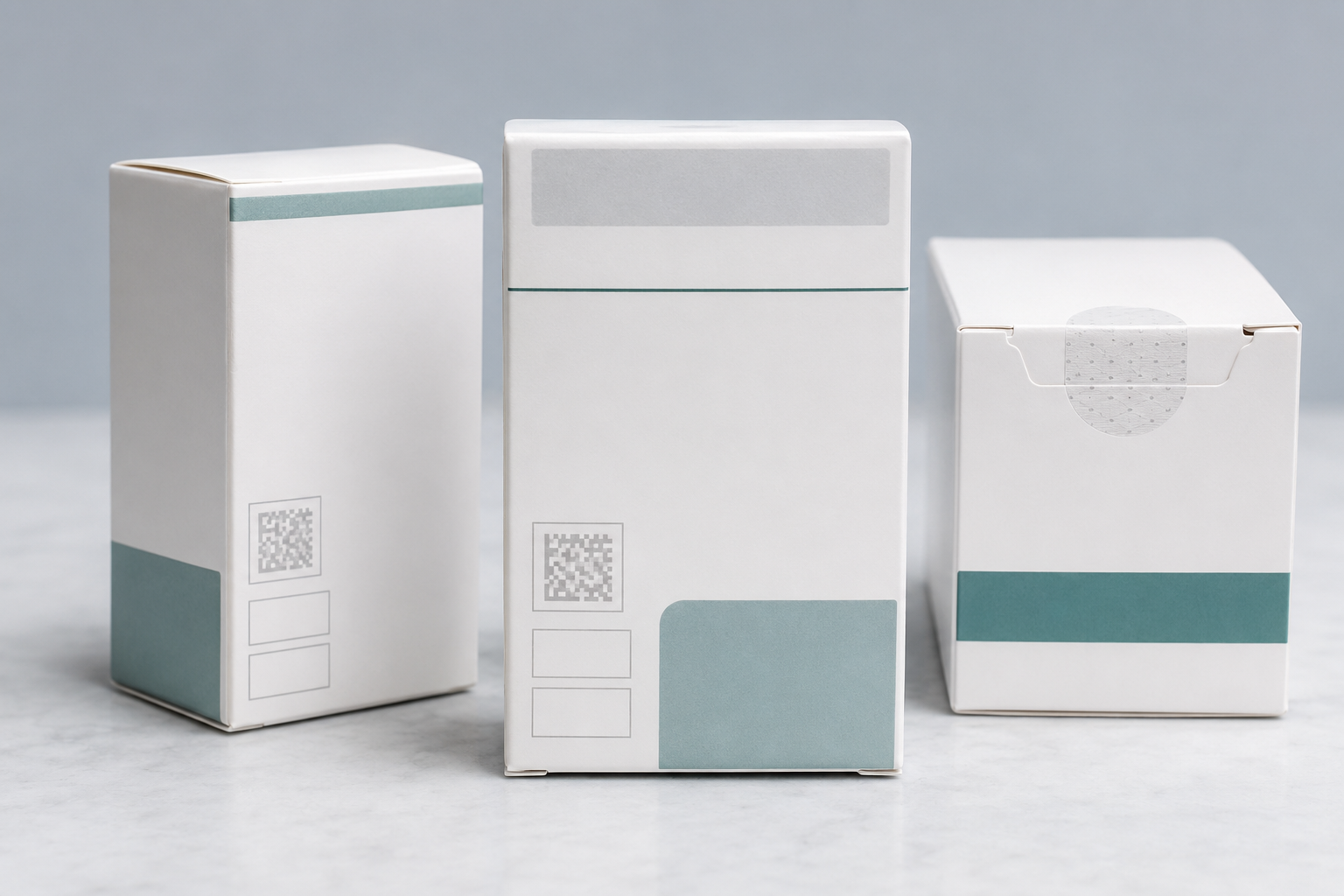
What Is the Difference Between Tamper-Evident and Child-Resistant Packaging?
These terms are related to safety, but they do not mean the same thing.
Tamper-Evident Features for Covered OTC Drug Products
Tamper-evident packaging is designed to show visible evidence of opening or entry. A shrink band, neck band, label seal, breakable closure, or overwrap may serve this function when it is properly selected and applied to the relevant package. The U.S. regulation for tamper-evident packaging applies to covered OTC human drug products and describes package features that provide visible evidence to consumers if tampering has occurred. See 21 CFR 211.132 for the current rule.
An outer carton can support a seal or provide a place for a feature, but the specified package system determines whether the feature serves the intended function. Document the component, placement, application method, inspection criteria, and opening behavior.
Child-Resistant Performance and the Relevant Package Layer
Child-resistant packaging is a performance concept for covered household substances. It applies to the relevant finished package and test conditions, not to a generic carton statement. The CPSC guidance on special packaging explains the framework. A folding carton around an ordinary bottle does not automatically create a child-resistant package.
If a product needs child-resistant performance, identify which layer provides it. It may be the primary closure, a blister, an exit package, or another defined system. The carton then needs to fit and protect that approved system without preventing proper use or inspection.
Selecting a Carton Around the Approved Closure System
Measure the approved closure, band, seal, and container together. Confirm that the carton does not scrape the seal, press against a cap, or prevent an opening-evidence feature from being inspected. If the package must be upright, build that orientation into the insert and case pack.
How Do Packaging and Labeling Controls Prevent Mixups?
Mixup prevention begins with the material and continues through line setup, inspection, and disposition. It is not solved by adding more graphics.
Material Receipt, Identification, and Release
Assign each carton, insert, label, seal, and shipper a controlled description and status. On receipt, compare the material to the approved specification. Store it so different products, strengths, dosage forms, and quantities remain identifiable. Release only material that meets the written acceptance criteria.
Line Clearance, Separation, and 100 Percent Checks
Before a packaging run, remove prior materials from the line and confirm the next approved materials. During the run, use the quality controls appropriate to the process. 21 CFR 211.122 describes special controls for cut labeling used with individual unit cartons or multiunit cartons, including dedicated lines, electronic examination, certain visual checks, or automated techniques that prevent incorrect labeling from being processed. The responsible manufacturer determines the method that applies.
Artwork Ownership, Batch Records, and Change Management
The packaging project should identify who owns the artwork, print master, variable data, proof approval, line parameters, and batch record. A converter can maintain production records for the supplied component, but it should not make the final drug-label decision. This division keeps commercial production aligned with the quality system.
How Should Pharmaceutical Boxes Be Tested for Distribution?
Visual approval alone does not show whether a carton will protect a product. Use a staged approach: first check dimensions and packout, then assess representative handling, then run any formal test plan that the channel or quality system requires.
Unit Fit and Packout Evaluation
Build a physical sample using the actual or production-equivalent bottle, vial, blister, leaflet, insert, seal, and cap. Check product retention, closure clearance, carton opening, leaflet placement, code visibility, and case pack. Test the worst-case product variant, not only the easiest one.
Drop, Vibration, Compression, and Abrasion
The relevant hazards depend on the channel. Parcel shipments can expose packages to drops and vibration. Warehouse storage can add compression. Retail or wholesaler handling can cause rub and crushed corners. A plan should define the actual product, unit carton, case, pallet, orientation, and shipment route. Retest if the product, insert, case pack, board, or distribution channel changes.
Pilot Runs, Physical Samples, and Reorder Controls
A pilot run gives the team a chance to observe real line behavior, code placement, rejection handling, count accuracy, and packout. Record the approved configuration so a later reorder does not quietly change the material, dieline, artwork, or variable-data process.
Which Sustainability Claims Require Evidence?
Fiber-based cartons can reduce plastic use in certain package layers, but an environmental statement must describe the actual attribute. The FTC Green Guides require environmental marketing claims to be truthful and supported.
Recycled Content and Material Reduction
If recycled content is requested, verify the board supplier's documentation and the exact percentage claim. If material reduction is the goal, compare the approved structure, board, insert, and shipment protection. A thinner carton that increases damage is not automatically a better outcome.
FSC Claims and Approved Artwork
FSC marks and claims need the correct certification or license route. FSC chain-of-custody guidance explains the supply-chain framework. Do not place an FSC logo in artwork until the claim, material path, and authorization are verified.
Coatings, Windows, and Local Recovery Conditions
A carton may contain coatings, film windows, foil, adhesives, or attached components that affect how it is accepted locally. State the material composition and local recovery condition rather than using an unqualified environmental label.
What Should You Provide for a Pharmaceutical Packaging Quote?
A complete quote request reduces rework and protects the approval schedule. Start with the product and the market, then add the package layer, structure, materials, print, quality controls, and distribution plan.
Product, Market, and Package-Layer Information
Provide the product type, primary container drawing or sample, filled weight, dimensions, closure, leaflet, market, and channel. Identify whether the request is for an immediate container component, unit carton, multipack, display, case, or parcel shipper.
Structure, Artwork, Quality, and Variable-Data Requirements
Provide the preferred structure, internal dimensions, board or material requirements, insert, coating, finish, quantity, and destination. Include an approved or draft dieline, artwork source file, color requirements, code area, variable-data specification, inspection expectations, and sign-off owner. Do not wait until the press date to decide where variable data will go.
Sample, Pilot, and Production Approval Plan
State whether you need a digital proof, blank structural sample, printed sample, or pre-production pilot. Then identify who approves fit, copy, color, code placement, packout, and final production. This sequence prevents a commercial deadline from becoming a quality-control shortcut.
Choosing Custom Pharmaceutical Boxes for a Controlled Packaging Workflow
The best pharmaceutical carton is the one that fits the specific product, carries approved information clearly, supports the required data and inspection process, and arrives at the right package layer for the distribution route. It should be built around the controlled workflow, not around a generic claim.
Start with the actual container and the destination market. Define the carton, insert, code panel, seal area, shipper, and approval steps as separate decisions. Then use a physical sample and the responsible quality process to confirm the configuration before production.
Packaging in Time can help you specify a custom printed carton, insert, or shipping component from those approved requirements. Share your product dimensions, package layer, artwork status, market, channel, variable-data needs, and quantity request to begin a practical packaging discussion.