
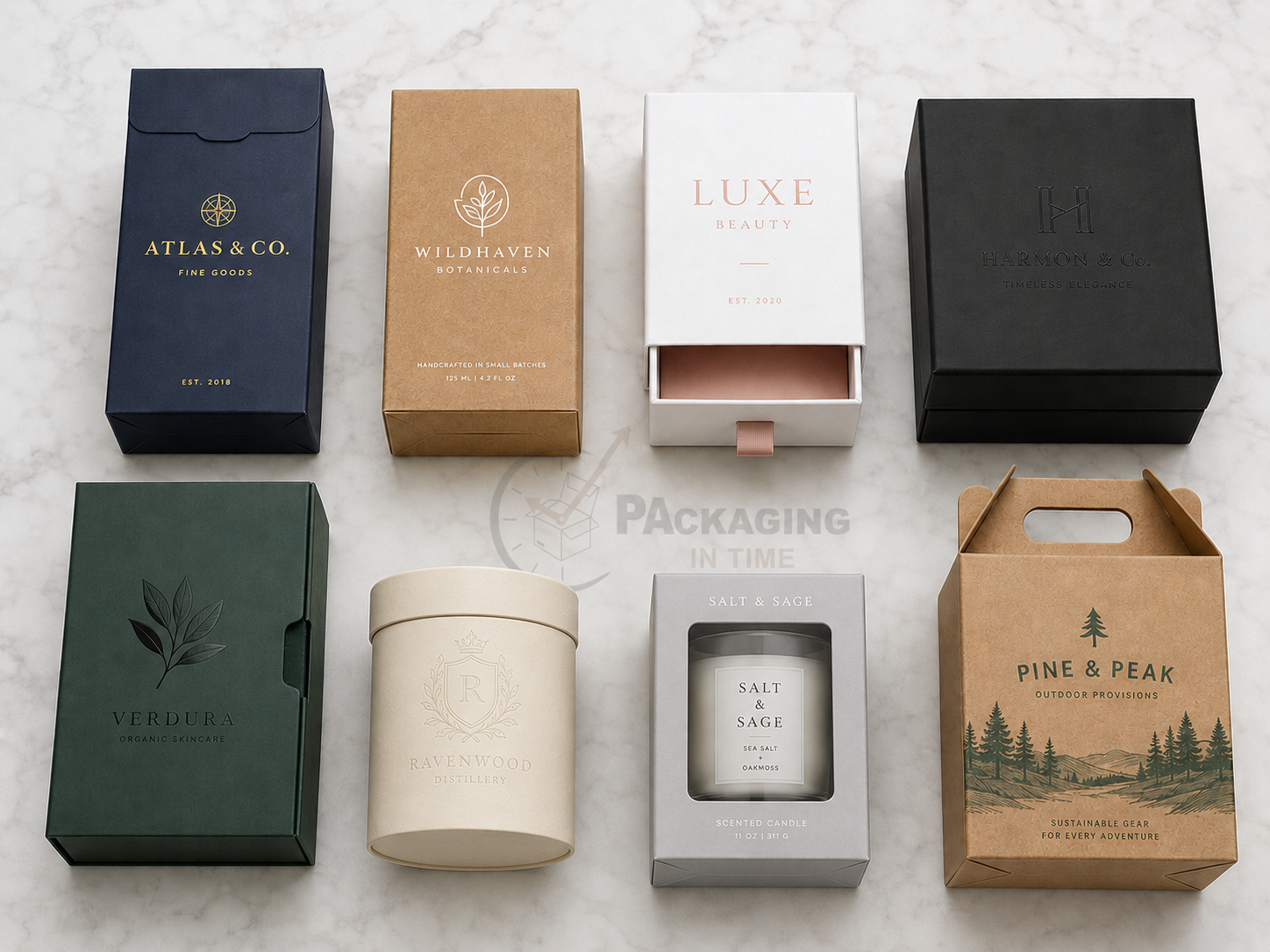
Custom product boxes sit at the center of a brand’s physical presentation strategy. A custom printed product box houses a specific product in a container built to its exact dimensions, carries the brand’s artwork across multiple printable panels, and communicates product quality before the consumer touches what is inside. The structural type of a custom product box, tuck-end folding carton, auto-lock bottom, sleeve and tray, rigid lid-and-base, or magnetic closure, determines how it is assembled, how it is displayed, and how it is perceived at point of sale or in an unboxing event. The sizes of custom product boxes are specified as internal dimensions to the 1/16-inch, with clearance allowances that affect both product fit and production line packing speed. The printing options available for custom product boxes range from short-run digital printing at 50 units to high-volume offset lithography with Pantone spot color accuracy above 500 units. This guide covers types, sizes, and printing options so brand owners and product managers can specify the right custom product box for their product, their retail channel, and their production volume.
What Are Custom Product Boxes?
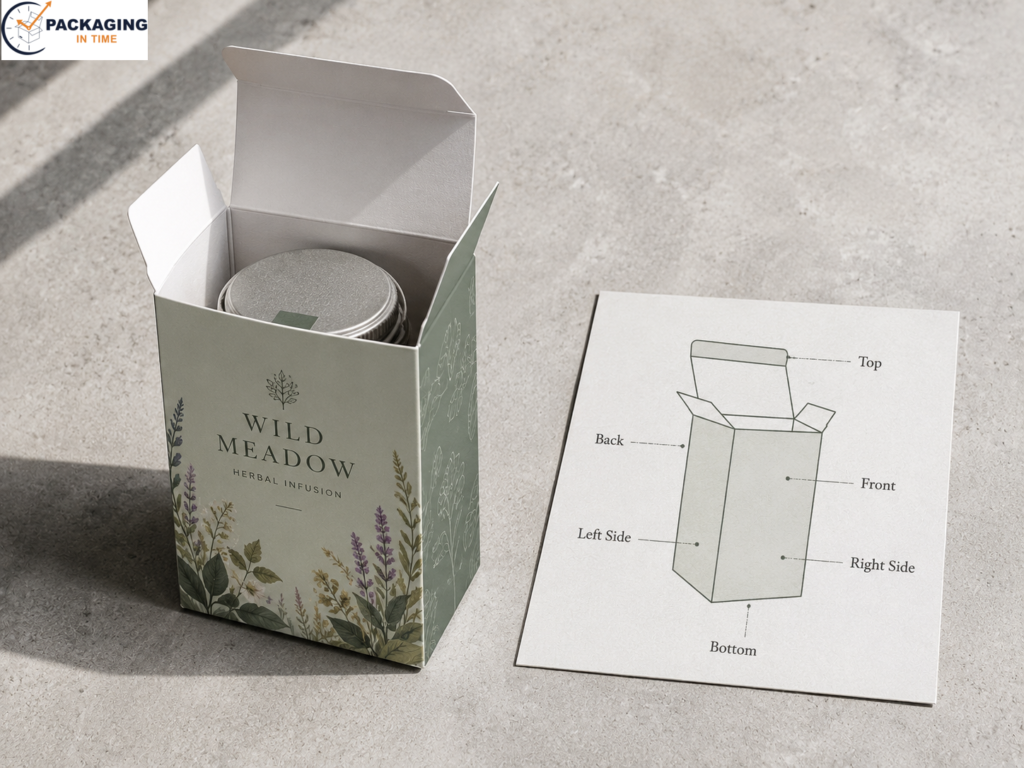
Custom product boxes are printed, product-fitted containers produced from paperboard, kraft board, or rigid board, engineered to the exact internal dimensions of a specific product, decorated with brand artwork, and designed to present the product on a retail shelf, in a gifting context, or in a direct-to-consumer unboxing event. Every custom product box starts as a flat die-cut sheet, called a dieline, that is scored along fold lines, cut to the box outline, and glued at seams to form a three-dimensional enclosure. The structural style of the box determines how the dieline is engineered, how many printable panels it provides, and how it closes. The substrate determines the structural strength and print surface quality. The printing method and finishing treatment determine how the brand appears on each panel.
Custom product boxes are a category within the broader custom packaging boxes family. The root distinction between a custom product box and other custom packaging formats is its audience: a custom product box is designed to be seen, held, and read by the end consumer. It is the primary brand communication surface. A shipping or transit box is designed to protect the product during carrier handling, its exterior may carry brand artwork, but its structural engineering priority is compression resistance and drop performance, not shelf presence or unboxing experience.
How Are Custom Product Boxes Different from Shipping Boxes?
A custom product box is the consumer-facing container, it sits on a shelf, rests inside a bag at point of purchase, or is the first thing a customer sees when opening a delivery. Its exterior panels carry the product name, brand mark, ingredient or feature list, barcode, regulatory marks, and any visual identity elements the brand uses to distinguish the product at retail. A shipping box, typically a corrugated outer, is the transit container that protects the product box and its contents during carrier handling. Many e-commerce brands ship a custom product box inside a corrugated mailer box as two distinct packaging layers: the mailer handles transit protection, and the product box handles brand presentation. In a retail channel, the custom product box is the only packaging layer the consumer sees on the shelf; no shipping outer is visible.
How Are Custom Product Boxes Different from Stock Boxes?
Stock product boxes are manufactured to standard dimensions, typically in whole-inch increments, with no print, no brand artwork, and no product-specific engineering. A stock box for a 3.5-inch-tall product is sold in a 3-inch or 4-inch standard height, leaving void space above or below the product that requires void fill or results in product movement inside the closed box. Custom product boxes are produced to the product’s exact internal dimensions, printed with the brand’s full-color artwork across all panels, and finished to the brand’s visual standard. The practical consequence is measurable: a custom product box built to fit eliminates rattle, reduces void fill cost, lowers dimensional weight charges when the product is shipped, and communicates brand identity at every consumer touchpoint that a plain white or brown stock box cannot.
What Industries Use Custom Product Boxes?
Custom product boxes serve every consumer-facing product category where brand differentiation at point of sale is a commercial priority. Cosmetics and personal care brands use custom tuck-end and sleeve product boxes for serums, moisturizers, supplements, and fragrance products. Food and beverage brands use custom product boxes for specialty confectionery, tea, spice sets, and wellness products. Pharmaceutical and supplement brands use custom product boxes that carry regulatory compliance panels alongside brand artwork. Candle brands use auto-lock bottom or rigid product boxes that support the weight of glass or ceramic vessels. Electronics accessory brands use rigid or magnetic closure product boxes for earphones, chargers, and smart devices. Apparel brands use folding carton or rigid product boxes for folded garments, belts, and accessories. In each category, the custom product box is the primary physical brand asset the consumer interacts with before the product itself.
What Are the Types of Custom Product Boxes?
Custom product boxes are produced in eight primary structural styles. Each style is defined by its dieline geometry, closure mechanism, panel count, and the product weight, product category, and retail channel it serves best.
Tuck-End Folding Carton Product Boxes
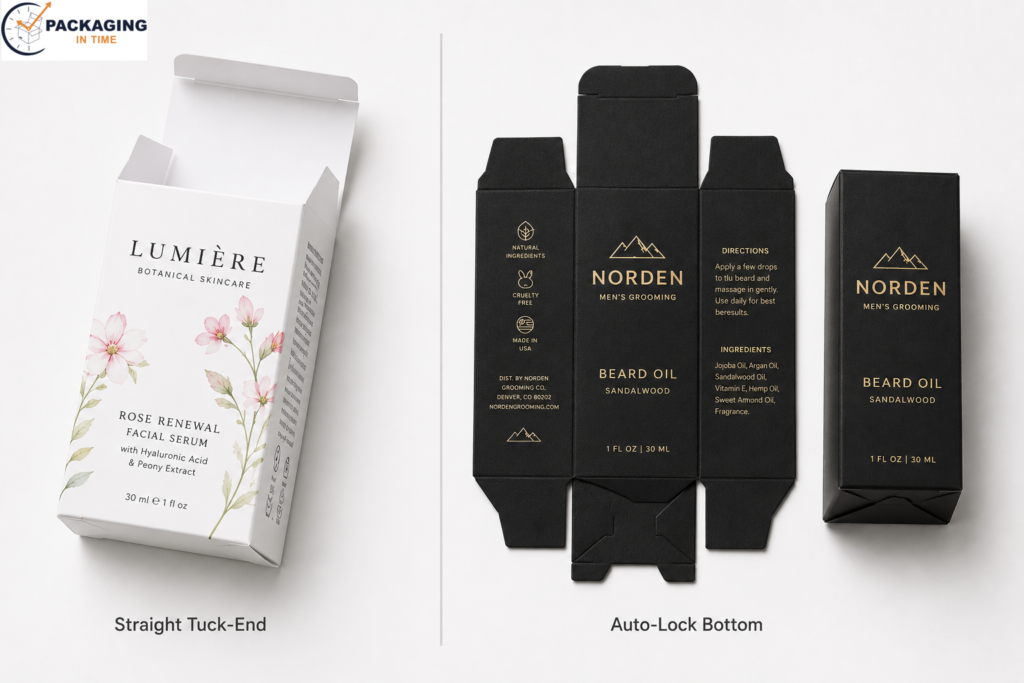
Tuck-end folding carton product boxes are produced from a single flat sheet of paperboard, SBS, CUK, or CCNB, scored into six panels (front, back, top, bottom, and two sides) with extended flaps on the top and bottom panels that fold inward and tuck into the box interior to close the structure. No glue is applied at the closure points, the friction between the tucked flap and the interior panel walls holds the box closed under normal handling conditions. The straight tuck-end style tucks both the top and bottom flaps in the same direction (toward the front panel), making it the fastest to assemble on an automated production line. The reverse tuck-end style tucks the top flap toward the back panel and the bottom flap toward the front panel, producing a cleaner front panel appearance because neither visible edge of a tucked flap is visible from the primary retail-facing side. Tuck-end folding carton product boxes suit lightweight retail products under approximately 1 lb, cosmetics, pharmaceuticals, food supplements, tea, and personal care items. They are the most widely produced custom product box style globally because their flat-sheet construction is compatible with high-speed sheet-fed offset printing presses and their assembly requires no tooling at the brand’s facility.
Auto-Lock Bottom Product Boxes
Auto-lock bottom product boxes share the same six-panel folding carton structure as a tuck-end box on the top three panels, front, back, sides, and a standard tuck-end top closure, but replace the tucked bottom flap with four interlocking base panels engineered to lock into a closed, load-bearing position when the box is pushed open from flat. The auto-lock base requires no tape, no glue, and no manual panel manipulation: the four base panels interlock under the force of the box being opened, creating a base that remains closed under product load. This makes the auto-lock bottom product box the standard for products that exceed the load capacity of a standard tuck-end base, glass candle jars, heavy skincare bottles, ceramic items, and packaged food items above 1 lb. Auto-lock bottom boxes require a slightly more complex dieline than a standard tuck-end, and consequently cost approximately 8 to 15% more per unit at equivalent quantity and substrate. That cost differential is recovered in reduced damage rates and eliminated taping labor on the brand’s production line.
Sleeve and Tray Product Boxes
Sleeve and tray product boxes consist of two components: a tray, a shallow, open-top container that holds the product, and a sleeve, a tube of printed paperboard that slides over the tray to enclose it. The sleeve is the primary printable surface for brand artwork, providing four uninterrupted exterior panels with no closure flaps, no tuck points, and no structural interruptions across the printable area. The tray provides the structural base and interior support for the product. This two-component structure is used in premium cosmetics, consumer electronics packaging, specialty confectionery, and personal care products where the brand requires a smooth, uninterrupted exterior print canvas combined with a structurally stable product holder inside. The sliding action of removing the sleeve from the tray is also a deliberate brand interaction, the controlled resistance of the sleeve sliding off the tray is a tactile quality signal that consumers associate with premium product positioning.
Rigid Lid-and-Base Product Boxes
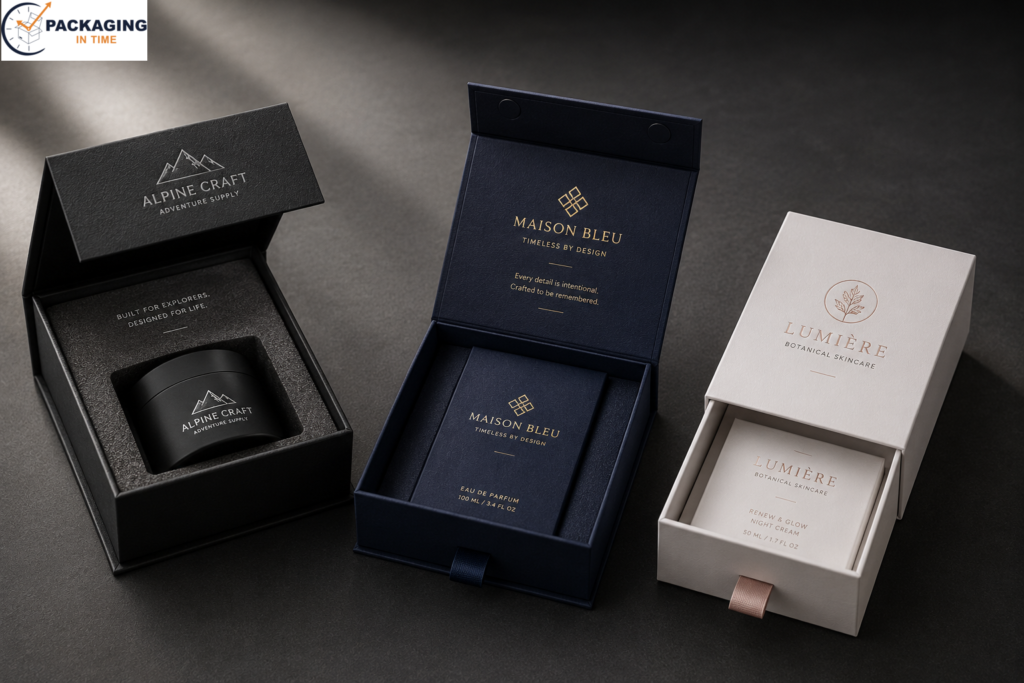
Rigid lid-and-base product boxes are constructed from thick greyboard (chipboard) in thicknesses from 1.5mm to 4mm, wrapped in printed paper, specialty paper, or fabric. Unlike folding carton product boxes, rigid boxes are pre-assembled at the manufacturing facility and cannot be collapsed for flat shipping, they ship in their final three-dimensional form, which increases freight cost but eliminates assembly time at the brand’s facility. The telescoping lid-and-base configuration consists of two separate pieces: a lid that drops over the base, overlapping the base walls by approximately 10mm to 20mm. The depth of the lid overlap determines how easily the lid removes and how secure the closure feels to the consumer. Rigid lid-and-base product boxes are used for premium cosmetics, jewelry, electronics accessories, spirits, high-end confectionery, and gifting applications where the box itself is part of the product’s perceived value and where the brand’s price point justifies the 3 to 8x higher per-unit cost compared to a folding carton equivalent.
Magnetic Closure Product Boxes
Magnetic closure product boxes are a variant of the rigid set-up box structure in which neodymium magnets are embedded into both the lid panel and the corresponding front wall of the base during manufacturing. When the lid is brought to the closed position, the magnets attract across the lid panel and base wall, producing an audible snap-close and a secure closure that requires deliberate force to open. The embedded magnet closure eliminates visible hardware, no clasps, no ribbon pulls, no velcro, keeping the exterior surface clean and uninterrupted for brand artwork. Magnetic closure product boxes are used for premium gifting, luxury cosmetics, electronics accessories packaged as gifts, and subscription products where the unboxing experience is a core brand differentiator. They are produced from 2mm to 3mm greyboard with printed paper wrap and are available with interior tray inserts, ribbon pulls on the base for product extraction, and foam, cardboard, or molded pulp inserts to hold the product in a fixed position inside the base.
Two-Piece Shoulder-and-Neck Product Boxes
Two-piece shoulder-and-neck product boxes are a rigid box configuration in which a base piece with raised interior walls, called the neck, fits inside the lid when closed, providing an additional layer of structural alignment between the lid and base beyond what a standard telescoping configuration offers. The neck sits proud of the base by 5mm to 15mm and contacts the interior walls of the lid when closed, preventing the lid from shifting laterally. This configuration is the standard for premium perfume and fragrance product boxes, where the lid must align precisely with the base at all times and where lateral movement of the lid on the base would signal poor manufacturing quality. Two-piece shoulder-and-neck boxes are also used for premium skincare sets, watch boxes, and jewelry presentation boxes in the mid-to-luxury price segment.
Window Product Boxes
Window product boxes are folding carton or rigid product boxes with a die-cut aperture in one or more panels, covered by a clear PET (polyethylene terephthalate) film bonded to the interior surface of the panel. The window allows the consumer to see the product, its color, texture, form, or quantity, without opening the box, which reduces return rates for products where visual product attributes drive the purchase decision. Window product boxes are standard in toy packaging (where the product’s visual complexity is a key purchase driver), specialty food (where product color or form signals quality), cosmetics (where product color must be evaluated against the consumer’s skin tone), and stationery or craft products (where the product variety in a set is visible through the window). The PET film used for the window is specified by thickness (typically 100 to 250 microns) and clarity grade based on the product’s humidity exposure and the temperature range of the storage and retail environment.
Gable Top Product Boxes
Gable top product boxes are folding carton structures with an integrated carry handle formed by the folding of the top panels into a peaked arch. The handle is engineered from the top panels of the box folding into interlocking tabs that form a rigid arch without any additional hardware, no wire, no ribbon, and no separate handle component. This handle forms at assembly and provides a functional carrying grip that makes the gable top product box dual-purpose: a product container and a carry bag substitute. Gable top product boxes are used in food service (bakery items, popcorn, juice, specialty snacks), gift retail (candles, bath sets, small gifting products), and promotional packaging (event giveaway bags, branded retail carry boxes). They are produced from SBS board or CUK kraft board, with food-safe aqueous or PE coating applied when the box will be in direct contact with food products.
What Sizes Do Custom Product Boxes Come In?
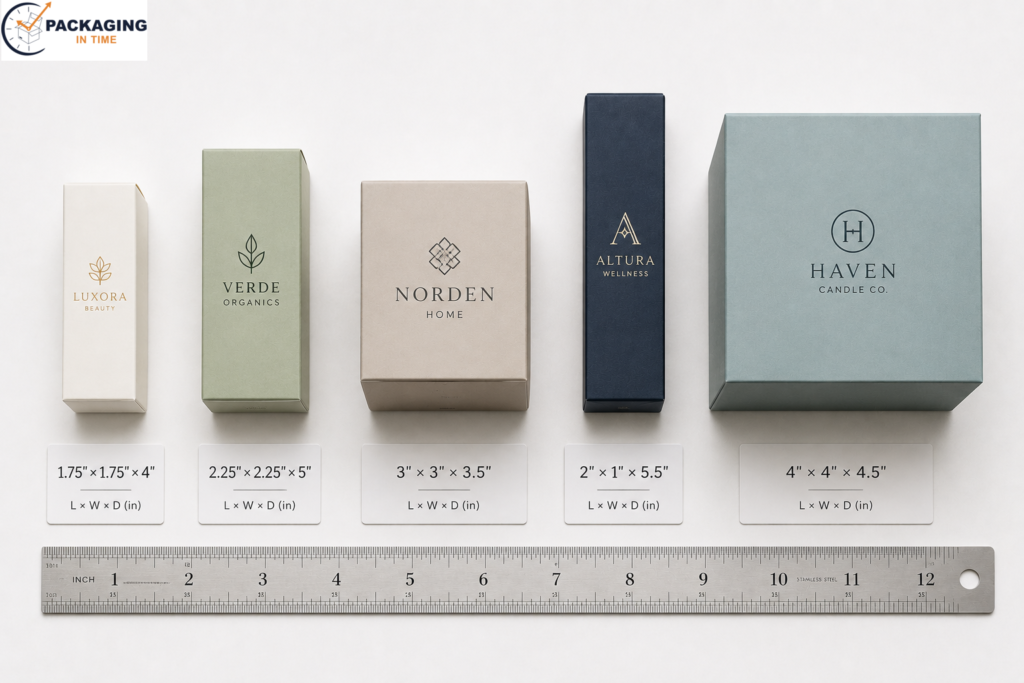
Custom product boxes are available in any size that a dieline can be engineered to produce within the structural limits of the chosen substrate. There is no fixed catalog of sizes for custom product boxes, the defining characteristic of a custom box is that its dimensions are determined by the product, not by a supplier’s standard tooling.
How Are Custom Product Box Sizes Measured?
Custom product box sizes are specified as internal dimensions in the order Length × Width × Depth, abbreviated L × W × D. Internal dimensions are measured from the interior wall surface of the assembled box on each axis, not from the exterior surface and not from the dieline flat dimension. Length refers to the longest horizontal dimension of the box when it is standing upright in its retail-facing position. Width refers to the shorter horizontal dimension (the depth of the box from front panel to back panel). Depth refers to the vertical dimension from the base to the top closure. This L × W × D notation is the standard used by Packaging in Time and by the packaging industry globally. Artwork submitted with dimensions specified in external measurements rather than internal measurements will produce a box that is smaller than specified by twice the board caliper (typically 0.028 to 0.048 inches shorter on each axis for a 14pt to 24pt SBS folding carton).
What Are Standard Custom Product Box Sizes by Industry?
Several product categories have converged on common custom product box dimension ranges that reflect the dominant product form factors in each industry.
Cosmetics serums and moisturizers in 30ml to 50ml bottle formats are most commonly packaged in tuck-end folding cartons ranging from 1.75″ × 1.75″ × 4″ to 2.5″ × 2.5″ × 5.5″ internal dimensions. Supplement and pharmaceutical capsule bottles in 60-count to 120-count format use tuck-end boxes from 2″ × 2″ × 4.5″ to 2.75″ × 2.75″ × 5.5″. Standard jar candles in 8oz to 12oz formats use auto-lock bottom boxes from 3.25″ × 3.25″ × 3.5″ to 4.25″ × 4.25″ × 4.75″. Retail pharmacy card or blister pack products use tuck-end boxes from 2″ × 0.75″ × 4″ to 2.25″ × 1.25″ × 5.5″ to fit standard pegboard hook display fixtures. These ranges are not binding standards, brands deviate from them when their product’s form factor requires it, but they reflect the most commonly produced custom product box sizes in each category and are available from Packaging in Time on pre-tooled dielines that reduce lead time and eliminate die tooling cost.
Custom Size vs. Standard Size: When Does a New Die Pay Off?
A standard size custom product box is produced on a pre-tooled dieline, a die that already exists in the supplier’s tooling library. No new die needs to be machined, which eliminates a one-time die tooling cost of $80 to $250 per box style and reduces lead time by 2 to 5 business days. However, a standard size box built to the nearest pre-tooled dimension will not fit the product as precisely as a fully custom box built to the product’s exact measurements. The question of whether a new die pays off depends on two factors: the volume of the order and the precision of fit required.
For a brand ordering 5,000 or more units per run, the die tooling cost of $80 to $250 represents less than $0.05 per unit, an insignificant per-unit premium for an exact product fit. For a brand ordering 100 units on a digital print run, the die cost adds $0.80 to $2.50 per unit, meaningful at that volume. In that case, choosing the nearest pre-tooled standard size is the more practical decision if the dimensional difference is within 1/4 inch on any axis. A product that requires an exact fit, a fragile item that cannot tolerate any panel-to-product gap, a retail product whose shelf footprint is constrained by a planogram, or a luxury item where rattle inside the closed box is commercially unacceptable, justifies a new die at any volume.
How Much Clearance Should a Custom Product Box Have?
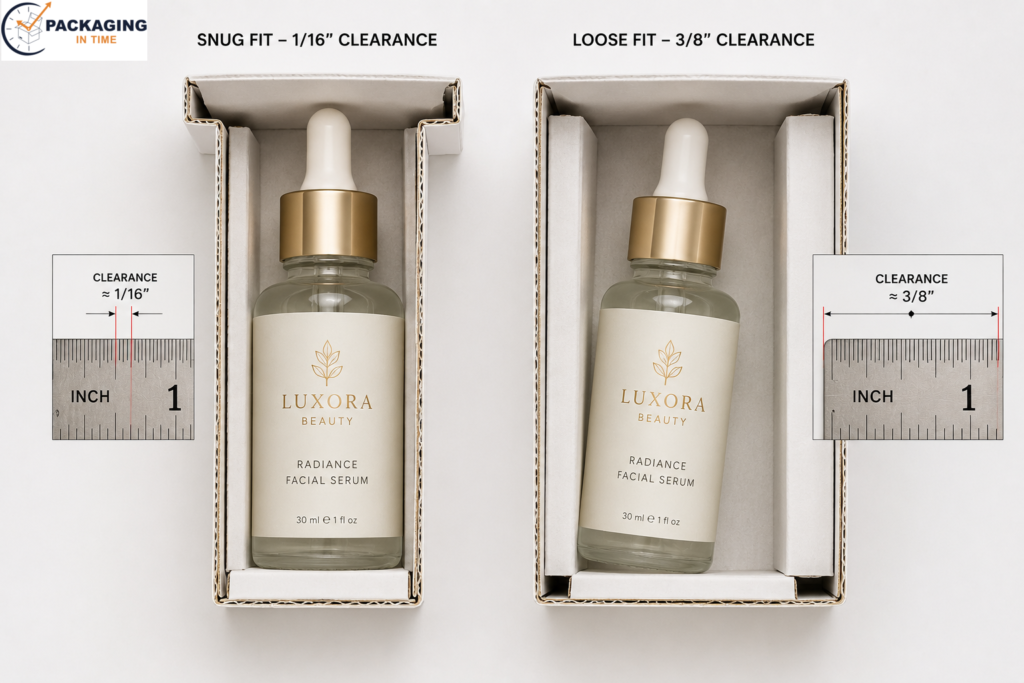
Clearance is the gap between the product’s outer dimension and the custom product box’s internal wall surface on each axis. A clearance allowance of 1/16 inch (1.6mm) to 1/8 inch (3.2mm) per side is the standard specification for most custom product box styles and product types. This clearance allows the product to insert smoothly by hand or on an automated filling line without binding against the interior walls.
Clearance below 1/16 inch on any axis causes panel binding during product insertion, the product contacts the interior wall before reaching its seated position, deforming the box panel under insertion pressure and slowing packing speed. Clearance above 3/16 inch (4.8mm) on any axis allows the product to move inside the closed box, producing the rattle that consumers associate with poor product fit and low product quality. For fragile products, glass bottles, ceramic items, and electronic components, a secondary foam or cardboard insert is specified inside the custom product box to eliminate movement at clearances above 1/8 inch.
What Materials Are Used for Custom Product Boxes?
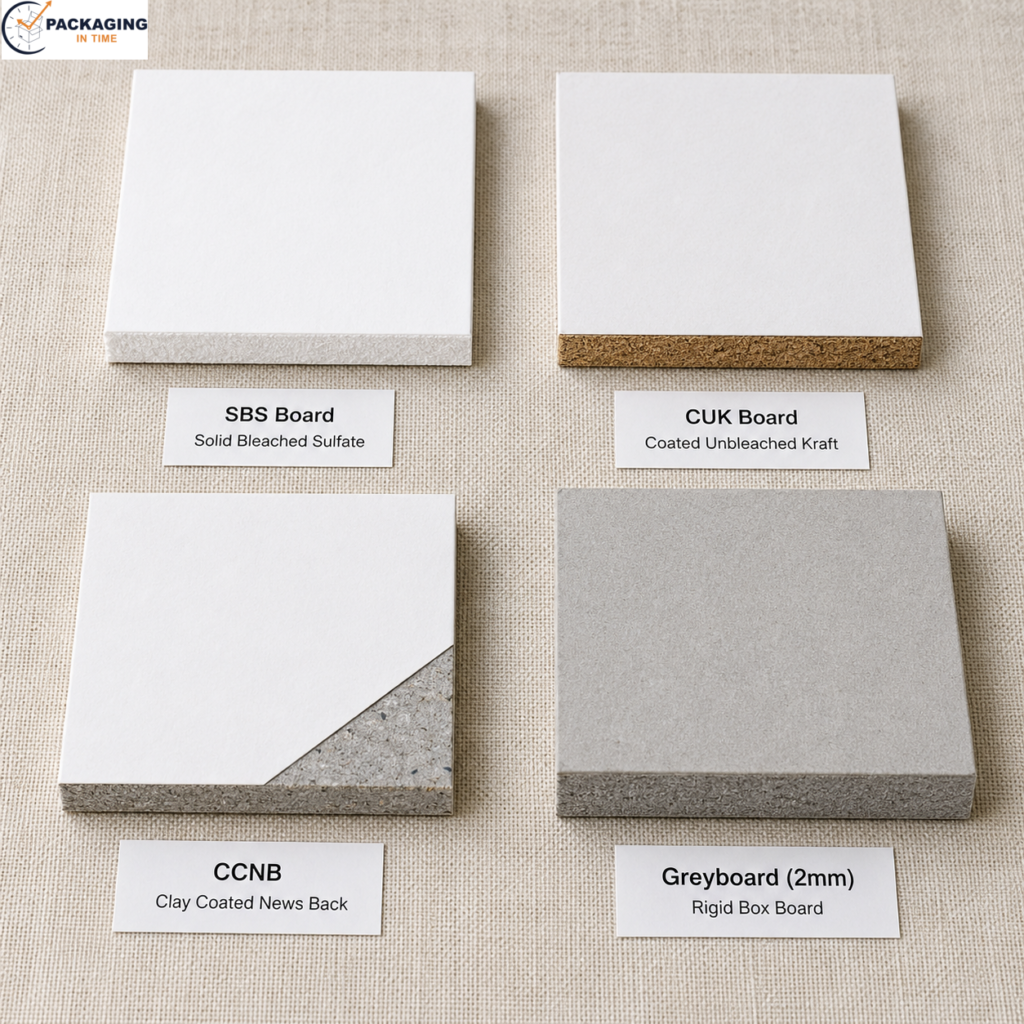
The substrate is the structural and surface foundation of a custom product box. It determines the box’s stiffness, its printable surface quality, its weight, and its compatibility with finishing treatments and retail channel requirements.
SBS Board for Retail Custom Product Boxes
Solid Bleached Sulfate board is produced from 100% virgin bleached wood fiber, providing a bright white clay-coated face on both sides with a smooth surface suited for high-resolution offset printing. SBS is available in calipers from 14pt (0.014 inches) to 24pt (0.024 inches) for standard custom product box applications, with basis weights from 60 lb to 120 lb. The bright white clay-coated surface allows CMYK inks to reproduce at full color gamut without graying or color shift, making SBS the preferred substrate for custom product boxes in cosmetics, pharmaceuticals, food supplements, and any category where brand color accuracy is a commercial requirement. SBS is compatible with all printing methods, digital, offset, and flexographic, and with all finishing treatments including foil stamping, embossing, and UV coating. For custom product boxes requiring food contact compliance, SBS is available with FDA-compliant coatings that prevent ink migration from the exterior printed surface to the product interior.
CUK Kraft Board for Natural-Finish Product Boxes
Coated Unbleached Kraft board is produced from unbleached kraft fiber, providing a clay-coated white face on the exterior and an unbleached brown fiber structure visible on the interior panels and cut edges. CUK produces the visual signature of “kraft packaging”, the natural brown edge and interior that signals organic, artisanal, or sustainably positioned brand identity, while maintaining a white coated exterior face adequate for color printing. CUK provides comparable stiffness to SBS at equivalent caliper, but its unbleached interior means the inside panels of a custom product box will show brown rather than white. Brands that use CUK for their custom product boxes must account for this in their interior panel design: any artwork that requires white interior panels must specify SBS board instead. For brands where the natural kraft aesthetic is a deliberate part of the brand identity, specialty food, botanical personal care, handcraft goods, CUK is the standard substrate choice.
CCNB Recycled Board for High-Volume Product Boxes
Clay-Coated News Back board is produced from 100% recycled fiber, post-consumer and post-industrial waste paper, with a clay-coated white face and a grey newsprint-colored back and interior. CCNB is the most cost-effective custom product box substrate and is used for high-volume consumer goods packaging where per-unit cost is the primary specification driver and interior panel appearance is not a brand consideration. Breakfast cereal boxes, laundry detergent cartons, over-the-counter pharmaceutical packaging, and general grocery product boxes are the dominant applications for CCNB. The recycled fiber content of CCNB supports sustainability certification claims and contributes to retailer sustainability scorecards for brands selling through major retail chains. However, at equivalent caliper, CCNB produces lower stiffness than SBS due to the variable fiber quality of its recycled content, brands specifying CCNB for custom product boxes that require high structural stiffness must specify a heavier caliper (typically 18pt to 24pt) to achieve the same panel rigidity as a 14pt to 18pt SBS box.
Rigid Greyboard for Premium Product Boxes
Greyboard is a dense chipboard produced from compressed recycled fiber in thicknesses from 1.5mm to 4mm. It does not carry a printable surface of its own, instead, greyboard forms the structural core of a rigid custom product box, and printed paper, specialty paper, fabric, or leatherette is wrapped and bonded to the exterior surface to provide the brand artwork surface. The greyboard thickness determines the structural weight and permanence of the custom product box: 1.5mm greyboard produces a mid-weight rigid box used for mid-market gifting and premium cosmetics; 2mm to 2.5mm greyboard is the standard for luxury cosmetics, electronics accessories, and spirits; 3mm to 4mm greyboard is reserved for high-end jewelry, watch boxes, and premium gifting applications where the box must convey permanence and value as an object independent of the product it contains. The wrap paper for a rigid custom product box is printed separately on an offset press, laminated or coated if required, and then bonded to the greyboard structure during assembly, a process that requires 15 to 20 business days from proof approval at Packaging in Time.
How Board Caliper Affects Custom Product Box Strength and Cost
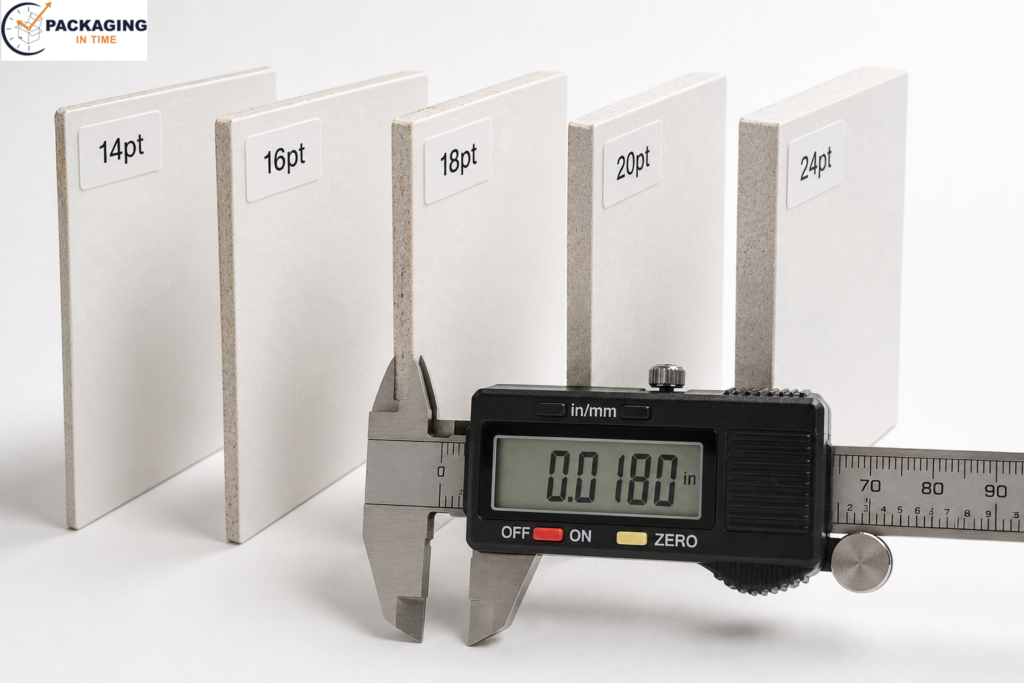
Board caliper, measured in points (pt), where 1 point equals 0.001 inches, is the primary structural variable for folding carton custom product boxes. Caliper affects stiffness, panel flatness, finish quality, and per-unit cost simultaneously. A 14pt SBS box provides adequate stiffness for products under 0.5 lb in a retail shelf context. An 18pt SBS box supports products up to 1.5 lb without base reinforcement. A 24pt SBS box provides stiffness suitable for heavier products and for custom product boxes that must maintain flat, unbowed panels under long-term retail shelf storage. Each point of caliper increase adds approximately 2 to 5% to the per-unit material cost of the custom product box. For brands choosing between 16pt and 18pt SBS, the 2pt difference represents a 4 to 10% material cost increase, a meaningful consideration at volumes above 5,000 units per run.
What Are the Printing Options for Custom Product Boxes?
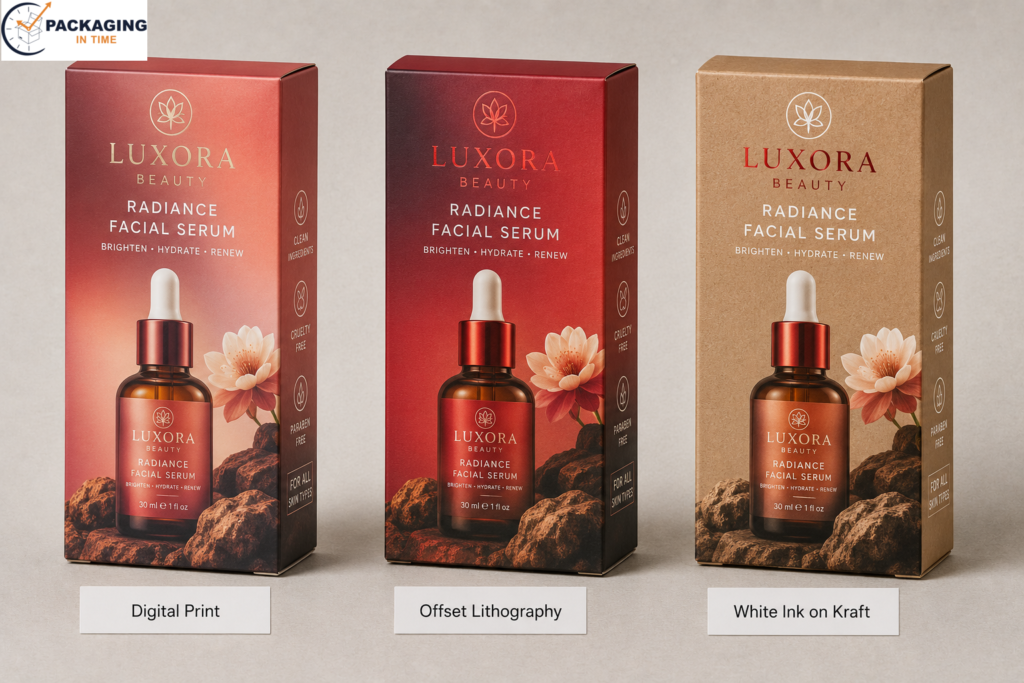
The printing method applied to a custom product box determines the color accuracy, image resolution, per-unit cost structure, minimum viable order quantity, and the type of artwork each method reproduces most effectively.
Digital Printing for Short-Run Custom Product Boxes
Digital printing applies toner (in electrophotographic presses) or inkjet ink directly onto the substrate surface without the use of printing plates. Because no plates are produced, there is no plate setup cost, making digital printing economically viable for short-run custom product box production of 50 to 500 units. Digital printing is the correct method for product launches where sell-through is unproven, for seasonal or limited-edition custom product boxes where a full offset run would result in unsold inventory, and for products with high SKU fragmentation where each SKU requires a unique artwork version. Digital printing supports variable data within a single production run, each box can carry a unique serial number, personalized name, or QR code without stopping the press or changing the setup. CMYK color is reproduced through the press’s standard gamut; Pantone spot colors are not natively supported but can be simulated within the press profile for most brand colors. At full magnification, digital print produces a slightly softer halftone dot structure than offset lithography, but at normal viewing distance on a retail shelf, the difference is not perceptible to the consumer.
Offset Lithography for High-Volume Custom Product Boxes
Offset lithography transfers ink from an aluminum plate to a rubber blanket and then onto the substrate surface in a three-cylinder process. Each color in the print artwork requires a separate plate: a standard 4-color CMYK job requires four plates; a job with two additional Pantone spot colors requires six plates. Plate production adds a one-time setup cost of $80 to $300 per color depending on press size. Above 500 to 1,000 units, the per-unit plate cost is amortized across enough units that offset’s ink cost advantage, lithographic inks are materially cheaper per unit than digital toner, makes it more cost-efficient than digital printing. Offset lithography produces sharper halftone dot structure, more accurate Pantone spot color reproduction, a wider color gamut, and more consistent color density across the sheet than digital printing. Sheet-fed offset is the standard production method for SBS and CUK folding carton custom product boxes. For custom product boxes requiring a precise brand color that must remain consistent across multiple production runs, cosmetics brands with brand-standard Pantone colors, pharmaceutical brands with regulated label colors, offset lithography with Pantone specification is the only printing method that guarantees run-to-run color consistency.
CMYK vs. Pantone Spot Color for Custom Product Box Consistency
CMYK is a four-color subtractive process in which cyan, magenta, yellow, and black inks are combined in varying dot percentages to reproduce a range of colors across the visible spectrum. CMYK is the standard mode for full-color photographic artwork, complex gradients, and multi-element panel layouts. However, a CMYK color built from a specific combination of four ink percentages will shift measurably between print runs as ink viscosity, substrate absorption, and press temperature vary between production sessions. Pantone (PMS) colors are pre-mixed single inks produced to a proprietary standardized formula. A Pantone ink is mixed to the same formula regardless of the press, the geographic location of the printing facility, or the production date. For custom product box brands that sell through multi-retailer channels where shelf adjacency between products from different production runs is visible to the consumer, Pantone color specification is the only method that eliminates visible color drift. Most custom product box production runs use CMYK for full-color photographic or gradient artwork with one or two additional Pantone spot colors designated for the brand mark, logo, and key brand color areas.
White Ink Printing on Kraft Custom Product Boxes
White ink printing applies an opaque white ink layer to CUK kraft board custom product boxes before or after the CMYK color layers are printed. Without a white ink base, CMYK colors printed directly onto the uncoated kraft face of a CUK board will absorb into the natural fiber surface and shift toward warm, desaturated tones, blues appear teal, whites appear cream, and vibrant colors appear muted. A white ink underprint applied to the panel area before the CMYK layers creates an opaque white base that allows CMYK colors to reproduce at full gamut on the kraft substrate. Selective white ink application, covering only the brand artwork area while leaving the natural kraft surface visible around it, is a deliberate design technique used in specialty food, botanical personal care, and artisan goods packaging, where the contrast between the printed brand panel and the natural kraft background is a visual identity element. White ink printing adds one press pass to the production process and increases per-unit cost by 8 to 18% depending on the coverage area.
What Are the Finishing Options for Custom Product Boxes?
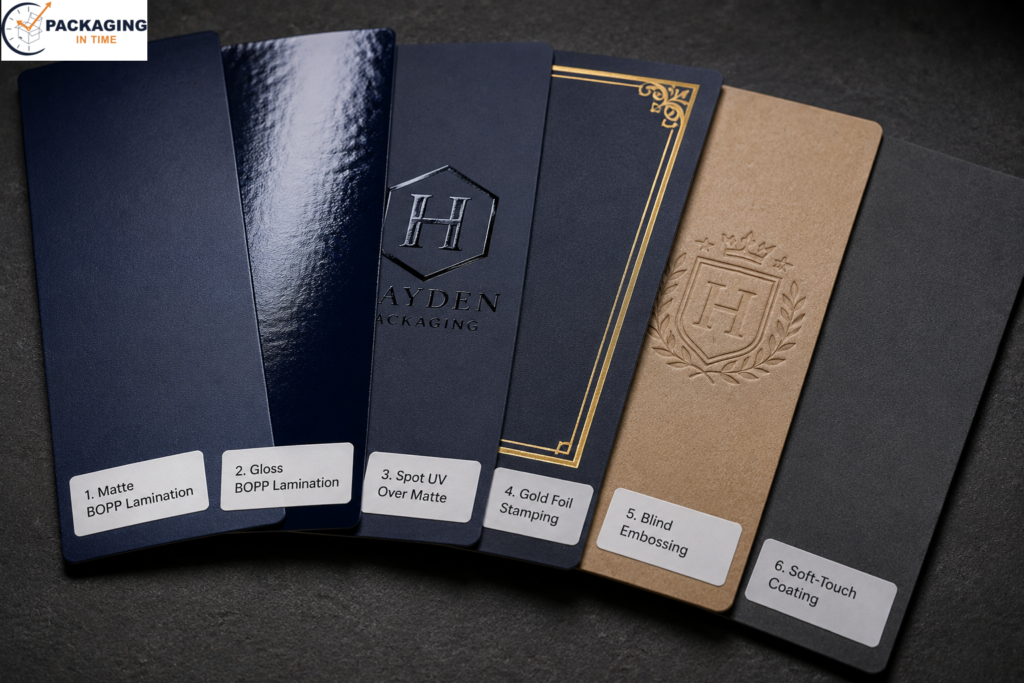
Finishing treatments are applied to the printed surface of a custom product box after printing to alter its surface appearance, tactile quality, durability, light-reflection characteristics, and recyclability.
Matte Lamination
Matte lamination bonds a 18 to 25 micron BOPP (Biaxially Oriented Polypropylene) film to the printed surface using heat and pressure. The film diffuses light reflection across the surface, producing a flat, non-shiny appearance that reduces fingerprint visibility and creates a softer, more restrained aesthetic than gloss lamination. Matte lamination is the standard finishing treatment for premium cosmetics, luxury food, and high-end personal care product boxes because it tests higher for perceived product quality in consumer research than gloss lamination at equivalent print quality, the non-reflective surface draws attention to the artwork and typography rather than the surface itself. Matte laminated custom product boxes are also more resistant to scuffing and surface scratching during retail handling than uncoated or varnished boxes. The BOPP film in matte lamination makes the box non-recyclable in standard curbside paper streams.
Gloss Lamination
Gloss lamination bonds a 12 to 18 micron BOPP film to the printed surface, producing a high-reflectance surface that intensifies color saturation and creates a vivid, high-contrast appearance under retail lighting. Gloss lamination is the standard finishing for toy packaging, children’s products, food and grocery items, and custom product boxes in product categories where color intensity and visual vibrancy are the primary shelf presence signal. Gloss laminated surfaces are highly resistant to moisture and surface contamination, making them suitable for products stored in humid environments such as bathroom personal care or kitchen food products. Like matte lamination, gloss BOPP lamination makes the box non-recyclable in standard paper recycling streams.
Spot UV Coating
Spot UV coating applies a UV-cured high-viscosity varnish selectively to defined areas of the printed panel surface, typically the brand logo, a hero graphic element, or a decorative border, rather than to the full panel. The UV varnish is cured instantly under a UV lamp, producing a raised, highly glossy, optically clear layer on the treated area while the surrounding surface retains its base finish. Spot UV over matte lamination is the most specified finishing combination for premium custom product boxes: the gloss-on-matte contrast is visible from across a standard retail gondola under fluorescent lighting, draws the consumer’s eye directly to the brand mark, and creates a tactile texture difference that reinforces the quality signal at point of touch. Spot UV requires a separate artwork file, a vector mask defining the exact areas to receive the UV varnish, in addition to the standard print artwork file.
Foil Stamping
Foil stamping transfers a thin metallic or holographic foil from a carrier film to the custom product box surface using a heated die pressed under controlled pressure. The die is machined to the exact shape of the element to be foiled, a logo, a border, a wordmark, or a decorative element. When the heated die contacts the foil carrier film and the box surface simultaneously, the foil adhesive activates under heat and bonds the metallic layer permanently to the surface. Foil colors for custom product boxes include gold, silver, rose gold, copper, champagne, matte gold, holographic rainbow, and holographic silver. Foil stamping is used on rigid product boxes, premium folding carton boxes for cosmetics and spirits, and gift packaging where a metallic element is required to signal premium or celebratory brand positioning. Foil-stamped areas cannot be overprinted with ink after stamping, and foil-stamped boxes are not recyclable in standard paper streams.
Embossing and Debossing
Embossing raises a defined area of the custom product box surface above the surrounding panel level by pressing the substrate between a male die (convex) and a female die (concave) under controlled pressure. Debossing presses the defined area below the surrounding surface using the same mechanical process in reverse. Both treatments create a three-dimensional relief on the panel that is both visible and tactile. Embossing is used on rigid product box lids, premium folding carton front panels, and sleeve box exterior surfaces to highlight a brand mark or logo with dimensional emphasis. Blind embossing, embossing applied with no ink and no foil on the embossed area, produces an understated, tone-on-tone relief effect used in luxury packaging for brands that position on craft, heritage, or minimalism. Registered embossing applies the dimensional relief over a previously printed or foiled area with precise die registration, combining the visual effect of the print or foil with the tactile dimension of the emboss.
Soft-Touch Coating
Soft-touch coating is a water-based or UV-curable surface treatment that, when applied and cured, produces a surface with a velvet-like tactile quality comparable to suede or fine matte paper. The coating is applied as a flood coat across the full panel surface. Consumer testing consistently shows that soft-touch coated custom product boxes score higher on perceived product quality and purchase intent than equivalent boxes finished with standard matte lamination, because the velvet tactile sensation activates a quality association at the moment of first physical contact with the product. Soft-touch coating is used on rigid product boxes, premium folding carton sleeves, and magnetic closure boxes for cosmetics, technology accessories, and premium gifting. It is not compatible with water-activated gummed tape, is not compatible with inkjet or laser variable data printing after application, and reduces surface friction, causing stacked boxes to slide on smooth shelf surfaces.
Aqueous Coating for Recyclable Custom Product Boxes
Aqueous coating is a water-based clear coating applied inline during the offset printing process as a flood coat over the full printed sheet. It dries rapidly, protects the ink surface from scuffing and abrasion during handling and folding, and adds a light gloss level without the reflectance of gloss BOPP lamination. Because aqueous coating contains no plastic film and is water-based, custom product boxes finished with aqueous coating remain recyclable in standard curbside paper streams. For brands with sustainability certification requirements, FSC supply chain, B Corp, 1% for the Planet, or for brands selling through retailers with published sustainability packaging policies (Target’s sustainable packaging guidelines, Walmart’s packaging scorecard), aqueous coating is the primary surface protection alternative to plastic lamination. It does not provide the moisture resistance, scratch resistance, or tactile premium of BOPP lamination, but for products distributed in controlled indoor retail environments and for brands where recyclability is a brand value, aqueous coating delivers adequate surface protection without recyclability conflict.
How Do You Design a Custom Product Box?
The design process for a custom product box spans from dieline template selection through panel layout, regulatory compliance review, and artwork file preparation. Each stage produces a specific deliverable that must be completed before the production file is submitted to Packaging in Time.
What Information Goes on Each Panel of a Custom Product Box?
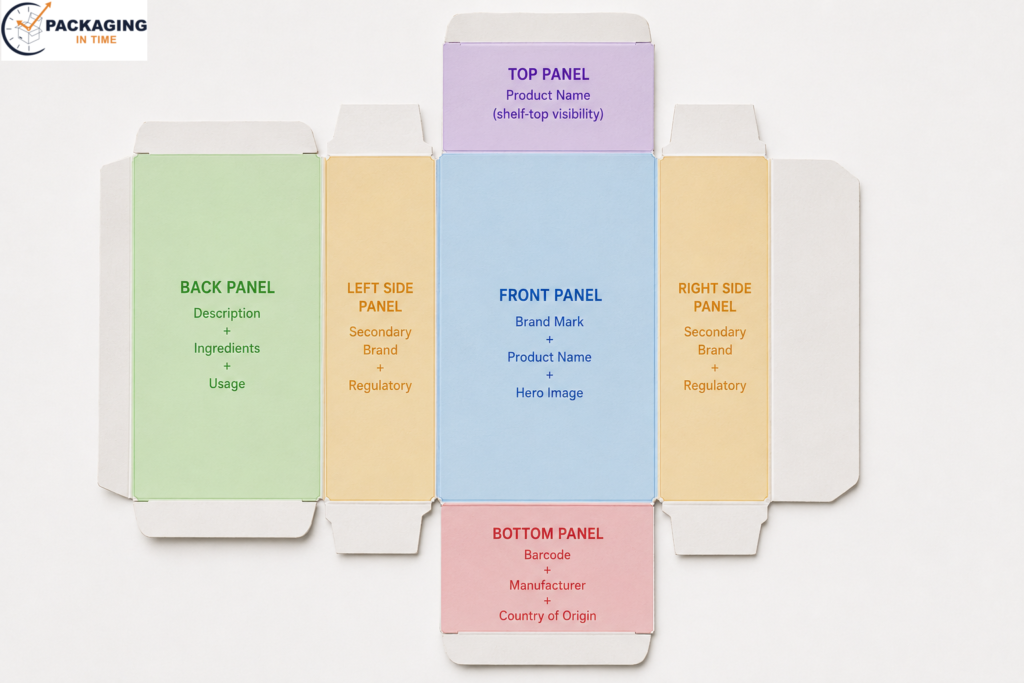
The six panels of a standard tuck-end folding carton custom product box each carry a defined category of information based on retail convention and consumer behavior at point of sale. The front panel carries the primary brand mark, the product name, and a hero image or graphic element, this is the panel that faces the consumer on the shelf and must communicate brand identity and product category within the 2 to 3 seconds of dwell time a consumer spends scanning a shelf section. The back panel carries the product description, ingredient or materials list, usage instructions, and any supporting claims (certifications, claims badges, sustainability marks). The two side panels carry secondary brand elements, additional product information, or regulatory statements that do not fit on the back panel. The top panel repeats the product name in a horizontal orientation for visibility from above, important for floor display units and gondola shelves where the consumer views the top panel before the front panel when approaching from the aisle. The bottom panel carries the barcode, country of origin, manufacturer address, lot number space if required, and any additional regulatory text.
Where Should a Barcode Be Placed on a Custom Product Box?
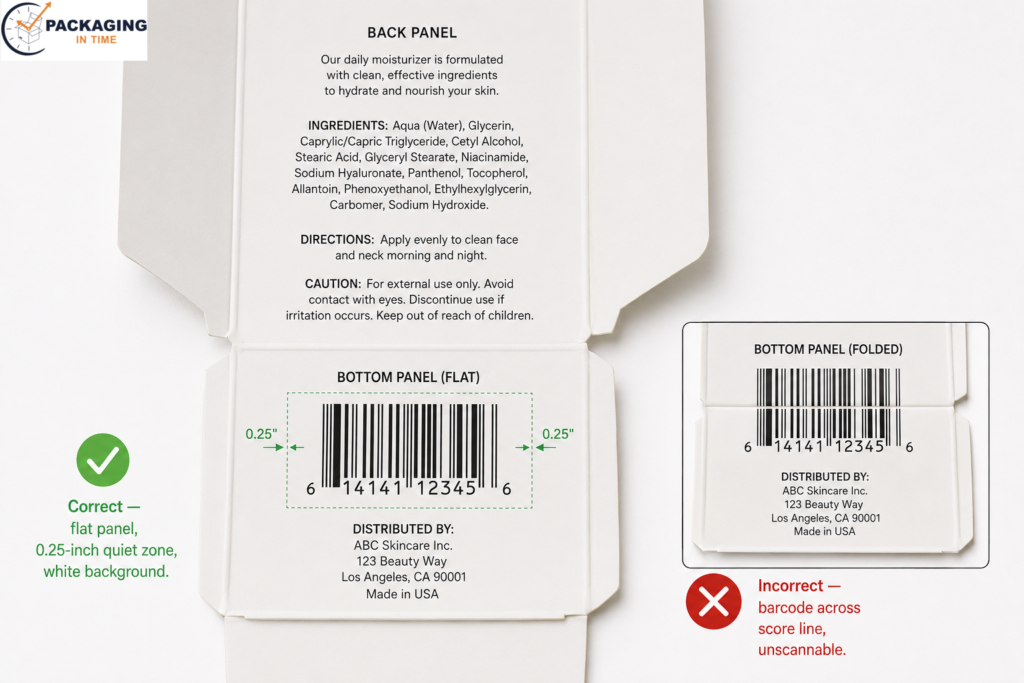
Barcodes on custom product boxes, whether UPC-A, EAN-13, or QR codes, must be placed on a flat panel surface, not across a score line or panel edge. The barcode quiet zone, the clear white space on each side of the barcode symbol, must be a minimum of 0.25 inches (6.35mm) on the left and right sides of the symbol and 0.1 inches (2.54mm) above and below. The barcode background must be white or a light color providing a minimum 80% contrast ratio between the bar color (black) and the background. The bottom panel or back panel are the standard placement locations for barcodes on custom product boxes. Barcodes placed on the front panel disrupt brand artwork and reduce shelf visual impact; barcodes placed across a fold line cannot be reliably scanned by retail point-of-sale scanners because the fold creates a physical break in the symbol. For products sold through Amazon or major retail scan-in receiving processes, barcode scannability is verified during the retailer’s receiving workflow, a non-scannable barcode results in product rejection at the retailer’s distribution center.
What Regulatory Information Must Appear on a Custom Product Box?
The regulatory information required on a custom product box is determined by the product category, the target retail market, and the applicable regulatory body. For food and beverage products sold in the United States, FDA regulations under 21 CFR require: statement of identity (product name), net quantity statement, ingredient list in descending order of predominance by weight, nutrition facts panel for most packaged food products, manufacturer or distributor name and address, and country of origin. For over-the-counter pharmaceutical and supplement products, FDA regulations under 21 CFR Part 201 require: drug facts panel or supplement facts panel, active and inactive ingredient lists, directions for use, warnings, and lot number with expiration date. For cosmetics, FDA regulations require: ingredient list in INCI nomenclature in descending order of predominance, net quantity, manufacturer name and address, and any required warning statements for products containing specific regulated ingredients. Minimum type size for warning statements is 6pt; minimum type size for ingredient lists is 1/16-inch (approximately 4.5pt). Brands must verify current regulatory requirements with their regulatory affairs counsel before artwork is finalized, as requirements change and vary by retail market.
What File Format and Specifications Are Required for Custom Product Box Artwork?
Custom product box artwork submitted to Packaging in Time must meet the following technical specifications. File format: print-ready PDF (PDF/X-1a or PDF/X-4 standard) or Adobe Illustrator (.AI) with all linked files embedded. Color mode: CMYK, RGB artwork will produce color shift when converted to the press’s CMYK profile and will not match the approved digital proof. Image resolution: 300 DPI minimum at 100% of final print size, images placed at a size larger than the source image’s resolution supports will appear pixelated on the printed box. Fonts: all fonts converted to outlines (also called “creating outlines” or “flattening fonts”), fonts not converted to outlines will substitute to the press system’s default font if the artwork file is opened on a system without the specified font installed. Bleed: 3mm of artwork extending beyond all cut lines on the dieline, panels without bleed will show white edges after trimming. Safe zone: all critical elements (text, logos, barcodes, regulatory information) placed within 5mm of the cut line edge on all sides. Spot colors: Pantone spot colors specified by PMS number in the file’s swatch panel, spot colors not correctly designated will be converted to CMYK during RIP processing and will not match the Pantone reference.
How Do You Order Custom Product Boxes?
Custom product box production at Packaging in Time follows a defined workflow from specification submission through proof approval, sample production, and full run delivery.
What Is the Minimum Order Quantity for Custom Product Boxes?
The minimum order quantity for custom product boxes at Packaging in Time depends on the printing method and box style. Digital print custom product boxes are available from 50 units for standard folding carton styles (tuck-end, auto-lock bottom, gable top). Offset print custom product boxes require a minimum of 500 units to amortize plate setup costs across a sufficient quantity of units. Rigid set-up product boxes, lid-and-base, magnetic closure, shoulder-and-neck, have a minimum of 100 units due to the manual wrapping and assembly process involved in rigid box production. Window product boxes and sleeve-and-tray product boxes have a minimum of 250 units on digital print and 500 units on offset print due to the additional components (PET film for windows, tray and sleeve assembly for sleeve boxes) involved in their production.
How Long Do Custom Product Boxes Take to Produce?
Production lead times at Packaging in Time are measured from the date of proof approval, the date the brand confirms the digital proof or physical sample, not from the date the order is placed. Digital print custom product boxes in standard folding carton styles are produced in 5 to 8 business days after proof approval. Offset print custom product boxes require 10 to 15 business days after proof approval to account for plate production, press makeready, printing, finishing, and cutting. Rigid set-up product boxes require 15 to 20 business days after proof approval due to the additional greyboard wrapping and assembly steps. Window product boxes add 2 to 3 business days to standard lead times for PET film application. Rush production is available for select folding carton styles at an additional cost. Brands ordering seasonal custom product boxes for Q4 holiday, Valentine’s Day (February), or Mother’s Day (May) should submit orders 8 to 10 weeks before the required in-hand date to allow for production, quality inspection, and freight transit without rush surcharges.
Can You Get a Physical Sample Before Full Production?
Physical samples are available for all custom product box styles at Packaging in Time before the full production run is committed. A pre-production physical sample is produced using the approved dieline geometry and the submitted artwork file, printed on the specified substrate with the specified finishing treatment, and assembled to the final box structure. The physical sample reflects every material and production decision in the order, substrate, caliper, printing method, finishing treatment, and assembly method, and is the only reliable method of confirming that the color, dimensions, finish appearance, and structural performance of the custom product box match the brand’s requirements before production volume is committed. Packaging in Time recommends physical sample review for all first-time custom product box orders, for all orders with new finishing specifications (particularly foil stamping and soft-touch coating), and for all rigid product box orders where the wrap paper grain direction, color, and texture must be confirmed against the greyboard base.
What Does a Custom Product Box Cost?
Custom product box pricing at Packaging in Time is determined by six variables: box style (folding carton vs. rigid), substrate and caliper (14pt SBS vs. 18pt SBS vs. 2mm greyboard), box dimensions (larger boxes use more board per unit), printing method (digital vs. offset), finishing treatment (aqueous coating vs. matte lamination vs. foil stamping), and order quantity. As a general reference, a standard tuck-end folding carton custom product box in 14pt SBS with matte lamination, produced by digital printing at 100 units, costs approximately $1.80 to $3.50 per unit depending on dimensions. The same specification produced by offset printing at 1,000 units costs approximately $0.60 to $1.20 per unit. Adding foil stamping to an offset run of 1,000 units adds approximately $0.15 to $0.35 per unit depending on the foil coverage area. Rigid magnetic closure product boxes at 250 units cost approximately $4.50 to $9.00 per unit depending on greyboard thickness, wrap paper specification, and dimensions. Packaging in Time provides itemized quotes for all custom product box orders, request a quote with your box style, dimensions, substrate, print specification, finishing requirement, and target quantity to receive accurate per-unit and total pricing.
What Are the Advantages of Custom Product Boxes?
Custom product boxes provide measurable advantages over stock packaging across four dimensions that directly affect brand performance at retail and in direct-to-consumer channels.
Exact Product Fit Eliminates Void Fill and Rattle
A custom product box built to the product’s exact internal dimensions with the correct clearance allowance eliminates void space inside the closed box. Void space causes two problems: it requires void fill material (tissue, foam, or paper fill) to prevent product movement, adding material cost and assembly time; and it allows the product to rattle inside the box during consumer handling, which consumers associate with poor product fit and reduced product quality. A custom product box with a 1/16-inch to 1/8-inch clearance allowance on each axis holds the product firmly without movement and without requiring secondary void fill for most product categories.
Full Panel Printing Communicates Brand at Point of Sale
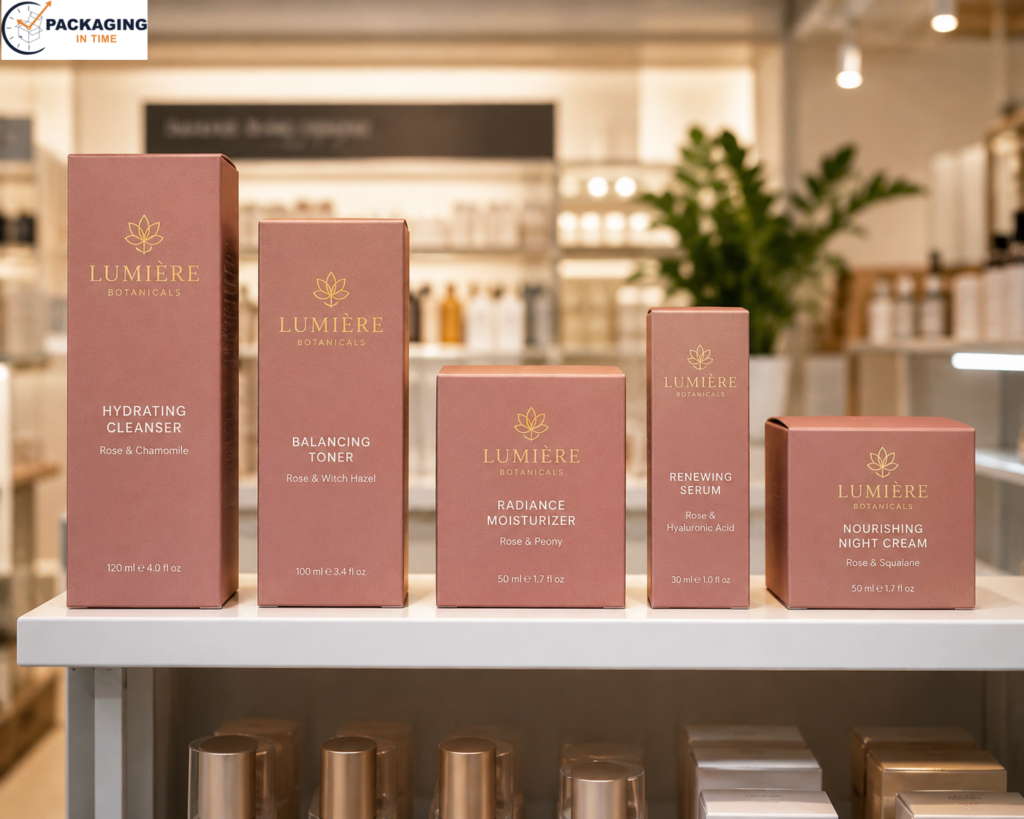
Custom product boxes carry the brand’s full artwork, brand mark, product name, color palette, typography, hero imagery, and product information, across all six panels of the box. In a retail shelf context, the front panel is the primary brand communication surface. In an e-commerce context where the product listing image shows the box front panel, the print quality and design of the custom product box directly affects click-through rate and conversion rate on product listing pages. Stock boxes provide none of these communication surfaces.
Premium Finishing Signals Product Quality Before the Box Is Opened
The finishing treatment applied to a custom product box communicates product quality before the consumer opens the box or reads the product description. A rigid custom product box with soft-touch coating and foil-stamped logo communicates a price point and quality level that a plain folding carton cannot, regardless of the product inside. For product categories where premium positioning is a commercial requirement (luxury cosmetics, spirits, electronics accessories, jewelry), the finishing treatment of the custom product box is a direct component of the brand’s price justification strategy.
Retailer-Ready Formats Reduce Time to Shelf
Custom product boxes produced to a retailer’s specific packaging requirements, shelf dimensions, barcode placement, hanging tab specification, or frustration-free packaging criteria, ship from Packaging in Time ready to place on the shelf or enter the retailer’s fulfillment process without secondary repackaging. Brands that use generic stock boxes and apply labels or stickers at their facility to meet retailer requirements add labor cost and introduce labeling quality variation that can result in product rejection at the retailer’s distribution center.
What Are the Limitations of Custom Product Boxes?
Custom product box production involves constraints and risk factors that brands must account for in their packaging planning process.
Minimum Order Quantities Require Upfront Volume Commitment
Custom product box production requires a minimum order quantity because setup costs, die tooling, plate production for offset printing, and rigid box assembly tooling, are fixed regardless of order size. A brand that orders 50 units of a digital print custom product box pays a higher per-unit cost than a brand ordering 5,000 units on an offset press. For early-stage product launches where retail sell-through is unproven, the MOQ and per-unit cost must be weighed against the risk of carrying unsold custom product box inventory if the product does not reach its sales forecast. Starting with a digital print short run and scaling to offset once the product’s velocity is established is the standard approach for new product packaging at Packaging in Time.
Color Inconsistency Across Reprint Runs
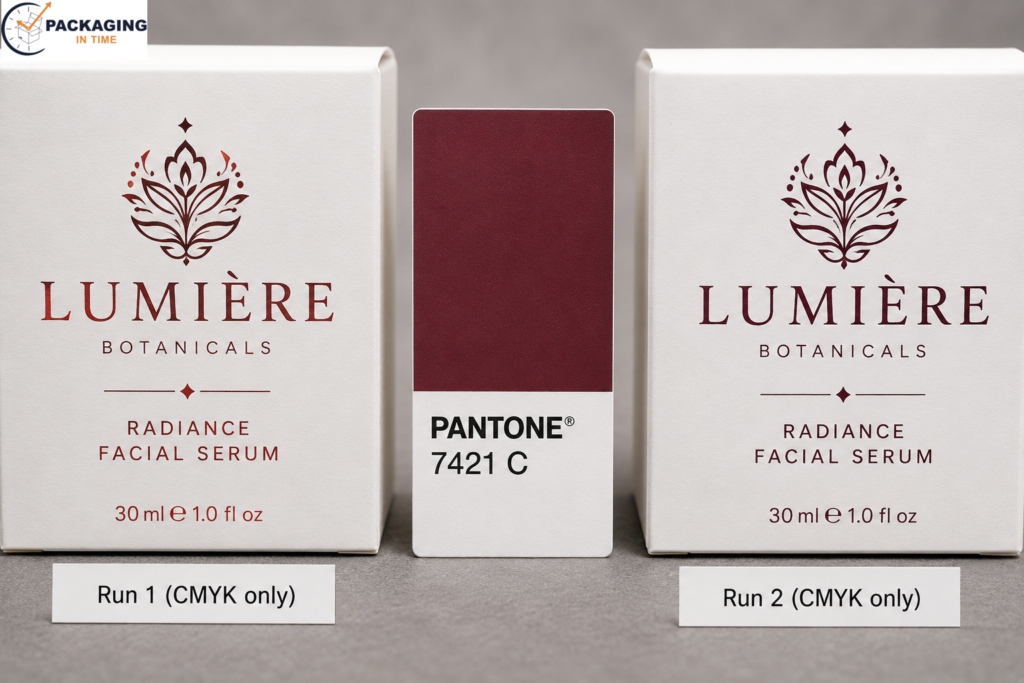
Custom product boxes reprinted in a second or third production run will show measurable color variation from the first run if Pantone spot colors were not specified in the original order. CMYK color values on a printing press vary slightly between runs as ink viscosity, substrate lot variation, and press temperature fluctuate. For brands selling through retail channels where multiple production batches of the same custom product box are on the shelf simultaneously, adjacent units from the first run and the second run visible side by side, CMYK-only color variation is visible to the consumer. Specifying Pantone colors for the brand mark and key brand color areas eliminates this variation across runs. Brands that did not specify Pantone colors in their first run and observed color inconsistency in their second run should update their artwork specification file to include Pantone designations before placing the next order.
Regulatory Compliance Must Be Built Into the Artwork
A custom product box for food, pharmaceutical, supplement, or cosmetic products that does not carry the legally required regulatory information cannot be sold through regulated retail channels regardless of how well-designed or well-printed it is. Regulatory non-compliance on a custom product box is discovered at the retailer’s compliance review, at the distribution center receiving process, or at an FDA spot inspection, all of which result in product hold or recall at substantially greater cost than the cost of correcting the artwork before production. Brands must complete their regulatory review and obtain sign-off from their regulatory affairs counsel before submitting artwork to Packaging in Time for production.
Retailer Packaging Requirements Vary by Channel
Major retail channels impose specific packaging requirements on products entering their supply chain. Amazon’s Frustration-Free Packaging certification requires custom product boxes that open without scissors or box cutters, use no loose void fill that spills when opened, and pass a six-sided drop test. Walmart’s packaging sustainability scorecard assigns ratings based on recycled content, recyclability, and packaging-to-product weight ratio. Target’s packaging guidelines specify minimum recycled content percentages for paper-based packaging and prohibit certain finishing treatments that prevent recyclability. Brands planning to sell through any of these channels must review the current channel-specific packaging specification document before finalizing their custom product box design and specification. Requirements update periodically, the version current at the time of design may not be the version in force at the time of the brand’s retailer review.
How Do Custom Product Boxes Compare to Other Packaging Formats?
Custom Product Boxes vs. Custom Mailer Boxes
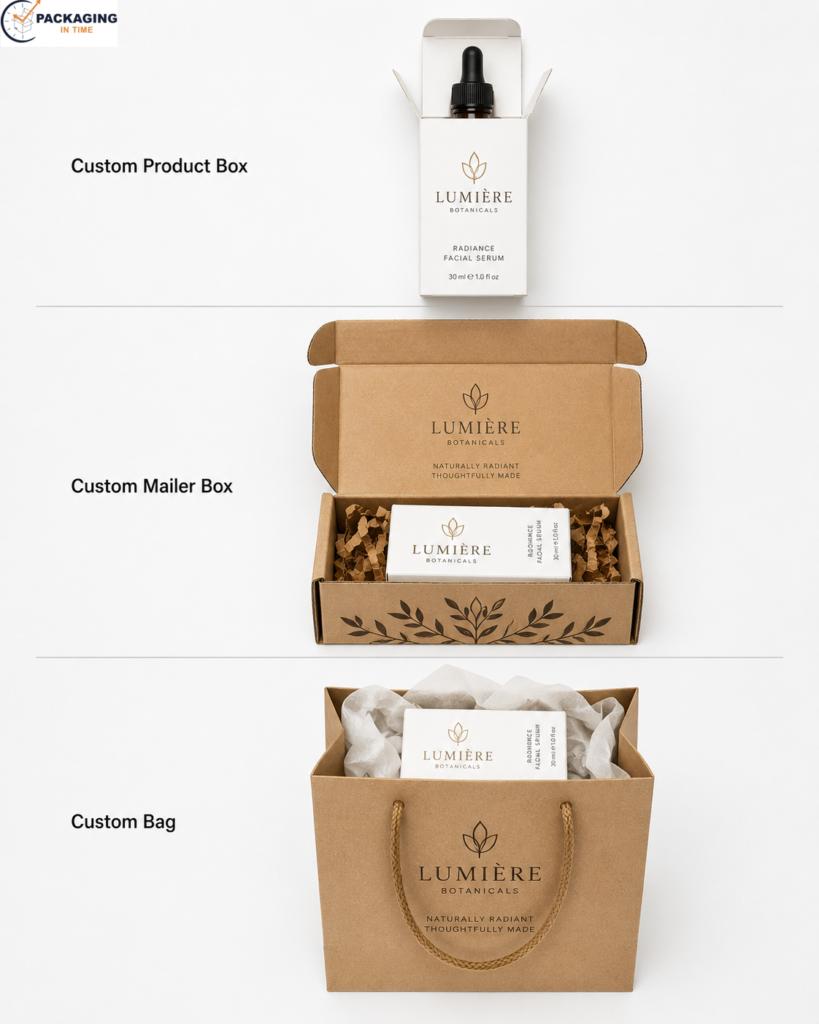
A custom product box is the consumer-facing container, it carries the brand artwork and product information that the end consumer sees at point of sale or at unboxing. A custom mailer box is the transit container that protects the product box and its contents during carrier handling between the fulfillment center and the consumer’s delivery address. In a direct-to-consumer e-commerce operation, both packaging layers serve distinct functions: the custom mailer box handles structural transit protection with its corrugated construction, and the custom product box inside handles brand presentation and product protection at the consumer interaction level. In a brick-and-mortar retail operation, no mailer box is present, the custom product box is the only packaging the consumer sees, handles, and takes home.
Folding Carton Product Boxes vs. Rigid Product Boxes
Folding carton custom product boxes ship flat-packed, are assembled at the brand’s fulfillment facility, and cost $0.50 to $3.50 per unit at commercial quantities. Rigid set-up custom product boxes ship pre-assembled, cannot be collapsed for storage, and cost $3.00 to $12.00 per unit at commercial quantities. The cost differential between the two formats is 3 to 8x, and it is justified by a measurable difference in perceived product quality, structural permanence, and consumer retention of the box after opening. A folding carton custom product box is discarded by most consumers after the product is removed. A rigid custom product box, particularly a magnetic closure or lid-and-base box, is retained and reused by a significant portion of consumers as a storage or organization container, which extends the brand’s physical presence in the consumer’s environment beyond the point of purchase. For product categories priced below $25 at retail, the rigid box cost is difficult to absorb into product margin. For products priced above $60, rigid product boxes are the standard consumer expectation in premium and luxury retail.
Custom Product Boxes vs. Custom Bags
Custom product boxes and custom bags serve different structural functions and different product categories. A custom product box provides a rigid enclosure that protects the product from compression, maintains the product’s three-dimensional shape, and creates a stable, upright display surface on a retail shelf or in a display fixture. A custom bag provides a flexible, lightweight enclosure suited to soft goods, apparel, textiles, footwear accessories, and flat items, that do not require compression protection and do not need to stand upright on a shelf. Custom bags reduce packaging weight and freight cost compared to custom product boxes for equivalent product volume, but they cannot protect fragile components, cannot stand upright on a shelf without support, and cannot carry the same surface area of print as a six-panel custom product box. The format decision is determined by the product’s fragility, its retail display requirement, and its distribution channel.
Frequently Asked Questions About Custom Product Boxes
What Is the Minimum Quantity for Custom Product Boxes?
The minimum order quantity for custom product boxes at Packaging in Time starts at 50 units for digital print folding carton styles. Offset print orders require a minimum of 500 units. Rigid set-up product box styles have a minimum of 100 units. Specific minimums by box style and printing method are confirmed at the time of quote.
Can I Order Custom Product Boxes in Multiple Sizes at Once?
Yes. Brands with multiple SKUs in different product sizes can order custom product boxes in multiple size variations within a single order. Each size variation requires its own dieline, if the sizes are variations of the same box style (tuck-end, auto-lock bottom), the same die setup process applies to each variation. Packaging in Time produces multi-SKU custom product box orders with consistent finishing specifications across all sizes to ensure visual cohesion across a product range.
Do Custom Product Boxes Come with Inserts?
Custom product box inserts, foam inserts, cardboard partitions, thermoformed trays, or molded pulp inserts, are available as add-on components to a custom product box order. An insert is a secondary structural component placed inside the box base that holds the product in a fixed position, prevents movement at the correct clearance, and provides additional compression protection for fragile items. Insert specification, material, thickness, and cavity geometry, is determined by the product’s dimensions, weight, and fragility. Packaging in Time produces both the custom product box and the insert in a single order to ensure dimensional compatibility between the box interior and the insert footprint.
Are Custom Product Boxes Recyclable?
Custom product boxes produced from SBS, CUK, or CCNB board with aqueous coating or no coating are recyclable in standard curbside paper streams. Custom product boxes finished with BOPP matte or gloss lamination, soft-touch coating, or foil stamping are not recyclable in most municipal paper recycling programs because the plastic film or metallic layer cannot be separated from the paper fiber. Brands requiring recyclable custom product boxes should specify aqueous coating, uncoated kraft board, or FSC-certified SBS without plastic lamination.
Can I Get Custom Product Boxes for Amazon FBA?
Custom product boxes for Amazon FBA fulfillment must comply with Amazon’s product packaging requirements, which specify that the product packaging must be the primary protective container, no poly bag overwrap is required for products packaged in a structurally sound box. For products enrolled in Amazon’s Frustration-Free Packaging (FFP) or Ships in Own Container (SIOC) programs, the custom product box must pass Amazon’s ISTA 6 test sequence, which includes a six-sided drop test, a compression test, and a vibration test. Packaging in Time produces custom product boxes to dimensions and structural specifications compatible with Amazon FBA requirements. Brands pursuing FFP or SIOC certification should share Amazon’s current packaging specification document with Packaging in Time at the time of order so that substrate caliper, box style, and closure mechanism can be specified to meet the test requirements.
Choosing the Right Custom Product Box for Your Product
Custom product boxes are specified by the intersection of three decisions: the structural type that fits the product’s shape, weight, and retail context; the size measured as internal dimensions with the correct clearance allowance for smooth product insertion and a rattle-free closed box; and the printing and finishing method that delivers the brand’s visual standard at the right production volume and per-unit cost. Tuck-end folding carton boxes serve lightweight retail products at the most accessible price point. Auto-lock bottom boxes support heavier products without base reinforcement. Rigid lid-and-base and magnetic closure boxes communicate premium positioning for high-margin product categories. Each type is available in fully custom sizes built to the product’s exact footprint, printed using digital or offset methods, and finished with lamination, spot UV, foil stamping, or aqueous coating to match the brand’s specification. Packaging in Time produces custom printed product boxes across all structural types with flexible minimum order quantities, standard and fully custom sizing options, and artwork review and physical sampling before every production run. Request a quote or download the dieline template for your box style to get started.