
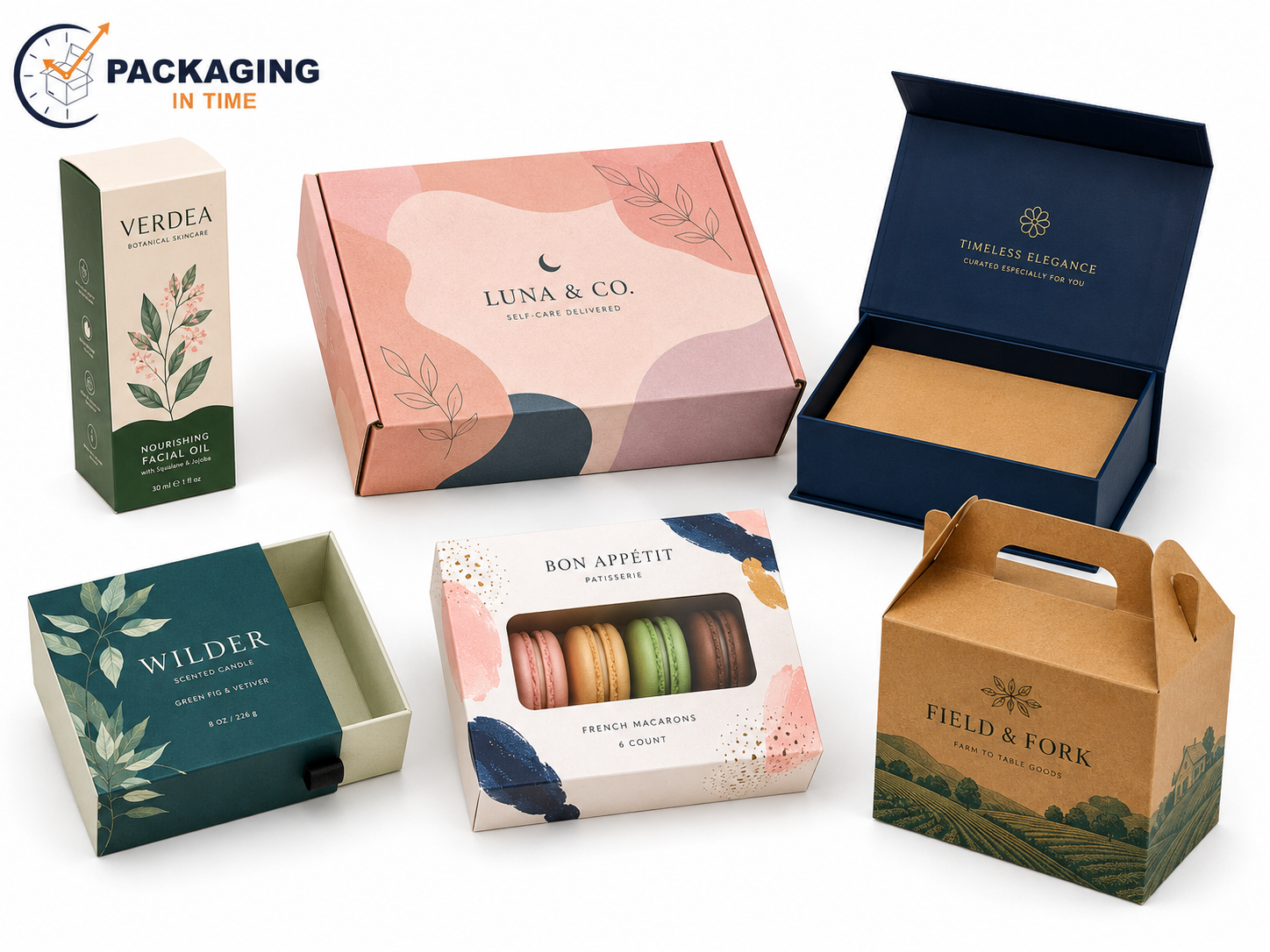
Custom packaging boxes give brand owners direct control over how a product is presented, protected, and shipped. A custom printed box is produced to a specific dieline, printed with brand artwork in CMYK or Pantone colors, and finished with laminates or coatings that reinforce shelf presence and product safety. The types of custom packaging boxes available today span folding cartons for retail display, corrugated mailer boxes for e-commerce shipping, rigid set-up boxes for luxury gifting, and sleeve boxes for high-end consumer goods. The material a box is made from, the printing method used, and the finishing treatment applied determine its cost, structural strength, and visual impact. This guide covers all three dimensions – box types, packaging materials, and printing options – so brand owners and product managers can specify the right custom packaging box for their product, channel, and budget.
What Are Custom Packaging Boxes?
Custom packaging boxes are structural containers manufactured from paperboard, corrugated board, or rigid board, printed with brand-specific artwork, cut to product-specific dimensions, and finished with coatings or laminates to protect, present, and ship a product. Every custom box starts as a flat die-cut sheet – called a dieline – that is scored along fold lines, cut to shape, and glued at seams to form a three-dimensional structure. The box style (tuck end, sleeve, rigid set-up, corrugated mailer) determines how the dieline is engineered. The substrate determines how much structural strength and print quality the finished box delivers. The printing method and finishing treatment determine how the brand appears on the surface.
How Are Custom Packaging Boxes Made?
Custom packaging boxes are structural containers manufactured from paperboard, corrugated board, or rigid board, printed with brand-specific artwork, cut to product-specific dimensions, and finished with coatings or laminates to protect, present, and ship a product. Every custom box starts as a flat die-cut sheet – called a dieline – that is scored along fold lines, cut to shape, and glued at seams to form a three-dimensional structure. The box style (tuck end, sleeve, rigid set-up, corrugated mailer) determines how the dieline is engineered. The substrate determines how much structural strength and print quality the finished box delivers. The printing method and finishing treatment determine how the brand appears on the surface.
What Is the Difference Between Custom and Stock Packaging Boxes?
Stock boxes are manufactured to standard dimensions – typically in increments of whole inches – with no print and no brand artwork. Custom packaging boxes are produced to exact internal dimensions specified by the brand, printed with full-color artwork across one or more panels, and finished to the brand’s visual standard. The practical consequence of this difference is significant. A stock box for a 4-inch product uses a 4-inch or 5-inch standard size, leaving void space that must be filled with tissue or foam. A custom box is built to fit the product, reducing void fill cost, lowering dimensional weight charges from carriers, and ensuring the product arrives without movement inside the carton. At the retail shelf or in an unboxing context, a custom printed box carries the brand mark, product name, regulatory information, and visual identity that a plain stock box cannot.
What Does a Custom Box Dieline Include?
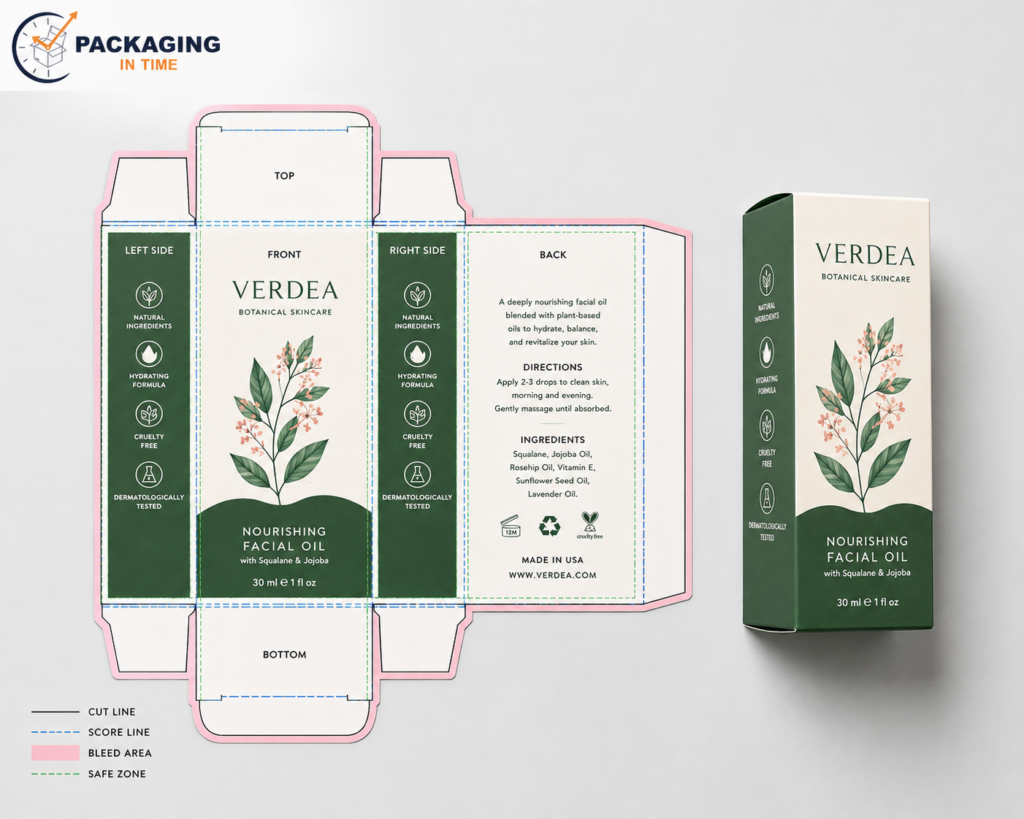
A dieline is the two-dimensional blueprint of a custom packaging box. It shows the cut lines (where the die cuts through the substrate), the score lines (where the substrate is creased to create fold points), the bleed area (3mm of artwork that extends beyond the cut line to prevent white edges after trimming), the safe zone (5mm inside the cut line where no critical text or logo should be placed), and the panel layout (front, back, top, bottom, and side panels labeled for artwork placement). Packaging in Time provides dieline templates for every box style in industry-standard formats including Adobe Illustrator (.AI) and PDF. Artwork files submitted for custom box production must be in CMYK color mode, at 300 DPI resolution minimum, with all fonts converted to outlines.
What Are the Types of Custom Packaging Boxes?
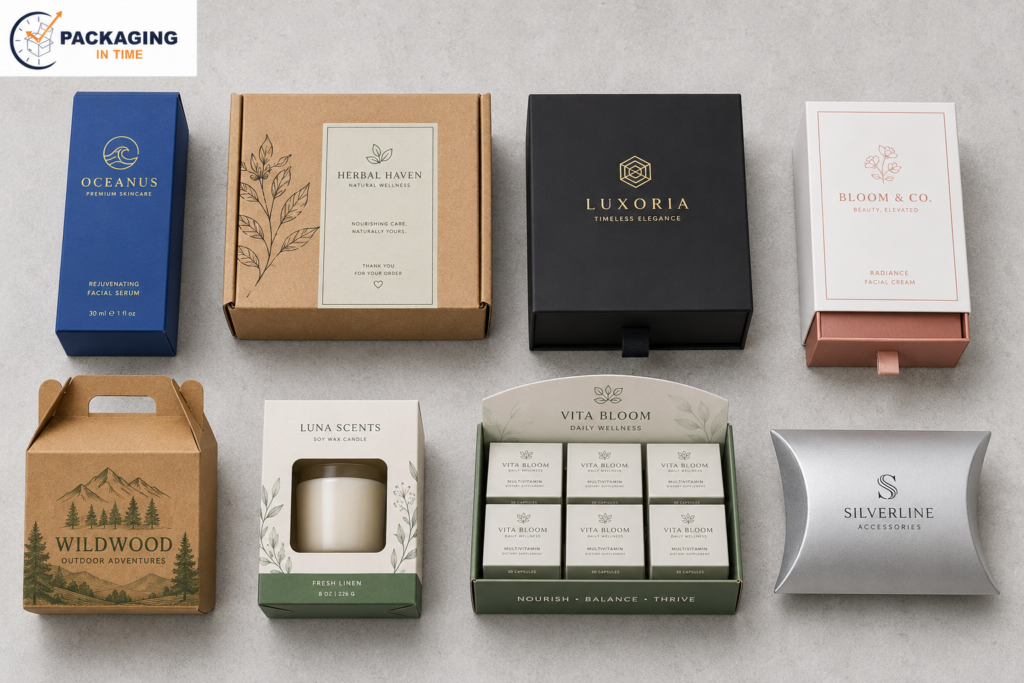
Custom packaging boxes are produced in eight primary structural styles. Each style is defined by its dieline geometry, closure mechanism, and the product categories and distribution channels it serves best.
Folding Carton Boxes
Folding carton boxes are produced from a single flat sheet of paperboard – typically SBS, CUK, or CCNB – that is scored, folded, and glued into a closed retail-ready container. They ship flat and are assembled at point of use. The most common closure styles are the straight tuck end (top and bottom panels tuck in the same direction), the reverse tuck end (top and bottom tuck in opposite directions for easier automated assembly), and the auto-lock bottom (a pre-glued base that locks into position when the box is opened, providing a sturdier base without taping). Folding cartons suit lightweight retail products including cosmetics, pharmaceuticals, food supplements, candles, and small consumer electronics. They are the most widely printed custom box format globally because their flat-sheet construction is compatible with high-speed sheet-fed offset presses.
Corrugated Shipping Boxes
Corrugated shipping boxes are manufactured from a three-layer sandwich structure: two flat liner sheets bonded to a fluted medium in between. The fluted medium creates an arch structure that resists compression and absorbs impact during transit. Flute types determine the box’s wall thickness and crush resistance: E-flute (1.5mm wall) provides 26-32 ECT and suits retail-ready corrugated packaging and e-commerce mailers for products under 10 lbs; B-flute (3mm wall) provides 32-44 ECT and suits general shipping cartons; C-flute (4mm wall) is the standard for heavier shipping applications; BC double-wall (6mm wall) combines B and C flutes for products that require maximum compression protection. Custom corrugated boxes are printed using flexographic or digital printing and are specified for e-commerce shipping, subscription box programs, and wholesale fulfillment operations.
Rigid Set-Up Boxes
Rigid set-up boxes are constructed from thick greyboard (chipboard) wrapped in printed paper, fabric, or specialty material. Unlike folding cartons, rigid boxes are pre-assembled at the factory and cannot be collapsed for flat shipping – they ship in their final three-dimensional form. This manufacturing method produces a box with substantially higher perceived weight and structural permanence than a folding carton. The two most common rigid box configurations are the telescoping lid-and-base (a separate lid drops over the base) and the clamshell (lid and base are hinged at the back). Rigid set-up boxes are used for luxury perfumes, premium cosmetics, jewelry, high-end electronics, spirits, and gift packaging where the box itself is part of the product’s value presentation. Magnetic closure rigid boxes add embedded magnets to the lid panel, producing an audible snap-close that reinforces premium product positioning.
Mailer Boxes
Mailer boxes are single-piece corrugated structures engineered for direct-to-consumer e-commerce shipping. They open from the top using a roll-end or side-tuck closure and require no additional tape for sealing because the self-locking tabs hold the box closed under normal shipping conditions. The interior base and lid panels face inward, making them printable on both exterior and interior surfaces – a feature that brands use to create an unboxing experience visible the moment the customer opens the lid. Mailer boxes are produced from E-flute or B-flute corrugated board and are the standard packaging format for subscription box programs, direct-to-consumer apparel brands, and specialty food companies shipping perishable or fragile products.
Sleeve Boxes
Sleeve boxes consist of two components: a tray (a shallow open-top container that holds the product) and a sleeve (a tube of paperboard that slides over the tray). The sleeve provides the full printable surface for brand artwork, while the tray provides structural support for the product. This two-piece configuration is common in cosmetics, consumer electronics, premium confectionery, and high-end personal care products because it creates a smooth, uninterrupted print canvas on the exterior while the tray interior can be finished differently. The sliding action of the sleeve over the tray is also a tactile brand interaction that supports premium positioning.
Gable Top Boxes
Gable top boxes are folding carton structures with an integrated carry handle formed by the folding of the top panels into a peaked roof shape. The handle is created without any additional hardware – the top panels fold into interlocking tabs that form a rigid arch. Gable tops are primarily used in food service (bakery items, takeout, juice cartons), gift retail (candles, bath products, small gifts), and promotional packaging. They are produced from SBS or kraft board with food-safe coatings when direct food contact is required.
Window Boxes
Window boxes are folding carton or corrugated boxes with a die-cut aperture in one or more panels, covered by a clear PET film bonded to the interior surface. The window allows the customer to see the product without opening the box, which reduces return rates for products where color, texture, or form is a purchase driver. Window boxes are standard in toy packaging, bakery retail, cosmetics, and specialty food. The PET film used for the window is heat-sealed or glued to the interior panel; the film thickness and clarity grade are specified based on the product’s humidity and temperature requirements.
Display Boxes and Counter Display Units
Display boxes – also called PDQ trays (Pretty Darn Quick trays) or counter display units (CDUs) – are corrugated or SBS structures designed to hold multiple product units upright on a retail shelf or countertop without additional shelf fixtures. A PDQ tray ships pre-loaded with product and is placed directly on the shelf, allowing retailers to introduce new products without planogram changes. A counter display unit holds 12 to 48 individual units and is positioned near a point-of-sale terminal to drive impulse purchases. Both formats are printed with brand artwork on the front panel and are engineered to tear open at a perforated line that transforms the shipping outer into the display unit itself.
What Materials Are Used for Custom Packaging Boxes?
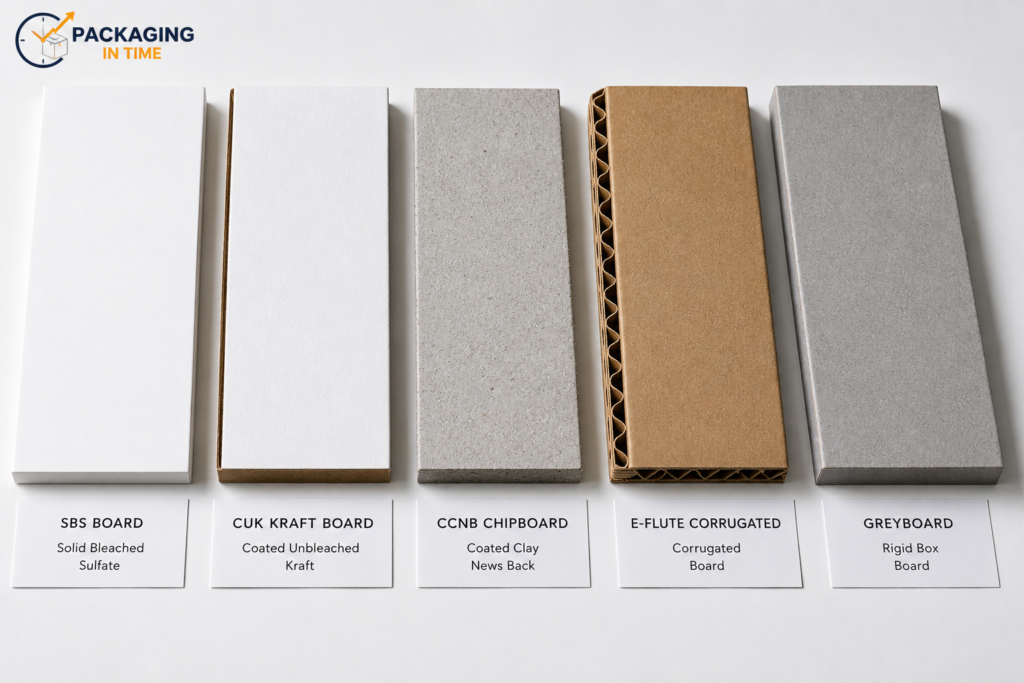
The substrate is the foundational material of a custom packaging box. It determines the box’s structural strength, its printable surface quality, its weight (which affects shipping cost), and its compatibility with specific finishing treatments.
Solid Bleached Sulfate (SBS) Board
Solid Bleached Sulfate board is produced from 100% virgin bleached wood fiber, giving it a bright white surface on both sides with a smooth clay-coated face suitable for high-resolution offset printing. SBS is available in calipers from 0.016 to 0.030 inches (16pt to 30pt) and basis weights from 60 to 120 lb. The bright white surface allows CMYK inks to reproduce at full gamut without graying or color shift, making SBS the preferred substrate for cosmetics, pharmaceuticals, food packaging, and any product where accurate color reproduction is a brand requirement. SBS is compatible with all printing methods and all finishing treatments including foil stamping, embossing, and UV coating.
Coated Unbleached Kraft (CUK) Board
Coated Unbleached Kraft board is produced from unbleached kraft fiber, giving it a natural brown interior layer with a clay-coated white face on the exterior. The unbleached interior is visible on the interior panels of the box and on cut edges, producing the visual signature of “kraft packaging” that signals natural, sustainable, or artisanal brand positioning. CUK provides comparable stiffness to SBS at equivalent caliper but at lower basis weight, making it a cost-efficient option for brands that want the kraft aesthetic with acceptable print quality on the exterior. The brown interior panels reduce print contrast on inside surfaces, which limits interior decoration on CUK boxes compared to SBS.
Recycled Chipboard (CCNB)
Clay-Coated News Back board is produced from 100% recycled fiber, with a clay-coated white face and a grey newsprint-colored back. CCNB is the most cost-effective folding carton substrate and is used for high-volume consumer goods packaging where the interior panel appearance is not a brand consideration – breakfast cereal boxes, laundry detergent cartons, and general grocery packaging are produced on CCNB. The recycled content of CCNB contributes to sustainability certification claims. However, the recycled fiber structure of CCNB produces a lower-stiffness board at equivalent caliper compared to SBS, requiring heavier basis weights to achieve comparable structural performance.
Corrugated Board: E-Flute, B-Flute, and BC Double Wall
Corrugated board is a composite structure consisting of two flat liner sheets (typically 35 lb or 42 lb kraft liner) bonded to a fluted medium. The flute arch resists compression perpendicular to the board surface. E-flute corrugated (1.5mm wall thickness) is used for retail-ready corrugated packaging and premium mailer boxes – it is thin enough to print on directly with offset or digital printing and provides adequate crush resistance for products under 10 lbs. B-flute (3mm wall) is the standard for general shipping cartons and provides 32-44 ECT. BC double-wall corrugated (6mm wall) combines B and C flutes in a two-medium sandwich for maximum compression resistance, used for heavy industrial shipments and products requiring extended transit protection.
Greyboard for Rigid Boxes
Greyboard is a dense, heavy chipboard produced from compressed recycled fiber in thicknesses from 1.5mm to 4mm. It does not have a printable surface of its own – instead, greyboard is wrapped with printed paper, fabric, or specialty material that carries the brand artwork. The greyboard provides the rigid structure of luxury set-up boxes; the wrap provides the visual surface. Greyboard thickness is specified based on the product weight the box must support and the perceived quality level the brand requires: 1.5mm greyboard is standard for mid-range gift boxes, while 3mm to 4mm greyboard is used for premium luxury packaging where the box must communicate permanence and value in itself.
How to Choose the Right Packaging Material for Your Product
The material selection for a custom packaging box is determined by four factors: the product’s weight and fragility, the distribution channel, the required print quality, and the brand’s sustainability position. Lightweight retail products sold through brick-and-mortar channels typically use SBS or CUK folding cartons. Products shipped direct-to-consumer use E-flute or B-flute corrugated. Premium products sold in specialty retail or gifted directly to consumers use rigid greyboard construction. Brands with sustainability commitments specify CCNB (recycled content), CUK (natural fiber), or FSC-certified SBS. Brands requiring bright color reproduction specify SBS. Brands prioritizing cost efficiency at high volume specify CCNB.
What Are the Printing Methods for Custom Packaging Boxes?
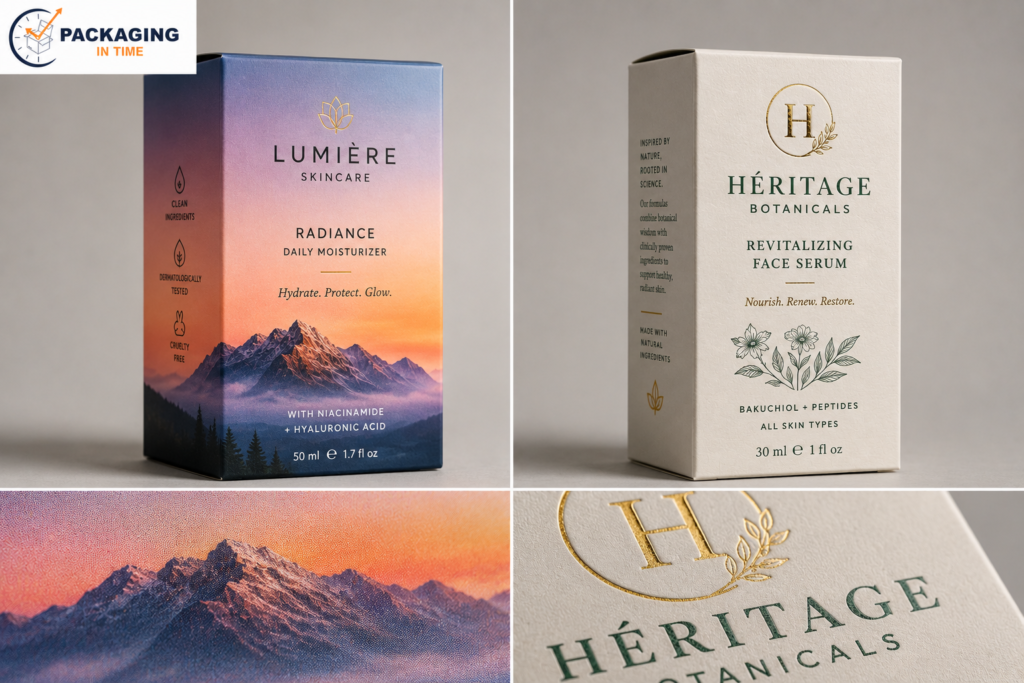
The printing method applied to a custom packaging box determines the color accuracy, image resolution, minimum viable order quantity, and per-unit cost of the finished box.
Digital Printing for Short-Run Custom Boxes
Digital printing applies toner (electrophotographic) or inkjet ink directly onto the substrate surface without the use of printing plates. Because no plates are required, there is no plate setup cost, which makes digital printing economically viable for short-run custom box production of 50 to 500 units. Digital printing supports variable data within a single run – each box can carry a different name, SKU, or QR code without stopping the press. Color is reproduced in the CMYK process color model; Pantone spot colors are not natively supported by digital presses but can be simulated within the press’s gamut profile. Digital print quality has improved significantly with modern toner and inkjet equipment, but at equivalent magnification, digital print produces a slightly softer halftone dot than offset lithography. Digital printing is the standard method for product launches, seasonal packaging, sample runs, and brands with SKU fragmentation that prevents high-volume offset investment.
Offset Lithography for High-Volume Custom Boxes
Offset lithography transfers ink from a plate to a rubber blanket and then onto the substrate surface. Each color in the print requires a separate plate – a standard 4-color CMYK print job requires four plates (cyan, magenta, yellow, and black). Plate production adds a one-time setup cost of $80 to $300 per color depending on the press size. Above 500 to 1,000 units, the plate cost is amortized across sufficient units that offset’s per-unit ink cost – lower than digital because lithographic inks are cheaper than toner – makes it more economical than digital printing. Offset lithography produces sharper halftone dots, more accurate Pantone spot color reproduction, and a wider achievable color gamut than digital printing. Sheet-fed offset is used for SBS and CUK folding cartons; web offset is used for very high-volume packaging runs.
Flexographic Printing for Corrugated Custom Boxes
Flexographic printing uses flexible rubber or photopolymer relief plates that transfer water-based or UV-curable inks directly onto the corrugated substrate at high speed. Because the corrugated surface is irregular – the fluted medium creates micro-variations in the liner surface – flexographic printing is better suited to this substrate than lithographic offset, which requires a flat, smooth surface for accurate ink transfer. Flexographic printing for corrugated custom boxes supports CMYK process color and Pantone spot colors. Line weights below 0.5pt and halftone screens above 85 lpi are not reliably reproducible on corrugated flexo presses due to surface irregularity. For premium corrugated packaging requiring photo-realistic print quality, litho-lamination is used: a separately offset-printed paper sheet is bonded to the corrugated liner after printing, producing a smooth, high-resolution surface on a corrugated structural base.
CMYK vs. Pantone Color Matching for Custom Packaging
CMYK (Cyan, Magenta, Yellow, Black) is a four-color subtractive process in which different percentages of each of the four inks are combined in a dot pattern to reproduce a range of colors. CMYK is the standard for full-color photographic artwork and complex gradients. Pantone (PMS) colors are proprietary standardized inks mixed to precise formulas and printed as a single color layer. A Pantone color is reproduced identically across any press, any substrate, and any geography where the matching system is in use. For custom packaging boxes, Pantone spot colors are specified when brand color accuracy is non-negotiable – a specific red that must match across boxes, bags, labels, and retail fixtures, for example. Most custom box production runs use CMYK for full-color artwork with one or two additional Pantone spot colors for brand marks or metallic elements.
What Are the Finishing Options for Custom Packaging Boxes?
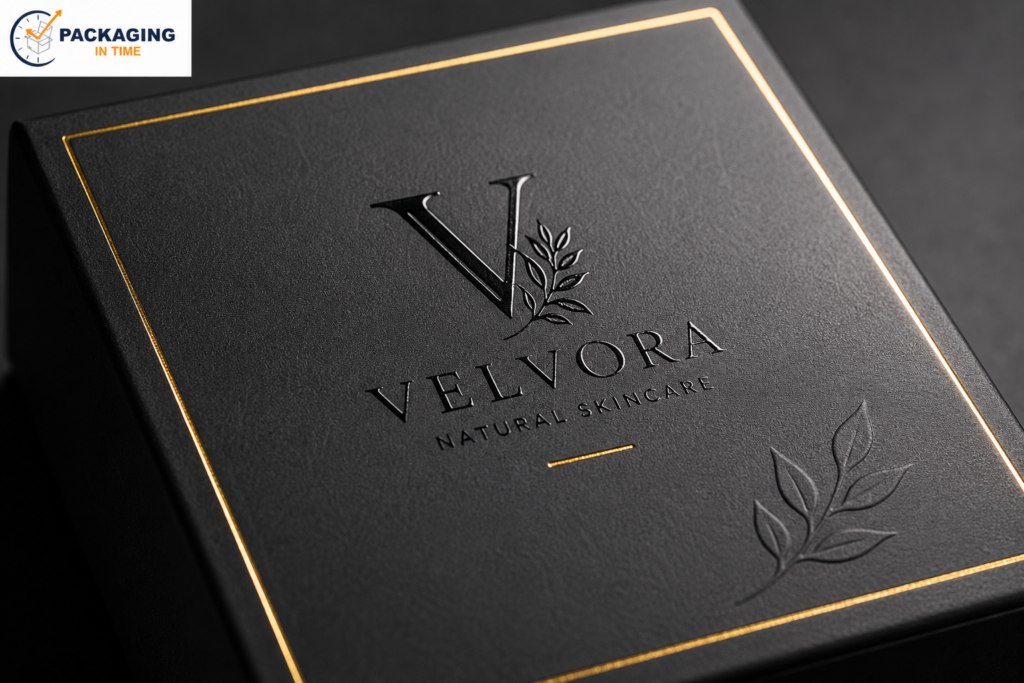
Finishing treatments are applied after printing to alter the surface appearance, tactile quality, durability, and light-reflection characteristics of the custom packaging box.
Matte and Gloss Lamination
Lamination bonds a thin BOPP (Biaxially Oriented Polypropylene) film to the printed surface using heat and pressure. Gloss lamination (12-18 micron film) produces a high-reflectance surface that intensifies color saturation and makes images appear more vivid. Matte lamination (18-25 micron film) diffuses light reflection, producing a flat, non-shiny surface that reduces fingerprint visibility and creates a softer, more premium aesthetic. Matte lamination is the standard finishing treatment for premium cosmetics, luxury food, and high-end consumer goods packaging. Both gloss and matte lamination increase the box’s resistance to moisture, scuffing, and tearing. However, laminated boxes are not recyclable in standard curbside paper streams because the plastic film cannot be separated from the paper fiber at most recycling facilities.
Spot UV Coating
Spot UV coating applies a high-viscosity ultraviolet-cured varnish selectively to defined areas of the printed surface – typically a logo, brand mark, or graphic element – rather than to the entire box panel. The UV varnish is cured instantly by passing under a UV lamp, producing a raised, highly glossy layer on the selected area while the surrounding surface retains its base finish (matte lamination, gloss lamination, or uncoated). The contrast between the spot UV area and the surrounding matte surface creates a tactile and visual effect that draws the eye and hand to the brand mark. Spot UV over matte lamination is one of the most specified finishing combinations in premium consumer packaging because the gloss-on-matte contrast is visible from across a retail aisle under standard fluorescent lighting.
Foil Stamping
Foil stamping transfers a thin metallic or holographic foil layer from a carrier film to the box surface using a heated die pressed under pressure. The die is machined to the exact shape of the logo, text, or graphic element to be foiled. When the die contacts the foil and substrate simultaneously, the adhesive on the foil activates under heat and pressure and bonds the metallic layer permanently to the surface. Foil colors available include gold, silver, rose gold, copper, holographic rainbow, and solid matte metallics. Foil stamping is used on rigid set-up boxes, folding cartons for cosmetics and spirits, and premium gift packaging. Foil-stamped surfaces cannot be overprinted with ink and are not recyclable in standard paper streams without deinking, which is not available in most municipal recycling programs.
Embossing and Debossing
Embossing raises a defined area of the box surface above the surrounding panel level by pressing the substrate between a male and female die under pressure. Debossing presses the defined area below the surrounding surface using the same die mechanism in reverse. Both treatments create a three-dimensional relief on the box panel that is visible and tactile. Embossing and debossing are used on rigid set-up box lids, folding carton front panels, and premium sleeve boxes to highlight a brand mark or logo. They can be applied over printed and laminated surfaces or on uncoated kraft surfaces for a clean, minimal brand presentation. Blind embossing (no ink, no foil on the embossed area) produces a subtle, understated brand signal used in luxury packaging for products positioned on heritage or craftsmanship.
Soft-Touch Coating
Soft-touch coating is a water-based or UV-curable surface treatment that, when applied and cured, produces a surface with a velvet-like tactile quality – similar to the feel of suede or fine matte paper. The coating is applied across the full panel surface using a flood coat method. Soft-touch coating dramatically increases perceived product quality in consumer testing because tactile sensation influences quality judgment at point of purchase. It is used on rigid set-up boxes, premium folding carton sleeves, and high-end mailer boxes. Soft-touch coating is not compatible with water-activated gummed tape (the gum does not adhere reliably to the treated surface) and reduces surface friction to a degree that can cause stacked boxes to slide. It is also not compatible with inkjet or laser printing, which means soft-touch boxes cannot have variable data applied after finishing.
Aqueous Coating
Aqueous coating is a water-based clear coating applied inline during the offset printing process as a flood coat over the entire printed sheet. It dries quickly, protects the ink from scuffing during handling and finishing, and slightly increases surface gloss without the reflectance of gloss lamination. Aqueous coating does not add a plastic film to the substrate, so boxes finished with aqueous coating remain recyclable in standard paper streams. For brands with sustainability commitments that need surface protection, aqueous coating is the primary alternative to plastic lamination. It does not provide the moisture resistance or tactile contrast of BOPP lamination, but for products distributed in controlled indoor retail environments, it provides adequate surface protection at a lower cost and without recyclability conflict.